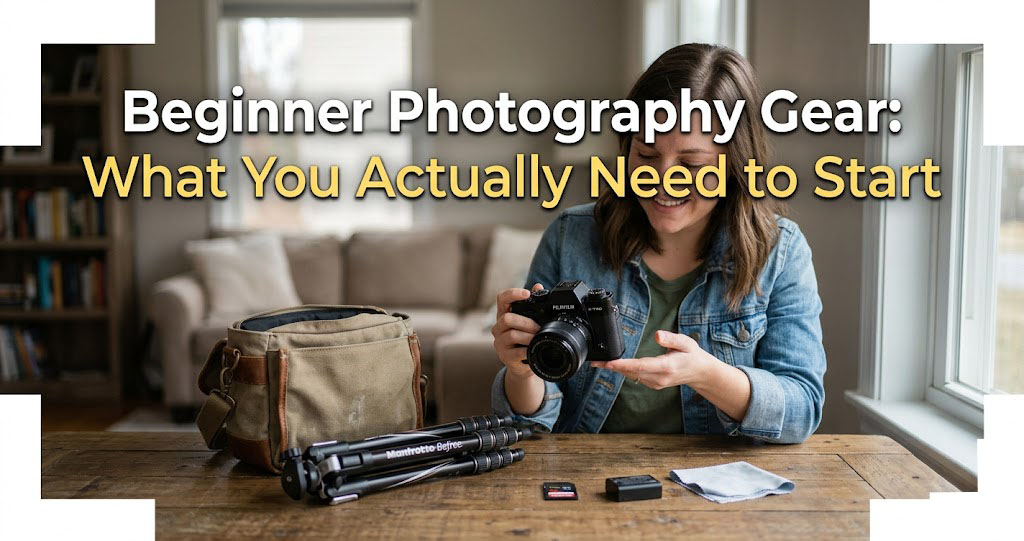
You finally did it—you picked up your first camera. Whether it was a planned upgrade or your entry point into photography, that moment of unboxing is exciting… and a little intimidating. Suddenly, you're faced with settings, lenses, and accessories, all promising to make your photos better .
The photography industry wants you to believe you need a dozen lenses, three flashes, and a backpack full of gadgets. But the truth is far simpler. After testing hundreds of equipment combinations and helping thousands of students build their first kits, I've learned that great photography comes from understanding your tools, not owning the most expensive gear .
This guide cuts through the noise. Here's exactly what you actually need to start your photography journey—and what you can safely ignore.
Quick Picks: Essential Beginner Gear 2026
Step 1: Ask Yourself the Right Questions
Before You Buy Anything
Before rushing to buy gear, ask yourself three questions :
- What type of photography excites you? Portraits, landscapes, street, wildlife, events?
- Are you starting as a hobbyist, a content creator, or testing the waters for a side hustle?
- What's your real budget? Include not just the camera, but lenses, memory cards, and accessories.
Your answers shape everything. If you love street photography, you'll want something compact. For wildlife, you'll benefit from a telephoto lens. Content creators need strong video features. Understanding your use case ensures your gear evolves with your skills—not against them .
Step 2: The Camera Body—Your Foundation
Mirrorless Cameras (Recommended for Most Beginners)
- Smaller, lighter bodies
- Electronic viewfinder shows exposure preview in real-time
- Advanced autofocus with eye/subject tracking
- Superior video capabilities (4K, 10-bit)
- Future-proof technology—all new lenses are mirrorless
- Downside: Shorter battery life (300–400 shots)
DSLR Cameras (Budget-Friendly Choice)
- Excellent value on used market
- Long battery life (600–1000+ shots)
- Optical viewfinder (no lag, natural view)
- Huge selection of affordable used lenses
- Durable, proven technology
- Downside: Larger, heavier, limited video autofocus
Top Beginner Cameras for 2026
Best Overall: Canon EOS R50
The Canon EOS R50 is currently the best bet for beginners. It benefits from Canon's advanced Dual Pixel CMOS AF II system that can accurately and quickly acquire a subject anywhere in the frame. Automatic metering and white balance are always well-judged, and continuous shooting up to 12fps is genuinely impressive .
Best Budget: Nikon Z50 II
The Nikon Z50 II makes smart tweaks to the original that improve ergonomics, autofocus, and tracking speed. It features 3D Tracking with up to 30fps focus drive and a light, compact build with weather protection. Perfect for beginners with enthusiast aspirations .
Best Budget Entry: Sony A6100 / A6400
The Sony a6400 balances price, features, and long-term use—perfect for both hobbyists and aspiring professionals. Its exceptional autofocus, taken from Sony's flagship models, is lightning-quick and rarely misses a shot. Great for travel, family, street, and sports photography .
Step 3: Lenses—The Real Key to Image Quality
Your lens has more impact on image quality than your camera body. Lenses control perspective, depth of field, and light gathering capability—the creative elements that define your photographic style. A good lens from 2026 will still be excellent ten years from now, while today's camera will be outdated in 3-5 years .
The Two Lenses Every Beginner Needs
1. Standard Zoom Lens (18-55mm or 24-70mm)
This is your everyday workhorse, often bundled as the "kit lens." It covers a wide range of focal lengths, making it ideal for landscapes, street photography, family moments, and casual portraits. Perfect for learning composition because you can zoom in and out without constantly moving your feet .
2. 50mm f/1.8 Prime Lens ("Nifty Fifty")
The 50mm f/1.8 is one of the most popular first upgrades. It produces sharper images, smoother background blur (bokeh), and better low-light performance than any kit lens. It's especially well-suited for portraits, detail shots, and everyday photography when you want a more professional look .
Together, these two lenses form the visual backbone of your photography starter kit. The 50mm f/1.8 costs under $200 and teaches you about aperture and composition better than any classroom .
Step 4: Essential Accessories That Actually Matter
Memory Cards
Many beginners don't think much about the memory card that manages their important files—this is a big mistake !
- Look for: Class 10 or UHS-I cards from reliable brands like SanDisk or Lexar
- Why it matters: Fast cards enable burst shooting and video recording without delay, and safely offload files when you're done
- Don't cheap out: Sandisk Extreme cards are temperature-proof, waterproof, shock-proof, and x-ray-proof—exactly what you need for irreplaceable photos
- Carry backups: Have at least two cards, especially when traveling or photographing important moments
Extra Batteries
Nothing kills the vibe like running out of battery mid-shoot. Keep at least one backup at all times . Mirrorless cameras have shorter battery life (300-400 shots), so spares are essential .
Tripod
A tripod is essential for keeping your camera steady during long exposures, low-light shooting, landscapes, night photography, and video. It also helps you be more intentional with composition .
What to look for:
- Balance of stability and portability so it's easy to bring along
- 4KG payload capacity—a match for most mirrorless and DSLR kits
- Quick and easy to use ball and socket head
Top picks: Manfrotto MK Element Small Travel Tripod (folds to 32cm), Vanguard Veo 3 GO 235AB (with smartphone adapter and Bluetooth remote) .
Camera Bag
A quality camera bag protects your equipment from bumps, weather, and everyday wear while keeping everything organized and easy to access .
Top picks:
- Vanguard BIB T22 Shoulder Bag: Suitable for DSLR/Mirrorless with configurable dividers and space for personal items
- Crumpler Triple A Sling Bag: 12L capacity, quick access, stylish colors
- LowePro Adventura BP150 III: Space for camera, 2-3 lenses, laptop, tablet, and accessories
Lens Cleaning Kit
Dust and smudges affect image clarity. A microfiber cloth, air blower, and cleaning spray go a long way in maintaining lens health .
Step 5: Optional Gear (Buy When You Need It)
External Flash
An external flash gives you far more control over lighting than a built-in camera flash. Perfect for indoor photography, events, and portraits where natural light is limited. External flashes can be bounced or diffused to create softer, more natural-looking light .
Beginner-friendly: Godox speedlights offer TTL metering and wireless control at affordable prices .
Filters
- UV filter: Helps protect the front element of your lens
- Polarizing filter: Reduces reflections and enhances skies
- Neutral density (ND) filter: Allows slower shutter speeds in bright conditions, great for long-exposure daytime photography
Brands: Tiffen, Hoya, B+W
Reflector
A simple reflector ($20-30) is your most valuable lighting tool. Use the white side for fill light to reduce shadows, silver for brighter fill, gold for warm tones in portraits, and black to subtract light and increase contrast .
Smart Shopping Strategies for Beginners
Buy Pre-Owned Wisely
High-quality photography gear doesn't have to come brand new. Consider buying secondhand—a camera with under 50,000 actuations has plenty of life left .
KEH's pre-owned equipment is expertly inspected and graded, making it easier to expand your kit with confidence while stretching your budget further .
Start Small, Upgrade Slowly
Begin with a basic lens kit and a few essential accessories, then add specialized gear as you discover what and how you love to shoot. This approach helps you avoid overspending and ensures every upgrade actually supports your creative goals .
Rent Before You Buy
Consider renting before you buy to figure out which brand you'll actually use. Remember that you cannot use lenses from different manufacturers, so once you select a brand, you'll have to start investing in lenses made for that brand .
Budget Breakdown: What You'll Actually Spend
Budget Starter Kit (Under $800)
- Camera: Canon EOS Rebel T7 or Nikon D3500 with 18-55mm lens (used: $400-500)
- Add: 50mm f/1.8 prime lens ($125-200)
- Tripod: Manfrotto Element ($80-150)
- Extra battery + SD cards ($50-70)
- Camera bag + cleaning kit ($50-70)
Perfect for hobbyists just starting out
Mid-Range Starter Kit ($1200-1500)
- Camera: Sony a6400 or Canon EOS R50 with kit lens ($800-900)
- Add: 50mm f/1.8 prime lens ($125-200)
- Manfrotto tripod ($150)
- Extra batteries + SD cards ($100)
- Stylish camera bag ($80-150)
Future-proof and flexible for committed beginners
Your Beginner Gear Checklist
Final Thoughts: Gear Up, But Focus on Skills
Remember this: The best camera is the one you know inside out. Don't get stuck in "gear envy." What separates beginners from pros is not the gear but understanding light, timing, and story .
Your beginner kit is your passport to storytelling. Use it as a foundation, not a finish line. As you grow, your skills will demand better tools—and when that day comes, you'll upgrade with purpose .