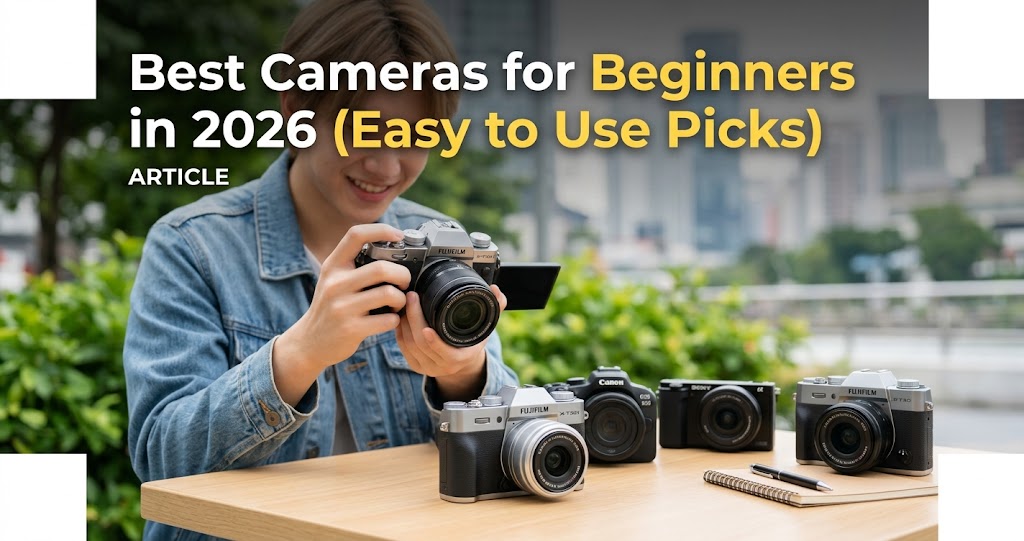
If you're daunted by the prospect of buying your first camera, don't be – we all had to start somewhere! A beginner camera needs to be user-friendly, while also taking significantly better images than the camera that everyone has in their pocket – a smartphone. It should also offer room to grow, for those who are looking to improve their photography and potentially upgrade to a more sophisticated camera once they've got the hang of it .
In 2026, beginner-friendly cameras are better than ever. You no longer need a massive budget or complicated setup to create great-looking content. Today's entry-level cameras offer excellent video quality, strong autofocus, built-in stabilization, and creator-focused features that make getting started simple . Whether you're launching a YouTube channel, posting on social media, or documenting everyday life, these are the best beginner cameras for 2026.
- Reliable autofocus: So your subject stays sharp
- Good stabilization: For handheld shooting
- Flip or articulating screen: For self-framing
- Simple menus and auto modes: That don't overwhelm
- Compact size: So you'll actually carry it
- Room to grow: As your skills develop
Quick Picks: Best Beginner Cameras 2026
Best Mirrorless Cameras for Beginners
Canon EOS R50
Of all the cameras I've used and tested, I think the Canon EOS R50 is currently the best bet for beginners. It's not Canon's cheapest mirrorless camera – that's the EOS R100 – but for my money, it's the cheapest worth buying . It benefits from Canon's advanced Dual Pixel CMOS AF II system, which can accurately and quickly acquire a subject anywhere in the frame, and it also boasts automatic subject recognition for humans, animals, and vehicles .
The 24.2MP APS-C sensor delivers consistently fine JPEG files direct from the camera, with automatic metering and white balance always well-judged. Continuous shooting performance is really impressive – up to 12fps, which not all that long ago would have been considered good enough for a professional sports camera . For video, it offers 4K recording, making it a versatile hybrid option.
The R10, a similar option, is praised for its beginner-friendly menus with clear descriptions and icons explaining complex features . While the R50 is very compact and lightweight, the viewfinder is on the small side, and the RF-S lens range is still growing – but third-party options are emerging .
Pros
- Extremely capable autofocus
- Very compact and lightweight
- Excellent touchscreen interface
- Rapid continuous shooting
Cons
- Limited physical controls
- Small, dim viewfinder
- Limited RF-S lens range
Ideal for: Beginners who want a straightforward, capable camera with excellent autofocus and great image quality straight out of the box .
Nikon Z50II
The Nikon Z50II makes smart tweaks to the original that improve ergonomics, autofocus, and tracking speed for an excellent entry-level mirrorless camera . It features 3D Tracking that supports up to 30fps focus drive, a sizable buffer for burst photography, and full-width 4K30 and cropped 4K60 with 10-bit color .
The camera offers easily accessible color profiles and filters, a light and compact build with weather protection, a flip-out LCD with touch support, an eye-level viewfinder, and a built-in flash . It's perfect for beginners with enthusiast aspirations.
Ideal for: Beginners who want excellent autofocus, good video specs, and a compact build with weather protection .
Fujifilm X-T30 III
While it's a little more expensive than other beginner options, the Fujifilm X-T30 III is one of the most charming starter cameras out there, with fantastic JPEG output and retro looks . Fujifilm has absolutely perfected its formula of stylish retro cameras, with dial-led controls that hearken back to the days of manual film SLRs. This isn't just about looks – having more physical controls can be a much more tactile way to learn than constantly messing around with a touchscreen .
Fujifilm is the king of JPEGs, and its cameras benefit from a range of fantastic Film Simulation modes – built-in color profiles that emulate the looks of classic film stocks like Provia, Velvia, and monochrome Acros. This makes them ideal for those who'd much rather be out shooting than sitting behind the computer fiddling with Photoshop .
There's also 4K video recording on board, and the range of Fujifilm X-Mount lenses is absolutely superb, consisting of lots of fast-aperture primes to help you create images with a beautifully shallow depth of field .
Pros
- Gorgeous JPEGs straight from camera
- Small size and light weight
- Stylish, retro design with dial-led controls
- Excellent lens range available
Cons
- Pricier than other entry-level cameras
- Small viewfinder
- Screen only tilts up/down
Ideal for: Beginners who value beautiful out-of-camera colors, tactile controls, and a camera that inspires you to pick it up and shoot .
Sony A6400
The Sony A6400 is a compact APS-C camera that is rich in features. Positioned as a midrange hybrid camera when it was first released, the A6400 can do a bit of everything quite well . It represents fantastic value for money, especially on the used market .
Its exceptional autofocus, taken from Sony's flagship models, is lightning-quick and rarely misses a shot. It's great for travel, family, street, and even sports photography . With fast and responsive operation, good image quality, and 4K 30p video, it's a great option for beginners, being simple to use .
When you go with Sony, you have access to a good range of full-frame and APS-C lenses .
Ideal for: Budget-conscious beginners who want excellent autofocus and access to Sony's huge lens ecosystem .
Best Vlogging-Focused Beginner Cameras
Canon PowerShot V1
The Canon PowerShot V1 is the new vlogging compact to beat – an impressively fully featured camera for vlogging that will suit the dedicated content creator . It's designed with the "new beginner Vlog artifact" philosophy, aiming to help users transition smoothly from novice to advanced levels with a lightweight body, excellent image quality, and intelligent operation .
It features a newly developed approximately 1.4-inch CMOS image sensor, with a photosensitive area about twice that of common 1-inch sensors, and an effective resolution of about 22.3 megapixels . It supports 5.7K oversampled uncropped 4K 30p video recording, and offers 4K 60p format. The second-generation all-pixel dual-core CMOS AF technology reliably recognizes and tracks faces and eyes of people and animals (cats/dogs) .
Built-in "Smooth Skin Short Film" mode supports 5-level beautification effects, optimizing skin tone and reducing blemishes in real-time. It offers 14 color filters and 15 creative filters covering retro, film, black and white, and more .
Pros
- Large 1.4-inch sensor (2x area of 1-inch)
- Excellent autofocus with face/eye tracking
- Built-in ND filter
- Cooling system for extended recording
- Smart modes for vlogging
Cons
- More expensive than some compacts
- Fixed lens (no interchangeable options)
Ideal for: Vloggers and content creators who want a compact all-in-one with professional features like built-in ND and excellent autofocus .
Sony ZV-E10 II
If you want a camera that can grow with you, the Sony ZV-E10 II is one of the best beginner choices in 2026. It's simple to start with, but powerful enough to last for years . It uses an APS-C sensor, providing excellent background blur and low-light image quality .
Its core advantage is the industry-leading fast hybrid autofocus system, which can accurately and stably track human eyes, faces, and even animal subjects . The dedicated "Product Showcase Mode" allows quick focus switching from a person's face to a product being held up .
With outstanding autofocus, great video quality for YouTube and social, and a compact and lightweight body, it's ideal if you think you'll eventually want better lenses, more creative control, or higher-end content .
Ideal for: Beginner vloggers who want interchangeable lenses, excellent autofocus, and room to grow .
DJI Osmo Pocket 3
The DJI Osmo Pocket 3 is a favorite among beginners who want smooth video without learning stabilization techniques . It integrates a 1-inch CMOS sensor and a physical three-axis mechanical gimbal into an extremely compact body, providing stability that no electronic or optical stabilization can match .
It features a 2-inch rotatable touchscreen, making composition and operation intuitive when taking selfies . It also introduces powerful AI tracking technology, capable of intelligently recognizing and following subjects, making solo shooting much easier .
Ideal for: Travel vloggers and beginners who want gimbal-smooth footage without any setup complexity .
Best Budget and Alternative Beginner Cameras
Olympus OM-D E-M10 Mark IV
It's an older camera now, but the Olympus OM-D E-M10 Mark IV still offers a lot to the beginner photographer. Based around a 20MP Four Thirds sensor, it offers excellent JPEG image quality with extremely attractive colours. The design is stylish and the ergonomics are well laid-out, while extremely effective in-body image stabilization keeps pictures sharp .
Micro Four Thirds uses a smaller sensor size, which allows for sophisticated camera bodies and long lenses to be much smaller than they are in other systems, making it brilliant for travel .
Ideal for: Beginners interested in travel photography, who value IBIS and access to small, affordable lenses .
Nikon D3500
On a tight budget? You can find amazing value when you look at older models. The Nikon D3500 is a small 24-megapixel APS-C DSLR, perfect for first-time shooters who are short on cash . Its unique 'Guide Mode' helps first-time photographers through the absolute basics of photography .
It has a good, high-resolution 24-megapixel sensor, extremely good battery life so you can shoot all day without charging, and access to Nikon's vast lens library .
Ideal for: Absolute beginners on a tight budget who want a camera that teaches them how to shoot .
Smartphone + Accessories: A Valid Starting Point
- Stabilization: A gimbal like the DJI Osmo Mobile 6 turns handheld phone footage into smooth, cinematic video .
- Audio: Wireless microphones like the DJI Mic 2 or RØDE Wireless GO II make it easy to capture clean voice audio .
- Support: A small tripod like the Joby GorillaPod is great for vlogging and creative angles .
How to Choose Your First Camera
1. Assess Your Needs
If you're focused on vlogging, prioritize flip screens, reliable autofocus, and good built-in mics . For travel, focus on stabilization and portability . For general photography, look for user-friendly menus and room to grow .
2. Consider the Lens Ecosystem
When you choose a camera, you are also entering a lens ecosystem. Sony has an enormous range of native lenses, Canon and Fujifilm are growing rapidly . Third-party lenses are also available, so consider this when making your decision .
3. Budget for the Whole Kit
A complete beginner camera kit includes: the camera with a lens, a spare battery, an extra memory card, and perhaps a simple tripod and microphone if you're into video .
Which Beginner Camera Should You Buy?
For most beginners overall: The Canon EOS R50 is the best bet – user-friendly, excellent autofocus, and great image quality .
For vloggers who want simplicity: The Canon PowerShot V1 delivers professional features in a compact, easy-to-use body .
For those who want room to grow with interchangeable lenses: The Sony ZV-E10 II offers excellent autofocus and a massive lens ecosystem .
For gorgeous JPEGs and retro style: The Fujifilm X-T30 III is a charming and capable starter camera .
For the tightest budget: Look at a used Sony A6400 or even a Nikon D3500 to learn the basics .
For travel and smooth video: The DJI Osmo Pocket 3 is unbeatable for its size and built-in gimbal .
Final Thoughts
In 2026, beginner photographers and vloggers have more great options than ever. Whether you want something ultra-simple, travel-friendly, or expandable as your skills grow, there's a camera that fits your style and budget .
The most important thing? Start creating. Don't wait for the "perfect" camera — choose one that feels approachable, learn it well, and focus on telling your story .