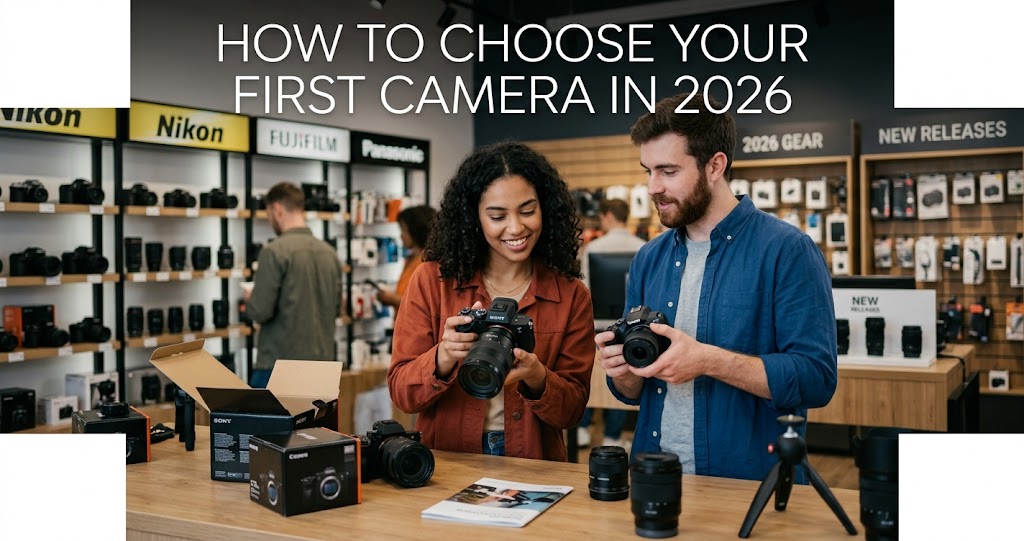
Choosing your first camera is one of the most exciting—and potentially overwhelming—decisions you'll make as a photographer. With so many options, technical terms, and price points, it's easy to feel lost before you even start. But here's the good news: in 2026, beginner cameras are better than ever, and with the right framework, you can find the perfect camera for your needs and budget .
This guide will walk you through every step of the decision process. By the end, you'll know exactly what to look for, which questions to ask yourself, and which cameras deserve your hard-earned money.
Quick Picks: Best Beginner Cameras 2026
Step 1: Ask Yourself the Right Questions
1 What Will You Shoot Most?
Your primary subject matter should drive your camera choice. Different types of photography prioritize different features .
- Portraits & family photos: Prioritize autofocus with eye detection and lenses with wide apertures (f/1.8) for blurry backgrounds.
- Travel & street photography: Look for compact, lightweight bodies with good battery life .
- Vlogging & video content: Flip screens, reliable autofocus, and microphone inputs are essential .
- Wildlife & sports: You'll need cameras with fast burst rates (8+ fps) and good autofocus tracking .
- Landscapes: Higher resolution sensors and weather-sealed bodies are valuable.
2 Set a Realistic Budget
Your camera budget should include not just the body, but also lenses, memory cards, extra batteries, and perhaps a bag. Entry-level mirrorless kits start around $600–$800, while used DSLRs can be found for $300–$500 .
Budget breakdown guide:
- Under $500: Look for used DSLRs like the Nikon D3500 or older mirrorless models .
- $500–$1,000: Excellent entry-level mirrorless cameras like Canon EOS R50, Sony ZV-E10, or Fujifilm X-T30 III .
- $1,000–$1,500: More advanced features like in-body stabilization (IBIS) and better video specs .
Step 2: Understand Camera Types
Mirrorless Cameras
The modern choice for beginners in 2026
- Smaller, lighter bodies
- Electronic viewfinder shows exposure preview
- Advanced autofocus with eye detection
- Superior video capabilities (4K, 10-bit)
- Growing lens ecosystems
- Downside: Shorter battery life, higher initial cost
DSLR Cameras
The budget-conscious choice
- Excellent value on used market
- Long battery life (600–1000+ shots)
- Optical viewfinder (no lag)
- Extensive legacy lens options
- Durable, proven technology
- Downside: Larger, heavier, limited video AF
For most beginners in 2026, I recommend starting with mirrorless. The technology is where all future development is happening, and features like real-time exposure preview and eye-detection autofocus make learning faster and more enjoyable .
Step 3: Understand Sensor Sizes
For most beginners, APS-C is the ideal balance of image quality, size, and cost .
Step 4: Key Features to Look For
4 Essential Beginner-Friendly Features
- Reliable autofocus: Look for face/eye detection—it makes a huge difference .
- Flip or articulating screen: Essential for selfies, vlogging, and shooting from awkward angles .
- In-body stabilization (IBIS): Helps get sharper shots in low light, especially on Olympus and Fujifilm models .
- 4K video: Even if you're not a videographer now, having the option is valuable .
- Beginner-friendly menus: Some cameras have Guide Modes that explain settings as you use them .
- Compact size: The best camera is the one you'll actually carry .
Step 5: Consider the Lens Ecosystem
When you choose a camera, you're also choosing a lens system. You'll want affordable options to grow into .
- Canon RF-S: Growing lineup, but limited for now. Adapters let you use older EF lenses .
- Nikon Z DX: Solid kit lenses, native options still limited, but adapting F-mount lenses works well .
- Sony E-mount: Huge selection, including affordable third-party lenses from Sigma and Tamron .
- Fujifilm X-mount: Excellent native lens lineup, particularly fast primes .
- Micro Four Thirds: Largest lens selection, incredibly affordable .
Top Beginner Cameras in 2026
Canon EOS R50
Of all the cameras I've used and tested, I think the Canon EOS R50 is currently the best bet for beginners. It's not Canon's cheapest mirrorless camera – that's the EOS R100 – but for my money, it's the cheapest worth buying .
It benefits from Canon's advanced Dual Pixel CMOS AF II system that can accurately and quickly acquire a subject anywhere in the frame, with automatic subject recognition for humans, animals, and vehicles .
The 24.2MP APS-C sensor delivers consistently fine JPEG files direct from the camera. Automatic metering and white balance are always well-judged, and continuous shooting performance is really impressive – up to 12fps .
Ideal for: Beginners who want a straightforward, capable camera with excellent autofocus and great image quality straight out of the box .
Fujifilm X-T30 III
While it's a little more expensive than other beginner options, I think the X-T30 III is one of the most charming starter cameras out there, with fantastic JPEG output and retro looks .
Fujifilm has absolutely perfected its formula of stylish retro cameras, with dial-led controls that hearken back to the days of manual film SLRs. Having more physical controls can be a much more tactile way to learn than constantly messing around with a touchscreen .
Fujifilm is the king of JPEGs, and its cameras benefit from a range of fantastic Film Simulation modes – built-in color profiles that emulate the looks of classic film stocks like Provia, Velvia, and monochrome Acros .
Ideal for: Beginners who value beautiful out-of-camera colors, tactile controls, and a camera that inspires you to pick it up and shoot .
Canon PowerShot V1
The Canon PowerShot V1 is the new vlogging compact to beat – an impressively fully featured camera for vlogging that will suit the dedicated content creator . It's designed with the "new beginner Vlog artifact" philosophy, helping users transition smoothly from novice to advanced levels .
It features a newly developed approximately 1.4-inch CMOS image sensor, with a photosensitive area about twice that of common 1-inch sensors . It supports 5.7K oversampled uncropped 4K 30p video recording and offers 4K 60p format .
The second-generation all-pixel dual-core CMOS AF technology reliably recognizes and tracks faces and eyes of people and animals. Built-in "Smooth Skin" mode optimizes skin tone in real-time .
Ideal for: Vloggers and content creators who want a compact all-in-one with professional features .
Sony ZV-E10 / ZV-E10 II
The Sony ZV-E10 was designed for content creators who want flexible storytelling and simple operation. It's an entry point to Sony's E-mount system, offering access to a huge range of lenses .
Its core advantage is the industry-leading fast hybrid autofocus system, which can accurately and stably track human eyes, faces, and even animal subjects . The dedicated "Product Showcase Mode" allows quick focus switching from a person's face to a product being held up .
With outstanding autofocus, great video quality for YouTube and social, and a compact body, it's ideal if you think you'll eventually want better lenses and more creative control .
Ideal for: Beginner vloggers who want interchangeable lenses, excellent autofocus, and room to grow .
Olympus OM-D E-M10 Mark IV
It's an older camera now, but the Olympus OM-D E-M10 Mark IV still offers a lot to the beginner photographer. Based around a 20MP Four Thirds sensor, it offers excellent JPEG image quality with extremely attractive colours .
The design is stylish and the ergonomics are well laid-out, while extremely effective in-body image stabilization keeps pictures sharp. You also get access to a huge set of small, affordable Micro Four Thirds lenses .
Micro Four Thirds uses a smaller sensor, which allows for sophisticated camera bodies and long lenses to be much smaller than other systems, making it brilliant for travel .
Ideal for: Travel photographers and anyone wanting IBIS on a budget .
Nikon D3500 / D610
On a tight budget? You can find amazing value when you look at older models that were—and still are—amazing cameras. The Nikon D3500 is a small 24-megapixel APS-C DSLR, perfect for first-time shooters who are short on cash .
Its unique 'Guide Mode' helps first-time photographers through the absolute basics of photography . Battery life is amazing—you can shoot all day without charging.
For those wanting full-frame, the Nikon D610 delivers outstanding ISO performance and image quality for the price, with fantastic dynamic range in RAW files. It represents outstanding value .
Ideal for: Absolute beginners on a tight budget who want to learn the fundamentals .
Your First Camera Decision Checklist
Where to Buy: New vs Used
Buying used is the best way to push your budget further, especially for beginners .
- New cameras: Warranty, latest technology, peace of mind. Best for those who want the newest features.
- Used/refurbished cameras: Excellent value. Reputable sellers like MPB and KEH test and warranty their gear. You can often get a higher-tier camera for the same money .
Final Step: The Most Important Thing
What to Do Next
The best camera is the one you'll actually use . After you've narrowed down your options, visit a camera store and hold them in your hands. Does the grip feel comfortable? Are the buttons intuitive? Can you easily reach the controls?
Then, once you've chosen, commit to learning it. A capable camera in the hands of someone who knows it well will always outperform a more expensive camera in the hands of someone who doesn't .
Final Thoughts
In 2026, beginner photographers have more great options than ever. Whether you want something ultra-simple, travel-friendly, or expandable as your skills grow, there's a camera that fits your style and budget .
The most important thing? Start creating. Don't wait for the "perfect" camera—choose one that feels approachable, learn it well, and focus on telling your story .