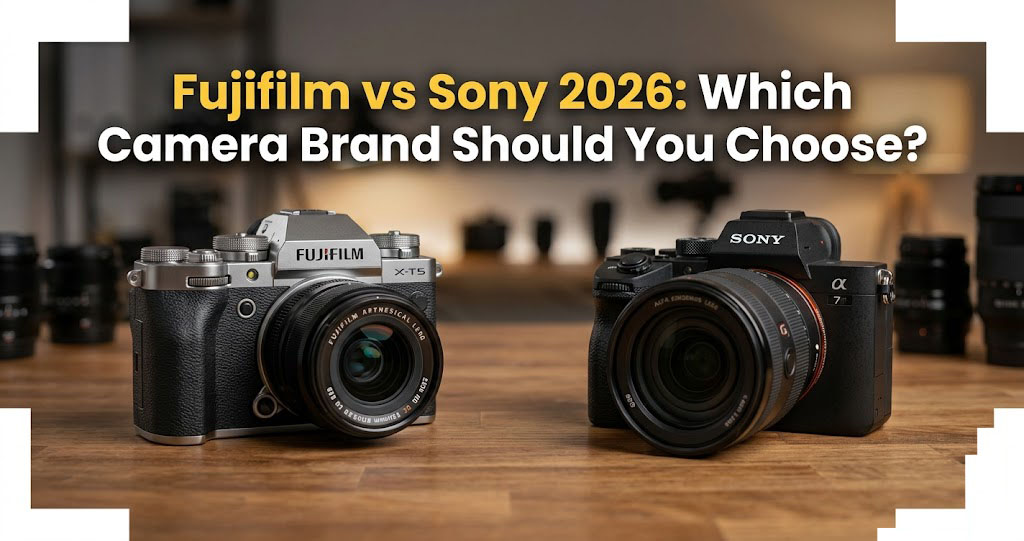
Fujifilm vs Sony in 2026 is less about which brand is "better" and more about which philosophy fits your creative style. Fujifilm builds cameras for photographers who love tactile controls, beautiful out-of-camera colors, and a filmmaking-inspired experience. Sony builds computational powerhouses with industry-leading autofocus, massive lens ecosystems, and bleeding-edge sensor technology. Both produce stunning images. The difference lies in how they make you feel when you shoot and how they handle your specific needs.
🏆 2026 TIPA Award Highlights
Both brands were recognized at the 2026 TIPA Photography Awards: Fujifilm won Best APS-C Camera (X-E5) and Best Professional Cinema Camera (GFX Eterna 55), while Sony won Best Full-Frame Enthusiast Camera (Alpha 7 V) and Best Premium Compact (DSC-RX1R III) . In Japan's March 2026 sales ranking, the Sony A7 V claimed the #1 spot, while Fujifilm's X-M5 and X-E5 placed 4th and 9th respectively . Both brands are thriving, but in different segments.
Market Position: Two Different Success Stories
In 2026, Sony continues to dominate the full-frame mirrorless market, while Fujifilm has carved out a loyal following in APS-C and medium format. Sony's sales success is driven by the A7 V, which has been the best-selling camera in Japan for five consecutive periods since late January 2026 . Fujifilm, meanwhile, has capitalized on the "エモい写真" (emotional photo) boom, with retro-styled cameras that appeal to creators seeking character over technical perfection .
As BCN Retail's 2026 market forecast notes, "デジタルカメラ市場は今、新たな局面を迎えています。「エモい写真」ブームやレトロデザイン機種への注目が新たな需要を喚起し、メーカー勢力図にも変化が生じています" — the camera market is entering a new phase, with demand for "emotional photos" and retro designs reshaping the competitive landscape .
Fujifilm vs Sony: Quick Reference
Fujifilm: The Photographer's Camera
🎞️ Fujifilm's Philosophy
Fujifilm approaches camera design differently from Sony. Instead of one "do-everything" camera, Fujifilm offers specialized tools for different needs: the X-H2S for speed, the X-H2 for resolution, and the X-T5 for the classic photography experience . This philosophy extends to their lens lineup, which prioritizes character and compactness over absolute sharpness.
Fujifilm Strengths
- Film Simulations: 20+ built-in profiles (Classic Chrome, Acros, Nostalgic Neg) produce gorgeous JPEGs straight out of camera
- Tactile Controls: Dedicated shutter speed, ISO, and exposure compensation dials on most bodies
- Open-Gate Video: 6.2K 3:2 recording on X-H2S and X-T5 — crop horizontally and vertically from one clip
- Medium Format: GFX system offers 102MP images for studio and landscape work
- Compact Design: X-E5 and X100 series are genuinely pocketable
Fujifilm Weaknesses
- Autofocus tracking lags behind Sony, especially for fast action
- Limited third-party lens support compared to E-mount
- Video autofocus can be less reliable in complex scenes
- Battery life generally shorter than Sony's full-frame bodies
- Menu system can be inconsistent across models
Sony: The Technical Powerhouse
📷 Sony's Philosophy
Sony builds cameras for photographers who want uncompromising performance, bleeding-edge technology, and the flexibility of the largest mirrorless lens ecosystem. The recently released A7 V, with its partially stacked 33MP sensor and AI autofocus, represents Sony's commitment to bringing professional features to enthusiast price points .
Sony Strengths
- AI-Powered Autofocus: Real-time Tracking recognizes people, animals, birds, insects, cars, trains, and airplanes
- Massive Lens Ecosystem: Over 300 native lenses including extensive third-party support from Sigma, Tamron, and others
- Full-Frame Sensor Technology: Industry-leading dynamic range (16 stops on A7 V) and low-light performance
- 4K 60p Full-Width: No crop on A7 V, 7K oversampling for exceptional detail
- Unlimited Recording: No overheating issues for extended video sessions
Sony Weaknesses
- JPEG colors can look clinical without grading (improved with newer models)
- Menu system, while improved, is still complex
- Smaller bodies can feel cramped with large lenses
- No open-gate video recording (3:2 full sensor capture)
- CFexpress Type A cards are more expensive than SD
Head-to-Head: Key Comparison Points
Fujifilm's Three Paths to Excellence
🏃 The X-H2S: Speed
For photographers who need to capture fleeting moments—sports, wildlife, documentary—the X-H2S is Fujifilm's answer. Its stacked sensor prioritizes readout speed above all else, delivering virtually no rolling shutter and reliable subject tracking. As Fujifilm Colombia notes, "Es la cámara para quien no puede pedirle al sujeto que repita la acción" . With 6.2K open-gate recording, internal ProRes, and 7-stop IBIS, it's also a professional video tool .
🔬 The X-H2: Resolution
The X-H2 pushes APS-C to its limits with a 40.2MP sensor. Its Pixel Shift Multi-Shot mode captures up to 160MP files by combining multiple exposures, eliminating moiré and achieving absolute color fidelity . This is the camera for architectural, product, and fashion photographers who need to print large or crop aggressively. The X-H2's video capabilities are also impressive, with 6.2K 30p recording in a compact body .
🎨 The X-T5: Experience
The X-T5 represents Fujifilm's core philosophy: the joy of photography itself. It shares the 40MP sensor of the X-H2 but packages it in a classic body with dedicated dials for shutter speed, ISO, and exposure compensation . For street photography, travel, and documentary work, the X-T5 offers the perfect balance of resolution, portability, and tactile engagement. As the 2026 TIPA awards recognized, the X-E5 (a rangefinder-style variant) won Best APS-C Camera, confirming Fujifilm's strength in this segment .
Sony's A7 Series: The Complete Full-Frame System
1 Sony A7 V: The New Standard
The A7 V represents a "着実かつ本質的な進化" (steady and essential evolution) for Sony's core full-frame lineup . Its partially stacked 33MP sensor reads 4.5 times faster than the A7 IV, enabling 30fps electronic shooting with blackout-free operation . The integrated AI processing unit recognizes nine subject types and improves auto white balance using deep learning .
Video shooters finally get full-width 4K 60p recording with 7K oversampling, while the 4-axis multi-angle LCD screen makes framing easier in both landscape and portrait orientations . With a claimed 16 stops of dynamic range, the A7 V is a genuine hybrid workhorse.
2 Sony's Lens Advantage
Where Sony truly dominates is lens selection. The E-mount ecosystem has over 300 native lenses, including extensive third-party support from Sigma, Tamron, and others. Whether you need affordable f/1.4 primes, compact travel zooms, or professional f/2.8 GM glass, Sony has options at every price point. Fujifilm's X-mount has excellent native lenses, but third-party support is limited, and prices for fast primes are generally higher.
Fujifilm Pros
- Beautiful out-of-camera JPEGs (Film Simulations)
- Tactile, engaging controls on X-T/X-Pro bodies
- Open-gate 6.2K video for multi-format delivery
- Medium format GFX system for ultimate resolution
- Compact APS-C bodies and lenses
- Unique retro aesthetic that inspires shooting
Fujifilm Cons
- Autofocus tracking lags behind Sony
- Limited third-party lens options
- Video autofocus less reliable
- Menu system inconsistent across models
- Smaller sensor means lower high-ISO ceiling than full-frame
Sony Pros
- Class-leading AI-powered autofocus
- Massive lens ecosystem with third-party support
- Full-frame sensor advantages (dynamic range, low-light)
- Full-width 4K 60p video on newer bodies
- Unlimited recording without overheating
- Timecode and professional video tools
Sony Cons
- JPEG colors can look clinical
- Complex menu system
- Smaller bodies can be cramped
- No open-gate video recording
- CFexpress Type A cards expensive
Which Brand Should You Choose?
Choose Fujifilm if:
- You love beautiful JPEGs straight out of camera and don't want to spend hours editing
- You value tactile controls and a classic photography experience
- You shoot street, travel, documentary, or lifestyle photography
- You want a compact system without sacrificing image quality
- You're a hybrid shooter who needs open-gate 6.2K video for multi-format delivery
- You prioritize color and character over absolute technical perfection
Choose Sony if:
- You need the best possible autofocus for action, sports, or wildlife
- You want access to the largest mirrorless lens ecosystem
- You prefer full-frame sensors for maximum dynamic range and low-light performance
- You're a professional who needs reliable, consistent results
- You shoot video and need full-width 4K 60p without crop
- You value third-party lens options and price flexibility
Real-World User Perspectives
On FujiX-Forum, one user offered a provocative perspective: "Sony is for specs-braggers, android nerds, and young vloggers. In 2026 their greatest advantage is lens ecosystem w/ third..." . While overly reductive, this highlights a real divide: Fujifilm attracts photographers who value the shooting experience itself, while Sony attracts those who prioritize technical specifications and lens choice.
For vloggers and content creators, the equation is different. A 6000元 Vlog相机横评 (RMB 6,000 vlog camera comparison) noted that Sony's ZV-1 II wins for beginners thanks to AI autofocus and built-in microphone quality, while Fujifilm's X-S20 offers better low-light performance and professional-grade features for those willing to invest more time in post-processing .