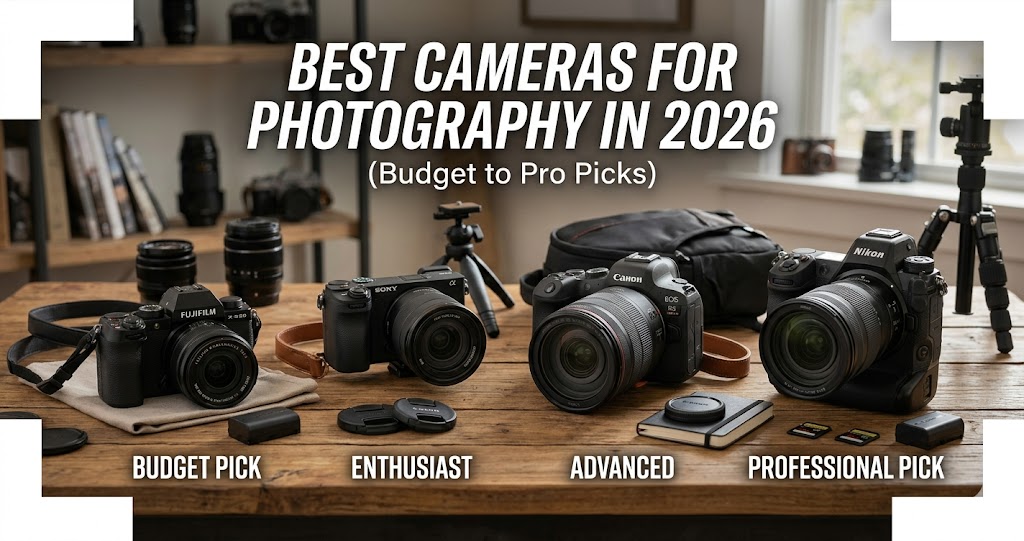
Choosing the right camera in 2026 is both exciting and overwhelming. With the rapid evolution of sensor technology—stacked CMOS, global shutter, AI-powered autofocus, and RED-influenced video codecs—there's never been a better time to upgrade or enter the world of dedicated photography. Whether you're a first-time buyer looking for a budget-friendly mirrorless, a travel enthusiast needing compact full-frame, or a professional seeking the ultimate hybrid flagship, this guide covers the best cameras across every price bracket. I've tested and researched dozens of models to bring you these recommendations, backed by real-world performance data and expert reviews .
Best Budget Cameras Under $1000
If you're stepping up from smartphone photography or need a capable travel companion, these entry-level mirrorless cameras offer fantastic image quality without breaking the bank .
Canon EOS R10
The Canon EOS R10 remains our top pick under $1000 for its blend of speed, autofocus, and usability. It packs a 24MP APS-C sensor, 15fps mechanical shooting, and Canon's excellent Dual Pixel AF with subject tracking—features usually found in much pricier cameras . The R10 is approachable for beginners but has enough depth to grow with you. The main drawbacks are mediocre battery life and a limited selection of native RF-S lenses, though third-party options from Sigma and Tamron are filling the gap .
Nikon Z50II
Nikon's Z50II is an excellent entry-level mirrorless with a 21MP APS-C sensor and the same 3D Tracking autofocus system found in Nikon's higher-end models . It recognizes nine subject types and offers a pre-capture mode (though JPEG-only). The twin command dials and deep grip make it comfortable to use, and it supports full-width 4K30 video. Battery life is average, and the lens selection is more limited than Sony or Canon, but for pure photography beginners, it's a superb start .
Sony a6100
The Sony a6100 has been around for a few years, but its 24MP sensor and Real-Time Tracking autofocus remain highly competitive. It's the most affordable way into Sony's vast E-mount lens ecosystem . The tilting touchscreen is great for vlogging, and 4K video is available (though with rolling shutter). The menu system is dated, and the build feels less robust than competitors, but for the price, the image quality and AF are outstanding .
Best Mid-Range & Enthusiast Cameras ($1000 – $3000)
This is the sweet spot where you get professional-level features—like stacked sensors, 10-bit video, and advanced AF—without the flagship price tag .
Canon EOS R6 III
The Canon EOS R6 III is a master of most trades: a 32.5MP full-frame sensor, 40fps electronic shooting, and 7K 60p RAW video internally. Its Dual Pixel AF II system is class-leading, and the handling is superb. Dynamic range isn't quite as strong as some competitors, and it can overheat in the most ambitious video modes, but for hybrid shooters, it's arguably the most complete package at this price .
Nikon Z6 III
The Nikon Z6 III features a world-first "partially stacked" 24.5MP sensor, offering 3.5x faster readout than its predecessor . This means virtually no rolling shutter, 20fps RAW bursts with a 1000+ frame buffer, and 6K 60p N-RAW video with RED color science. The AF is inherited from the Z9, with excellent subject detection. There's a slight dynamic range trade-off at base ISO, but for most users, this is a phenomenal hybrid camera .
Sony a7C II
The Sony a7C II packs a 33MP full-frame sensor and AI-powered AF into a tiny, travel-friendly body. It's essentially an A7 IV in a smaller package, with the same excellent image quality, 10-bit 4K video, and Auto Framing mode . The viewfinder is small and there's no joystick, but if portability is your priority, this is the full-frame camera to beat .
Fujifilm X-T50
Fujifilm's X-T50 brings a 40MP APS-C sensor and 7-stop IBIS to a compact, retro-styled body. The Film Simulation dial encourages creative JPEG shooting, and the new kit lens is excellent. Autofocus tracking isn't class-leading, but for travel, street, and portrait photography, the out-of-camera colors are gorgeous .
Best Professional & Flagship Cameras ($3000+)
For those who demand the absolute best—fastest readout, highest resolution, most rugged build—these are 2026's pro heavyweights.
Canon EOS R5 Mark II
The Canon EOS R5 Mark II fixes the original's overheating and adds a stacked 45MP sensor, 8K 60p RAW, and Eye-Control AF. It's the most complete high-resolution hybrid camera on the market, with class-leading AF and build quality .
Sony A1 II
The Sony A1 II combines a 50MP stacked sensor with 30fps blackout-free shooting and 8K video. It's the ultimate tool for pros who need both resolution and speed, with tank-like build and AI-powered autoflexibility .
Nikon Z8
The Nikon Z8 packs Z9 performance into a smaller body: 45.7MP stacked sensor, 20fps RAW, 8K video, and exceptional subject-detection AF. It's a wildlife and action powerhouse .
How to Choose the Right Camera
Before you buy, ask yourself: what do you shoot most? Travelers should prioritize size and IBIS—look at Sony a7C II or Fujifilm X-T50 . Sports/wildlife shooters need speed and reach—Nikon Z8 or OM System OM-1 II are excellent . Hybrid creators who shoot equal stills and video should consider Canon EOS R6 III or Nikon Z6 III . Budget beginners can't go wrong with Canon R10 or Nikon Z50II—they'll grow with you .
Quick Pick Guide
- Best Budget: Canon EOS R10
- Best Beginner: Nikon Z50II
- Best All-Rounder Under $3000: Canon EOS R6 III
- Best for Speed: Nikon Z6 III
- Best Travel Compact: Sony a7C II
- Best JPEG Colors: Fujifilm X-T50
- Best Pro Hybrid: Canon EOS R5 Mark II
- Best Wildlife: Nikon Z8
- Best High-Res Speed: Sony A1 II
The camera market in 2026 is incredibly competitive, which is great news for us photographers. Whether you're just starting out or upgrading your professional kit, there's a perfect camera waiting for you. Happy shooting!