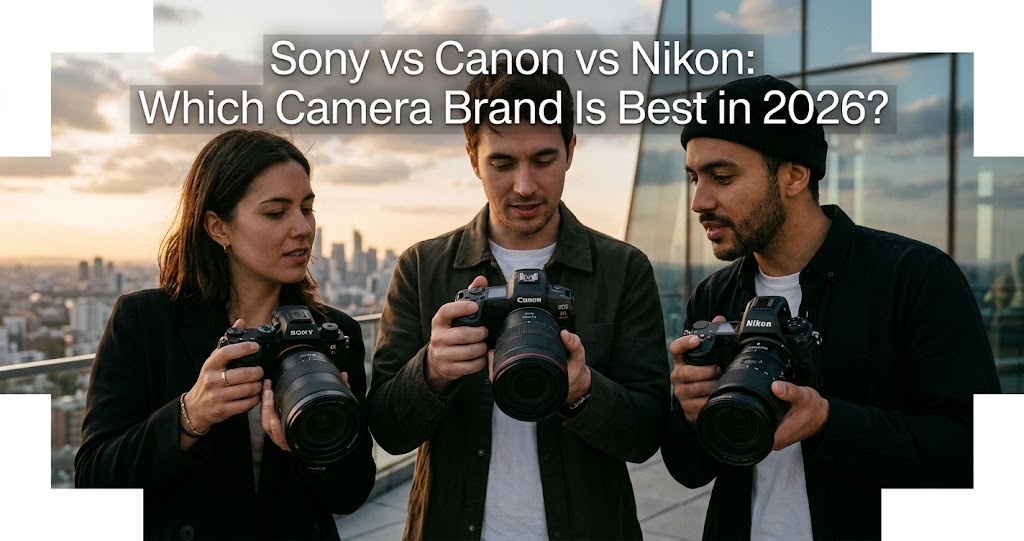
For photographers in 2026, the choice between Sony, Canon, and Nikon has never been more complex—or more exciting. Each brand has spent the last decade refining its mirrorless systems, building extensive lens libraries, and integrating cutting-edge technology like stacked sensors, AI autofocus, and professional video codecs. But despite their convergence on mirrorless, they remain distinct in philosophy, ecosystem, and real-world performance. This comprehensive guide breaks down the state of each brand—market position, pro adoption, lens selection, autofocus, video capabilities, and future trajectory—to help you decide which system deserves your investment.
The Big Picture: Market Position in 2026
According to Japan's authoritative BCN retail data, Sony currently leads the mirrorless camera market with a 29.9% share, followed closely by Canon at 27.4%, while Nikon holds 15.1% . Sony's lead is thanks to its early mirrorless dominance and continuous innovation, but Canon has been steadily closing the gap with its R-series bodies and aggressive marketing. Nikon, while third in overall volume, maintains a loyal following among enthusiasts and professionals who value its color science, ergonomics, and the recent infusion of RED video technology .
In the professional workflow space—cameras used by working pros for paid shoots—Canon actually leads with 44% adoption, Sony follows with 26%, and Nikon with 21% . This tells an important story: Canon's ecosystem and reliability make it the top choice for high-volume professionals, while Sony's innovation attracts tech-savvy shooters. Nikon holds steady with a dedicated user base that's unlikely to switch .
Sony: The Innovation Leader
Sony
Sony's greatest strength is its head start. The E-mount system has been open to third-party manufacturers for years, resulting in the largest lens ecosystem in mirrorless—over 70 native lenses from Sony, Sigma, Tamron, and others. Tamron actually leads the Japanese lens market with 23% share, followed by Sigma at 17.8%, many of which are for E-mount . This means Sony users have unparalleled choice at every price point.
Autofocus is Sony's crown jewel. The AI processing units in cameras like the A7 V and A1 II deliver class-leading subject recognition for humans, animals, birds, insects, and vehicles . Real-time Tracking is sticky and reliable, making Sony the go-to for action and wildlife shooters. The A7 V, with its 33MP partially stacked sensor, is PCMag's pick for best overall full-frame camera in 2026 .
Video capabilities are strong, with caveats. Sony's cinema line (FX3, FX6) is industry-standard for indie filmmakers, but hybrid shooters should note that internal RAW recording is limited compared to competitors. The A7S III remains a low-light king, though its sensor resolution shows its age . Sony's color science has improved dramatically, with natural skin tones and S-Cinetone pleasing out of camera .
Body design is polarizing. Sony's menus have evolved from terrible to decent, but some find the ergonomics cramped compared to Canon and Nikon. Battery life is excellent thanks to the NP-FZ100 cells, and the compact size of bodies like the A7C II appeals to travelers .
Lenses
Largest selection (70+ native)AF
Best in classVideo
Pro cinema line, limited internal RAWCanon: The Professional's Choice
Canon
Canon's dominance among working pros is undeniable: 44% of high-volume photographers use Canon as their primary system . The top two most-used cameras by professionals are the Canon EOS R6 Mark II and EOS R6, and Canon holds 11 of the top 20 slots in pro workflows . This isn't by accident—Canon builds cameras that are reliable, ergonomically excellent, and backed by a professional service network.
The R-series lineup covers every niche. The EOS R6 Mark III, with its 32.5MP sensor, 40fps burst, and 7K 60p open-gate video, is arguably the most complete hybrid camera under $3,000 . The R5 Mark II delivers stacked-sensor performance with 8K 60p RAW and Eye-Control AF, fixing the original's overheating issues . For wildlife and sports, the APS-C R7 offers 15fps mechanical and 40fps electronic with a 1.6x reach advantage .
Lens ecosystem: quality over quantity. Canon's RF lenses are optically superb, with many reviewers considering them the best in the industry. However, Canon has been slow to open the mount to third parties, limiting budget options. Sigma and Tamron are now producing RF-S lenses for APS-C, but full-frame RF remains largely Canon-only . This keeps quality high but prices high too.
Video has caught up. The addition of 3:2 open-gate recording in the R6 Mark III and R5 Mark II allows simultaneous vertical and horizontal crops from the same clip—a major win for content creators . Canon's Dual Pixel AF remains excellent, and C-Log3 provides grading flexibility.
Pro adoption
44% of prosLenses
Optically superb, limited third-partyErgonomics
Industry-leadingNikon: The Enthusiast's Dark Horse
Nikon
Nikon has reinvented itself through technology partnerships and stacked sensors. The acquisition of RED has begun bearing fruit, with Nikon cameras gaining internal RAW recording and RED color science. The Z6 III features a world-first "partially stacked" 24.5MP sensor, delivering 3.5x faster readout than its predecessor—eliminating rolling shutter and enabling 20fps RAW bursts with massive buffers . The Z8 remains a high-resolution powerhouse with 45.7MP and Z9-level performance in a smaller body .
Color science is Nikon's secret weapon. Nikon's out-of-camera JPEGs are beloved for their natural, accurate colors and the recent addition of Deep Tone Monochrome and other creative profiles . For photographers who want minimal editing, Nikon delivers.
Lens mount: quality and cautious opening. The Z mount is technically superb, with a short flange distance enabling excellent optical designs. Nikon has been slower than Sony to allow third-party autofocus lenses, but Sigma and Tamron are now producing Z-mount glass, expanding options. Native Z lenses are expensive but outstanding .
Video: RED influence grows. The Z6 III's 6K 60p N-RAW internal recording and RED LUTs bring cinema quality to a mid-range body . The rumored ZR C could bring RED tech to APS-C at a lower price point . For hybrid shooters, Nikon is suddenly very competitive.
APS-C strategy. Nikon is reportedly doubling down on APS-C, with rumored successors to the Z50, Zfc, and possibly a D500-style Z500 . The Z50II already offers 21MP and 3D Tracking at an affordable price .
Growth
Fastest-improving AFVideo
N-RAW + RED LUTsColors
Natural, accurate JPEGsHead-to-Head: Key Decision Factors
Lens Selection and Ecosystem
Sony wins on sheer quantity and price range. With native support from Sigma, Tamron, and others, you can outfit a Sony system at almost any budget. Canon wins on optical quality but at a premium price and with fewer budget options. Nikon is catching up with third-party Z lenses now available, but the selection is still thinner than Sony's .
Autofocus Performance
Sony remains the benchmark for consistent, reliable AF across all scenarios. Canon's Dual Pixel AF is excellent and particularly strong for video. Nikon's 3D Tracking has closed the gap significantly and is now competitive, especially with the latest Expeed 7 processors .
Video Capabilities
Nikon leads on internal RAW and color science thanks to RED integration. Canon offers open-gate recording and excellent codecs but lacks internal RAW in many models. Sony's cinema line is pro-grade but its hybrid bodies often require external recorders for RAW .
Ergonomics and Handling
This is subjective, but Canon is widely praised for intuitive controls and deep grips. Nikon's ergonomics are excellent for those who grew up with DSLRs. Sony is more compact but can feel cramped for larger hands .
What Working Pros Actually Use
Among high-volume photographers (those with the most paid shoots), the top cameras are workhorses that deliver reliability and consistent files .
The most-used bodies: Canon EOS R6 Mark II, Sony A7 IV, Nikon Z6 II, Canon EOS R5, Nikon Z8 .
Future Outlook: Where Each Brand Is Headed
Sony will continue refining its AI autofocus and sensor technology. Expect more stacked sensors and perhaps a global shutter in flagship models. The third-party lens ecosystem will only grow, making E-mount the safest choice for lens selection .
Canon is likely to slowly open its mount to more third-party lenses while focusing on professional reliability and hybrid video features. The R5 Mark II shows Canon can compete on speed, and future R1-series bodies will push boundaries .
Nikon has the most to gain from its RED acquisition. Expect more cameras with N-RAW and RED color science, possibly at lower price points. Nikon is also betting on APS-C growth, which could bring new users into the system .
Pros and Cons at a Glance
Sony Strengths
- Largest lens ecosystem (native + third-party)
- Best-in-class autofocus with AI
- Compact body options (A7C II)
- Strong video pedigree (FX line)
- Excellent battery life
Sony Weaknesses
- Ergonomics not for everyone
- Menus still dense
- Internal RAW limited
- Colors historically less pleasing (improving)
Canon Strengths
- #1 in professional adoption
- Excellent ergonomics and controls
- Superb RF glass
- Open-gate video recording
- Reliable Dual Pixel AF
Canon Weaknesses
- Limited third-party lens options
- Higher system cost
- Slower to adopt stacked sensors (until R5 II)
- Some video features lag Nikon
Nikon Strengths
- Best color science / JPEGs
- RED video integration (N-RAW, LUTs)
- Innovative partially stacked sensors
- Excellent Z mount optics
- Growing APS-C lineup
Nikon Weaknesses
- Third smaller market share
- Fewer native lenses than Sony
- AF not quite class-leading (but close)
- Some models feel incremental
Which Brand Should You Choose?
Choose Sony if...
You want the widest lens selection, the absolute best autofocus, and don't mind slightly cramped ergonomics. Ideal for tech-savvy shooters, hybrid creators who value AF above all, and anyone building a system on a budget thanks to third-party glass .
Choose Canon if...
You're a professional or serious enthusiast who values reliability, ergonomics, and the support of an ecosystem trusted by 44% of working pros. You're willing to pay a premium for RF glass and want a camera that just works .
Choose Nikon if...
You love beautiful out-of-camera colors, want the benefits of RED video technology, and appreciate Nikon's unique sensor innovations. You're willing to wait for the lens ecosystem to mature and value image quality above all .
Ultimately, there are no bad choices in 2026. All three systems produce stunning images, focus reliably, and offer professional video capabilities. The best brand for you depends on your budget, your lens needs, and—most importantly—how the camera feels in your hands. If possible, visit a store and try each before committing. Whichever you choose, you're investing in a system that will serve you well for years to come.