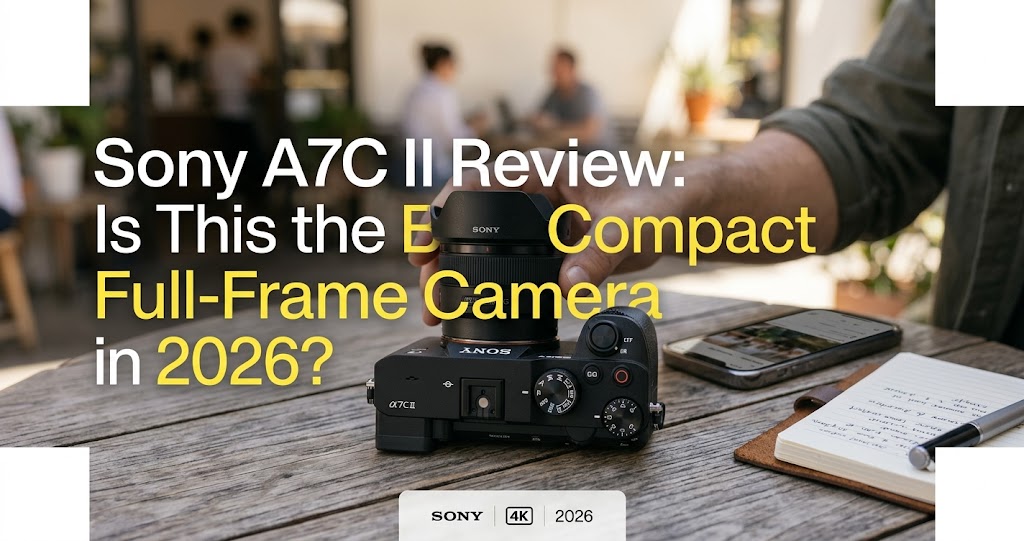
More than two years after its release, the Sony A7C II remains one of the most talked-about compact full-frame cameras on the market. In 2026, with rivals like the Canon R8 and Nikon Zf competing for the same travel/street crown, does Sony’s small wonder still deserve the throne? I’ve spent the last month shooting with it everywhere—from crowded night markets to foggy coastlines—and here’s my full, in-depth review.
Who Is the A7C II For?
The A7C II sits in a unique spot: it’s a full-frame camera designed for people who prioritize portability but refuse to compromise on image quality. Think travel bloggers, street photographers, vloggers, or anyone who wants a capable second body. It’s also an ideal entry point for amateurs ready to leap from APS-C without the bulk of a traditional DSLR-style mirrorless .
Sensor and Image Quality: 33MP Sweet Spot
At its heart lies the same 33MP backside-ilSHOTAVIXted Exmor R CMOS sensor found in the highly respected A7 IV. This is a proven performer, delivering excellent dynamic range (around 15 stops) and clean files up to ISO 6400 . The extra resolution over the original A7C’s 24MP gives you meaningful cropping flexibility—a lifesaver when you can’t physically get closer to your subject while traveling .
In practice, the RAW files are incredibly malleable. I underexposed a night market shot by nearly four stops, and pulling the shadows in Lightroom revealed no ugly banding—just smooth, usable detail. For JPEG shooters, Sony has finally tuned its color science; skin tones are more natural, and the new Creative Look presets (like “Neutral” and “Film”) produce share-ready images straight out of camera .
Autofocus: AI-Powered and Almost Telepathic
The A7C II inherits the AI processing unit from Sony’s flagship models. This isn’t just marketing hype: the camera now recognizes humans, animals, birds, insects, and even vehicles with startling accuracy . During a test at a local dog park, it locked onto a running border collie’s eye and held focus even when the dog turned away momentarily—something that would have confused earlier generations.
“The AI processor enables human pose estimation, tracking body and head positions even when the subject’s face is obscured. It’s a massive leap for candid street shooting.”
For video shooters, Real-time Tracking works just as seamlessly, and the new Auto Framing feature (AI-based) can automatically crop to follow a moving subject—perfect for solo creators .
Design and Handling: Small Compromises
The camera body weighs just 514g with battery, making it one of the lightest full-frame ILCs ever . It’s built around a magnesium alloy chassis with weather sealing, so a sudden rain shower won’t ruin your day. The grip is slightly deeper than the original A7C, but if you have large hands, you’ll still find your pinky dangling. Sony offers the GP-X2 extension grip, which helps with heavier lenses .
Controls have been thoughtfully upgraded. There’s now a front control dial and an extra custom button—both missing on the first-gen model. The top plate features a three-way mode lever (stills/video/S&Q), letting you switch instantly without menu diving . However, the viewfinder remains small and low-resolution (2.36M dots); it’s usable, but you’ll rely more on the excellent vari-angle touchscreen.
Sony A7C II Key Specs
Image Stabilization: Handheld Magic
Sony claims up to 7 stops of in-body stabilization, and in real-world use, it’s nothing short of impressive. I shot a handheld 0.6-second exposure at 35mm and got a perfectly sharp image. For video, Active Mode adds electronic stabilization with a slight crop, letting you walk smoothly without a gimbal . This makes the A7C II a legitimate tool for run-and-gun documentary work.
Video Capabilities: Hybrid Hero
With 4K 60p (from a 7K oversample, though at 60p there’s a minor APS-C crop), 10-bit 4:2:2 internal recording, and S-Cinetone color, the A7C II punches well above its weight class . The lack of 8K is fine—most hybrid shooters don’t need it, and 4K 60p is plenty for professional work. Overheating? In moderate climates, I recorded over 45 minutes of 4K 30p without a warning. The new heat-dissipating structure helps .
For vloggers, the vari-angle screen and microphone/headphone jacks are essential. The Multi Interface Shoe supports digital audio, so you can plug in Sony’s ECM-B1M shotgun mic without cables .
Real-World Travel Test: One Week in Lisbon
I took the A7C II as my only camera on a week-long trip to Lisbon. I paired it with two lenses: the ultra-compact FE 28-60mm f/4-5.6 for daytime, and the Sigma 35mm f/2 for low-light evenings. The whole kit fit in a small sling bag.
Streets of Alfama: The silent electronic shutter (with minimal rolling shutter thanks to the stacked sensor) let me shoot candidly without disturbing anyone. Eye AF tracked faces even in chaotic crowds. Tram 28: Inside a bumpy vintage tram, IBIS kept my 1/15s shots sharp. Sunset at Miradouro: The dynamic range captured both the bright sky and shadowed tiles in a single frame.
By the end of the trip, I never wished I’d brought a bigger camera. The A7C II simply disappeared into my daily carry, yet delivered files that rival much larger setups.
Battery Life: Reliable, but Carry a Spare
The NP-FZ100 battery is rated at 540 shots (viewfinder) or 570 (LCD) . In mixed shooting with some video, I got about a day and a half of moderate use. For heavy days, one spare is enough. USB-C power delivery means you can top up from a power bank—a must for travelers .
Pros and Cons
Pros
- Class-leading 33MP image quality in a tiny body
- AI autofocus: best-in-class subject recognition
- 7-stop IBIS works wonders handheld
- 10-bit 4K 60p video with great color
- Excellent battery life for its size
- Huge E-mount lens selection
Cons
- Small, low-res viewfinder
- Single UHS-II card slot (no backup)
- 4K 60p has a 1.5x crop
- Grip is shallow for larger hands
- Menu system still dense (though customizable)
Alternatives: How It Stacks Up in 2026
Canon EOS R8: Lighter and cheaper, but lacks IBIS and has weaker battery life. If you don’t need stabilization and want Canon colors, it’s a contender . Nikon Zf: Retro looks, excellent build, but much heavier (710g) and bulkier. Fujifilm X-S20: APS-C sensor, so low-light isn’t as strong, but film simulations and a lower price appeal to many. Sony A7 IV: Same sensor, better EVF, dual slots, but 30% heavier. The A7C II exists for those who prioritize portability.
Who Should Buy the A7C II in 2026?
- Travel photographers: Unbeatable size/performance ratio.
- Street shooters: Compact, silent, and discreet.
- Vloggers/hybrid creators: 10-bit video, great AF, and IBIS.
- Amateurs upgrading: Future-proof investment that grows with you .
Final Verdict
The Sony A7C II isn’t perfect—the viewfinder and single card slot frustrate some pros. But as a compact full-frame camera that delivers flagship-level autofocus, superb image quality, and genuine hybrid video power, it remains the benchmark in 2026. If you want a camera that you’ll actually carry everywhere, this is it.
Check price →