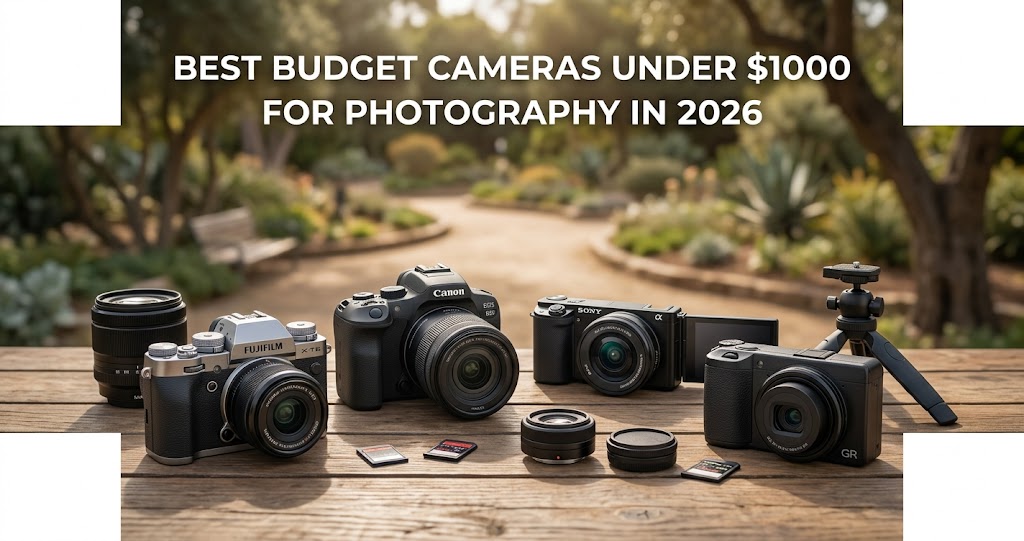
$1000 might sound like a lot of money for a camera, but it's probably the least we'd recommend spending if you want to go beyond phone photography, especially as photography equipment is steadily getting more expensive. The picks on this list will give you more control than a phone and offer a more satisfying photographic experience. At this price point, your options will be entry-level interchangeable lens cameras or larger-sensor compact cameras with built-in lenses.
Quick Picks: Best Cameras Under $1000 in 2026
Canon EOS R10
The Canon EOS R10 is a 24MP APS-C mirrorless camera that shines as an excellent choice for both stills and video shooting under $1000. Its standout features and balanced performance make it a top contender for enthusiasts and beginners alike. There are a few things that earn it the top spot on this list. The first is its stand-out usability, with dual top-plate dials for controlling exposure settings and a joystick to control its very capable autofocus system.
The R10 has a powerful AF tracking system with subject recognition that makes it especially good at focusing on people, animals and vehicles. We found it both easy to use and effective. 15fps shooting with the mechanical shutter is good, though the buffer is limited. It also has a decent selection of lenses; third parties like Sigma and Tamron have stepped in to round out the selection of primes and higher-end zoom lenses available for it, so you have several good options for moving beyond the kit lens that came with it, something that isn't necessarily true with Nikon's system.
Ideal for: Beginners and enthusiasts who want a camera that balances stills and video performance with room to grow. The R10 is approachable, capable, and now has a solid lens ecosystem thanks to third-party support.
Nikon Z50II
The Nikon Z50II is an entry-level APS-C mirrorless camera, built around a 21MP CMOS sensor. It features Nikon's '3D tracking' autofocus system, and can recognize nine subject types. The Z50II makes a case for being the best pick for beginners, thanks to a simple and mostly reliable AF system with automatic subject detection.
It has a solid grip, twin top-plate control dials, and a wide variety of customizable buttons, including one that, by default, controls color mode. Focusing is handled using the touchscreen or four-way controller. The Z50II can shoot Log or HLG video and has a waveform monitor to help set correct exposure. A headphone socket helps maintain audio quality but the lack of in-body stabilization counts against its use for video.
Ideal for: Beginners who want Nikon's excellent color science and 3D Tracking AF in an affordable body. The Z50II is a solid hybrid camera with several features from Nikon's higher-end models.
Sony a6100
The Sony a6100 is an entry-level APS-C mirrorless camera. It has a compact body and a 24MP sensor. It was a very capable and affordable camera when it was launched several years ago, offering some of the best autofocus around and a wide selection of lenses. The latter part is still an advantage, but many competitors' autofocus systems are now on par with the a6100's. However, it's still worth considering if you want to get both a camera body and a decent prime lens for under $1,000.
Sony's autofocus system has been trained to recognize people and pets as subjects, and will follow them flawlessly throughout the frame. Coupled with the ability to touch the screen to place a focus point, it's a system that will serve beginner users very well, whatever they're shooting. The a6100 makes it easy to record 4K footage or slow-motion 1080 video. There's a socket to connect an external mic but no way to connect headphones for monitoring.
Ideal for: Budget-conscious beginners who prioritize autofocus performance and want access to Sony's vast E-mount lens ecosystem. With a few settings changes, it can help you get excellent shots, easily.
Fujifilm X-T30 III
The Fujifilm X-T30 III is an APS-C camera equipped with a 26.1 MP APS-C X-Trans CMOS 4 sensor, X-Processor 5, and Advanced AI-powered subject detection AF, which can track people, animals, vehicles, birds, insects, and more. You can also record 6.2K/30p internal 10-bit video and 4K/60p video, along with 30fps of burst shoot. Other features include a Film Simulation dial with 20 looks.
While its autofocus isn't quite as easy to use as Canon's, it has a flexible Auto mode that still gives you a fair level of control to let you grow into the camera, and a kit lens whose wide-angle focal range will be familiar to phone photographers. Fujifilm's "Film Simulation" JPEG color mode help it deliver really attractive out-of-camera images, and the retro design language has proven popular, too.
Ideal for: Beginners who want beautiful out-of-camera colors and a camera that inspires you to pick it up and shoot. The Film Simulations are a game-changer for those who don't want to spend hours editing.
Canon PowerShot G7 X III
The Canon PowerShot G7X III is the last in what used to be a popular style: the pocketable enthusiast photographers' compact, with a relatively large Type 1 20MP sensor and bright zoom lens. Canon has added features to make it more vlogging-friendly, but the clicking control wheel gives a satisfying, hands-on shooting experience.
The PowerShot G7X III can deliver excellent image quality, backed up by good (though not great) autofocus. It features a 20MP Type 1 Stacked CMOS sensor, 24-100mm equiv. F1.8-2.8 lens, and 4K/30p video capture with live streaming to YouTube.
Ideal for: Travelers and vloggers who want a pocketable camera with a bright zoom lens and don't need interchangeable lenses. A note on availability: the PowerShot G7X III has been difficult to get, but Canon has recently reiterated that it's working on ramping up production.
Sony ZV-E10
The Sony ZV-E10 is purpose-built for content creators. The standout feature is the Product Showcase Setting that automatically shifts focus from your face to products you hold up – brilliant for review channels. Background Defocus gives you that blurry bokeh look with one button press, perfect for creating professional-looking shots without manual lens knowledge.
The 4K video is oversampled from 6K with full pixel readout, resulting in sharp footage with minimal rolling shutter. Live streaming is plug-and-play over USB-C – no capture card needed. The flip-out screen makes self-framing easy, and the directional 3-capsule microphone captures decent audio right out of the box.
Ideal for: Vloggers, product reviewers, streamers, and anyone prioritizing video over stills photography on a budget. The ZV-E10 is the best camera for vloggers under $1000.
What to Look For in a Camera Under $1000
1. Interchangeable Lenses vs. Fixed Lens Compacts
At this price point, your options will be entry-level interchangeable lens cameras or larger-sensor compact cameras with built-in lenses. Compacts offer more control than a phone and a greater zoom range, but likely won't offer a huge jump in image quality compared to the latest flagship phones (despite their typically larger sensors).
Meanwhile, an interchangeable lens camera won't be as easy to carry around and comes with the added expense of lenses. However, they can make you feel even more involved in the photographic process, and the flexibility of swappable lenses will let you learn and grow into different types of photography as you develop your passion. They also feature much larger sensors than phones and the majority of compacts.
2. Lens Ecosystem Matters
It's worth noting that camera makers sometimes assume that beginners will stick with the basic 'kit' zoom that comes with the camera, so it's worth checking whether a good selection of lenses is available (at a price you're willing to spend) before deciding which brand's system to buy into. Sony's E-mount has the widest selection, including affordable third-party options from Sigma and Tamron. Canon's RF mount is growing, with third parties now making RF-S lenses. Nikon's Z-mount is excellent but DX lens selection remains limited.
3. Autofocus: The Beginner's Best Friend
Good autofocus is arguably the most important feature for a new photographer. Modern cameras like the Canon R10 and Nikon Z50II have AF systems that recognize people, animals, and vehicles, and track them automatically. This means you can focus on composition while the camera handles focus—a huge confidence boost.
4. Video Capabilities
If you plan to vlog or create video, look for: fully articulated screen (ZV-E10, R10), microphone jack, and good autofocus. 4K is standard now, but check if there's a crop (Z50II crops at 4K60, R10 crops at 4K60).
Quick Comparison: Best Under $1000 Cameras 2026
Canon R10
Nikon Z50II
Sony a6100
Fujifilm X-T30 III
Sony ZV-E10
Canon G7X III
The Budget Camera Reality in 2026
One thing to note is that we used to keep a dedicated entry for the best full-frame camera you could buy under $1,000. However, times have changed and the market has shifted, and there just aren't really full-frame cameras you can buy new at that price point any more. If budget is a concern, and you absolutely need full-frame, you might want to check out the best second-hand full-frame camera bargains, where you won't get the latest features, but you will get much friendlier prices.
But honestly, the APS-C cameras on this list are so good that most photographers won't miss full-frame. They're smaller, lighter, and the lenses are more affordable—perfect for anyone starting their photography journey or looking for a capable travel companion.
Final Thoughts
The best camera under $1000 in 2026 is the Canon EOS R10 for most people. It strikes the perfect balance of performance, ease of use, and value, with dual control dials, a joystick, and excellent autofocus that make it a joy to use. If you're on a tighter budget, the Sony a6100 offers incredible autofocus and access to Sony's vast lens ecosystem for under $600. For vloggers, the Sony ZV-E10 is purpose-built and hard to beat. And if you want gorgeous JPEGs straight out of camera, the Fujifilm X-T30 III with its Film Simulations is worth every penny.
Whichever you choose, remember that the camera is just a tool. Your eye, your curiosity, and your willingness to learn are what will ultimately create great images. Happy shooting!