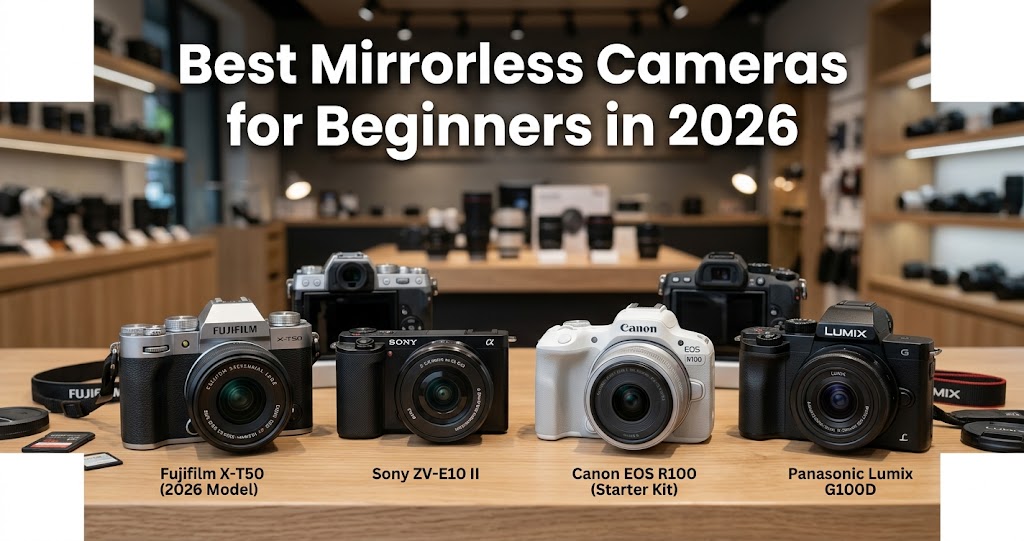
If you're just getting started with photography in 2026, you're living in a golden era for beginner cameras. Today's entry-level mirrorless models offer autofocus systems borrowed from professional flagships, 4K video, and image quality that rivals pro gear from just a few years ago. The challenge isn't finding a good camera—it's choosing among so many excellent options. I've tested and researched dozens of models to bring you this definitive guide to the best mirrorless cameras for beginners in 2026 .
Quick Picks: Best Beginner Mirrorless Cameras 2026
Canon EOS R50
The Canon EOS R50 is, in my view, the best camera for most beginners in 2026. It's not Canon's cheapest mirrorless—that's the EOS R100—but it's the cheapest worth buying . It benefits from Canon's advanced Dual Pixel CMOS AF II system, which accurately and quickly acquires subjects anywhere in the frame with automatic recognition of humans, animals and vehicles .
The 24.2MP APS-C sensor delivers excellent JPEG image quality straight out of camera, with well-judged automatic metering and white balance. Continuous shooting up to 12fps is genuinely impressive—not long ago, that would have been considered professional-grade . For content creators, the fully articulating touchscreen makes selfie shooting and vlogging easy, and 4K 30p video with 6K oversampling ensures crisp footage .
Ideal for: Beginners who want a camera that's easy to use but delivers exceptional results from day one. The R50 grows with you as your skills develop .
Nikon Z50II
The Nikon Z50II makes smart tweaks to the original, improving ergonomics, autofocus, and tracking speed for an excellent entry-level mirrorless camera . It features a 20MP APS-C sensor paired with Nikon's latest Expeed 7 processor, bringing 3D Tracking and subject-detection autofocus down from the flagship Z9 .
The camera recognizes nine different subject types and offers a pre-capture mode (though JPEG-only). With 11fps burst shooting, it's fast enough for action, and the fully articulated touchscreen makes it vlog-friendly . For beginners, the Intelligent Auto Mode takes care of exposure settings so you can focus on composition without being overwhelmed .
Ideal for: Beginners who want Nikon's excellent color science and 3D Tracking AF in an affordable, compact body .
Fujifilm X-T30 III
The Fujifilm X-T30 III is one of the most charming starter cameras on the market. It features a 26.1MP X-Trans APS-C sensor and Fujifilm's legendary Film Simulation modes—built-in color profiles that emulate classic film stocks like Provia, Velvia, and Acros black-and-white . This means you can get gorgeous, share-ready JPEGs straight out of camera without editing.
The retro design with physical dials offers a tactile way to learn exposure—it's not just about looks; having more physical controls can be much more intuitive than endless menu scrolling . The X-T30 III also benefits from the latest autofocus advancements, including automatic subject recognition, and the X-mount lens lineup is absolutely superb .
Ideal for: Beginners who want beautiful out-of-camera colors and a camera that inspires you to pick it up and shoot .
Sony ZV-E10
The Sony ZV-E10 is designed specifically for content creators. While it can be used for stills photography, its true strength is video and vlogging, with features that remove common pain points . It automatically tracks faces and eyes using Sony's excellent Real-Time AF, and includes a "Product Showcase" mode that smoothly shifts focus from your face to an object you hold up—ideal for unboxings and reviews .
The fully articulated screen makes self-shooting easy, and the built-in directional three-capsule mic captures clean audio. It uses Sony's E-mount, giving you access to a huge range of affordable lenses from Sony, Sigma, and Tamron .
Ideal for: Aspiring YouTubers, vloggers, and content creators who want a camera that makes video easy .
Olympus OM-D E-M10 Mark IV
It's an older camera now, but the Olympus OM-D E-M10 Mark IV still offers exceptional value for beginners, particularly travelers . Based around a 20MP Four Thirds sensor, it delivers excellent JPEG image quality with attractive colors. The standout feature is in-body image stabilization (IBIS)—rare at this price—which keeps pictures sharp even in low light .
The Micro Four Thirds system means lenses are smaller and more affordable than other systems, and with over a decade of lenses available, you have huge choice. The flip-down screen is great for selfies, and the camera is a joy to use .
Ideal for: Travelers and anyone who wants a compact, stabilized system that won't weigh you down .
Canon EOS R100
If your budget is tight, the Canon EOS R100 is the most affordable way into Canon's RF mirrorless system . It's designed for those new to photography, with a 24.1MP APS-C sensor and Creative Assist modes that enhance photos without requiring technical knowledge .
You miss out on some features—no articulating screen, lower max ISO of 25600—but image quality is solid, and you can use the full range of RF lenses (via adapter if needed). For absolute beginners on a strict budget, it's a capable starting point .
Ideal for: Beginners on a strict budget who want a new camera with room to grow .
What to Look For in a Beginner Camera
1. Autofocus: The Beginner's Best Friend
Good autofocus is arguably the most important feature for a new photographer. Modern cameras like the Canon R50 and Nikon Z50II have AF systems that recognize people, animals, and vehicles, and track them automatically . This means you can focus on composition while the camera handles focus—a huge confidence boost.
2. Image Quality: Megapixels Aren't Everything
All the cameras on this list produce excellent images. A 24MP sensor (like Canon R50, Sony ZV-E10) offers plenty of detail and cropping flexibility. Fujifilm's 26MP X-Trans sensor delivers unique character, especially with Film Simulations . Olympus's 20MP sensor trades some high-ISO performance for portability and stabilization .
3. Ease of Use: Intuitive Menus and Controls
Look for cameras with beginner-friendly features: Canon's Creative Assist, Nikon's Guide Mode (on older models), or Fujifilm's dedicated dials that teach exposure . A responsive touchscreen that works like your phone is a huge plus .
4. Lens Ecosystem: Room to Grow
Your first camera is just the start. You'll want to buy lenses as you progress. Sony's E-mount has the widest selection, including affordable third-party options . Canon RF is growing, with Sigma and Tamron now making RF-S lenses . Fujifilm X-mount has excellent native glass . Nikon Z-mount is excellent but DX lens selection remains limited .
5. Video Capabilities
If you plan to vlog or create video, look for: fully articulated screen (ZV-E10, R50, Z50II), microphone jack, and good autofocus. 4K is standard now, but check if there's a crop (Z50II crops at 4K60) .
Quick Comparison: Best Beginner Cameras 2026
Canon R50
Nikon Z50II
Fujifilm X-T30 III
Sony ZV-E10
Olympus E-M10 IV
Canon R100
How to Choose Your First Mirrorless Camera
Start with your budget. Cameras like the Canon R100 ($459) and Olympus E-M10 IV ($730) are excellent entry points. If you can stretch to $800–$1000, the Canon R50 and Nikon Z50II offer significantly better autofocus and features .
Consider the system. Sony offers the most affordable lenses long-term thanks to Sigma and Tamron. Canon and Nikon have excellent but pricier native glass. Fujifilm's lenses are superb but also premium .
Think about video needs. If vlogging is your goal, Sony ZV-E10 is purpose-built. If you want a hybrid that does everything well, Canon R50 or Nikon Z50II are better balanced .
Don't forget ergonomics. The best camera is the one you'll actually carry. Fujifilm's retro styling inspires some to shoot more. Olympus's tiny size disappears into a bag. Sony's ZV-E10 is lightweight but lacks a viewfinder .
Final Thoughts
The best beginner mirrorless camera in 2026 is the one that fits your specific needs and budget. For most people, the Canon EOS R50 strikes the perfect balance of performance, ease of use, and value . If you prioritize gorgeous out-of-camera JPEGs, the Fujifilm X-T30 III is worth the premium . For vloggers, the Sony ZV-E10 removes technical barriers . And if you're on a tight budget, the Canon R100 gets you into a quality system .
Whichever you choose, remember that the camera is just a tool. Your eye, your curiosity, and your willingness to learn are what will ultimately create great images. Happy shooting!