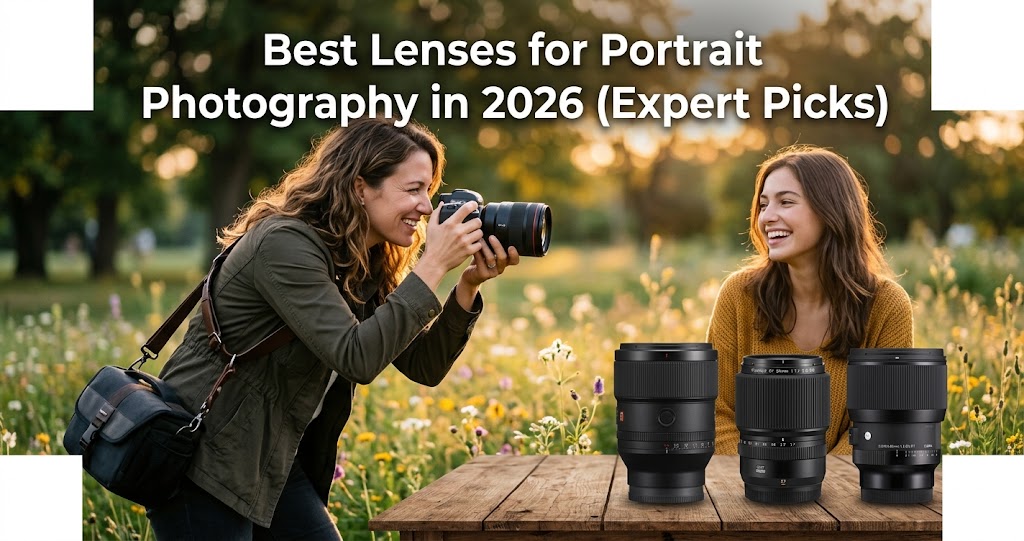
Two photos of the same person, taken seconds apart, can look like completely different people. The secret lies in selecting the best focal length for portraits . Focal length does not just zoom in or out—it changes the perspective, the spatial relationship between subject and background, and most importantly, how facial features are rendered .
In 2026, photographers are spoiled for choice. Whether you're shooting environmental portraits with context, classic headshots with creamy bokeh, or high-end fashion with dramatic compression, there's a perfect lens waiting for you. I've spent years testing portrait lenses across Canon, Nikon, Sony, Sigma, and Fujifilm systems. Here's my comprehensive guide to the best portrait lenses you can buy in 2026 .
Understanding Focal Length for Portraits
How Focal Length Changes the Face
24–35mm
Environmental portraits with context, but facial distortion if too close
50mm
Natural look, similar to human field of view, ideal for casual portraits
85mm
Classic professional choice—flattering, balanced, and comfortable working distance
105–135mm
Beauty and headshots—very flattering compression, refined look
200mm
Editorial/fashion—dramatic background compression, requires space
For most photographers, the best portrait focal length sits between 85mm and 135mm . Facial proportions become closest to human eye perception at a comfortable viewing distance, and background separation is stronger even at moderate apertures .
🏆 Top Portrait Lenses of 2026 by Focal Length
35mm f/1.4 – The Storyteller
A 35mm lens is often overlooked for portraits, but it's a powerful storytelling tool . This focal length lets you include more of the environment while still keeping your subject front and center. It's handy for lifestyle portraits, couples and family sessions, editorial-style work, and shooting in tight indoor spaces .
Because 35mm lenses require you to work closer to your subject, they can feel more intimate—but that also means being mindful of distortion. Used intentionally, a 35mm creates portraits that feel candid, immersive, and grounded in place .
Ideal for: Photographers who want portraits with atmosphere, context, and a sense of story or narrative .
50mm f/1.8 – The Workhorse
The 50mm earns its reputation for a reason. It delivers a natural-looking perspective that closely matches how we see the world, making it one of the most versatile portrait lenses available . Often called the "nifty fifty," this lens is compact, affordable, and capable of producing beautifully sharp images with smooth background blur—making it a go-to choice for photographers at any stage .
This focal length works well for casual portraits, half-body and full-body shots, natural light photography, and smaller studios or home setups . Many photographers build entire portrait portfolios around this lens—and never feel limited .
Ideal for: Photographers who want one lens that can handle almost anything . The 50mm f/1.8 is the best value in photography .
85mm f/1.4 – The Classic
If there's a focal length most closely associated with portrait photography, it's 85mm . This lens is known for flattering compression, comfortable working distance (around 1.2–1.5 meters for a head-and-shoulders frame), and subject separation that feels intentional without being overpowering . The subject looks natural, and the surroundings fade into a smooth blur .
An 85mm is ideal for headshots, tight portraits, studio work, and controlled outdoor sessions . Because you're shooting from slightly farther back, subjects often feel more at ease—which can make a big difference, especially during longer sessions .
Ideal for: Photographers focused on traditional portraits, headshots, and refined imagery . The 85mm is the most dependable portrait lens .
105–135mm f/1.8 – The Beauty Specialist
Longer portrait lenses like 105mm and 135mm offer even more compression, creating a distinctive look that emphasizes facial symmetry and background separation . Around 135mm, portraits begin to look cleaner and more refined. The face appears more relaxed, cheekbones show naturally, and the skin already looks smoother, even before any editing . That is why fashion photographers and model portfolios often rely on this focal length .
These focal lengths are great for outdoor portraits, fashion and editorial work, and situations where you want extra subject isolation . However, they require more space to work comfortably. Indoors, they can feel restrictive—but outdoors, they really shine .
Ideal for: Photographers who want maximum control over perspective and background .
70-200mm f/2.8 – The Flexible Performer
Prime lenses get a lot of attention in portrait photography, but zooms deserve a place in the conversation—especially if you value adaptability . Popular portrait zoom ranges include 24–70mm and 70–200mm . Zoom lenses allow you to adjust framing and perspective quickly, which is invaluable during live sessions, events, or fast-paced shoots . While they may not always match the widest apertures of primes, modern zooms offer impressive sharpness and consistency .
A 70-200mm f/2.8 effectively covers the classic portrait focal lengths (85mm, 105mm, 135mm) in one lens, giving you tremendous flexibility .
Ideal for: Photographers who shoot varied portrait styles or need flexibility on the fly .
System-Specific Recommendations
Sony E-Mount
Sony's E-mount system has the widest selection of native and third-party portrait lenses .
- Sony FE 85mm f/1.4 GM: "A premium portrait lens known for stunning sharpness, creamy bokeh, and exceptional subject isolation" .
- Sony FE 50mm F1.2 GM: For those who demand the absolute fastest aperture and dreamy bokeh.
- Sigma 85mm F1.4 DG DN | Art: Widely recognized as a professional standard for portrait work .
- Sigma 105mm f/1.4 DG HSM Art: "A standout lens for dramatic compression and ultra-shallow depth of field" .
- Tamron 70-180mm f/2.8 Di III VC VXD G2: Lighter and more compact than the Sony 70-200mm, with excellent sharpness.
Best budget entry: Sony FE 85mm F1.8 – excellent value for money .
Canon RF & EF
- Canon EF 85mm f/1.2L II USM ("The Eye of God"): "Hands down a must-have for bokeh lovers. Known for its stunning f/1.2 full-frame sensor-like bokeh effect, 0.11x magnification, and solid 1,025g weight" .
- Canon RF 70-200mm f/2.8 L IS USM: "RF mount era new benchmark, dual NANO USM motor for fast silent tracking, 5-stop coordinated anti-shake, 0.7m closest focus distance, splash and dust proof design" .
- Canon EF 70-200mm f/2.8L IS II USM: "Classic evolutionary version, 5 UD lenses and 1 fluorite lens for pure image quality under high contrast, IS II anti-shake provides about 4 stops compensation, robust splash and dust proof structure" .
- Canon 50mm f/1.8 STM: "Often called the 'nifty fifty,' compact, affordable, and capable of producing beautifully sharp images with smooth background blur" .
Best budget entry: Canon RF 50mm f/1.8 STM – the modern nifty fifty .
Nikon F & Z
- Nikon AF-S NIKKOR 35mm f/1.8G ED: "A lightweight, sharp prime that's ideal for environmental portraits and everyday shooting" .
- Tamron SP 70–200mm f/2.8 Di VC USD G2 (Nikon FX): "Ideal for portraits that need reach and compression, this zoom excels outdoors and in studio settings" .
- Nikon Z 135mm f/1.8 S Plena: The ultimate Z-mount portrait lens, with incredible sharpness and bokeh.
- Nikon Z 85mm f/1.2 S: Nikon's premium portrait prime for the Z system.
Best budget entry: Nikon Z 50mm f/1.8 S – optically superb, affordable .
Fujifilm X-Mount (APS-C)
Note: Fujifilm lenses require multiplying by 1.5x for full-frame equivalent focal length .
- Fujifilm XF 35mm f/1.4 R: "It is a very small and compact model. Great lens speed allows shooting almost in any lighting conditions without setting ISO more than 3200. 35 mm is ideal focal length for Fujifilm camera" .
- Fujifilm XF 56mm f/1.2 R: "One of the most unusual lenses in the entire Fujinon XF lineup. The model has the highest lens speed. It does not feature all-weather protection and optical stabilization. However, the lens has the highest image quality throughout the frame from the very edge to the centre" . (Equivalent to 85mm full-frame)
- Fujifilm XF 90mm f/2 R LM WR: "Many photographers waited for Fujifilm 90mm f/2 more than other X line models. Among the main features are high build quality, all-weather protection, a very beautiful bokeh, fast and silent focusing" .
- Fujifilm XF 50mm f/2 R WR: "The lens is a high-quality, stylish model. It provides excellent sharpness starting from an open aperture. This Fuji lens is great for portrait shooting. 75mm focal length will allow you to capture the proportions of the model's face and body without perspective distortion" .
Best budget entry: Fujifilm XF 35mm f/2 R WR – compact, weather-resistant, and affordable .
Prime vs Zoom for Portraits
The debate between prime lens and zoom lens options continues in professional portrait work . While primes emphasize optical simplicity and wide apertures, zooms prioritize framing flexibility .
Some professionals carry both to maximize versatility. The choice ultimately depends on workflow, subject distance, and creative goals .
Key Features of a Professional Portrait Lens
Fast Aperture (f/1.4 – f/1.2)
Fast apertures allow better control over depth and light. Many professionals prefer a prime lens with f/1.4 or wider for its superior background separation . Wider apertures also enable lower ISO usage in dim conditions, resulting in cleaner images . Additionally, shallow depth of field enhances subject focus while creating dramatic visual impact .
Sharpness & Detail Rendering
Sharpness defines professional quality. Modern portrait lenses are engineered to deliver high center sharpness while maintaining smooth edge transitions . Quality glass elements reduce chromatic aberration and maintain clarity even at wide apertures .
Autofocus Accuracy
Accurate autofocus ensures sharp eyes and crisp facial details. In portrait photography, eye focus is critical . Modern systems use advanced motor technology for fast and silent operation. Eye-detection autofocus combined with responsive motors increases keeper rates .
Build Quality & Reliability
Professional portrait sessions often involve outdoor conditions and extended shooting hours. Weather sealing, durable materials, and stable internal mechanisms ensure long-term reliability . High-quality lenses maintain performance even after intensive use .
Focal Length Cheat Sheet for Portrait Shooters
- 24–35mm: Environmental portraits, lifestyle, family sessions – includes context, tells a story .
- 50mm: Natural perspective, casual portraits, half-body, full-body, small studios .
- 85mm: Classic headshots, studio work, traditional portraits – flattering compression .
- 105–135mm: Beauty, fashion, editorial – maximum compression and subject isolation .
- 70-200mm zoom: Versatility for events, weddings, outdoor sessions – covers all portrait focal lengths .
Building Your Portrait Kit
Most photographers don't start with a full lineup of portrait lenses—and they don't need to . Many begin with one reliable focal length and expand as their style, subjects, and shooting environments change .
A strong portrait kit often looks like :
- One versatile everyday lens (50mm)
- One dedicated portrait lens (85mm or 135mm)
- Optional flexibility from a zoom (70-200mm)
There's no universal "right" setup. The best portrait lenses are those that enable you to work comfortably, connect with your subject, and achieve the desired look .
Final Thoughts: Choosing Your Portrait Lens
Selecting among portrait lenses depends on shooting style, subject distance, and creative vision . Some photographers prioritize shallow depth and controlled environments. Others need flexibility during fast-paced assignments .
Before purchasing, evaluate lighting conditions, working distance, and client expectations . While primes emphasize aesthetic control, zooms provide adaptability . Balancing focal length, aperture, and workflow ensures long-term satisfaction. Rather than following trends, align lens choice with professional goals and project demands .
Quick Recommendation Guide
- If you shoot environmental/lifestyle: Start with a 35mm f/1.4
- If you want one lens for everything: Start with a 50mm f/1.8 (best value)
- If you focus on classic portraits/headshots: Start with an 85mm f/1.4
- If you shoot beauty/fashion: Consider a 105mm or 135mm f/1.4
- If you shoot events/weddings: A 70-200mm f/2.8 zoom is essential
- If you're on a tight budget: 50mm f/1.8 – the "nifty fifty" delivers stunning results for minimal cost
The best portrait lens for you is the one that lets you work comfortably, connect with your subject, and achieve your creative vision. As photographer Chase Jarvis famously said: "The best camera is the one you have with you" – and the same applies to lenses. The lens you'll actually bring to the shoot is infinitely more valuable than the one left at home . Happy shooting!