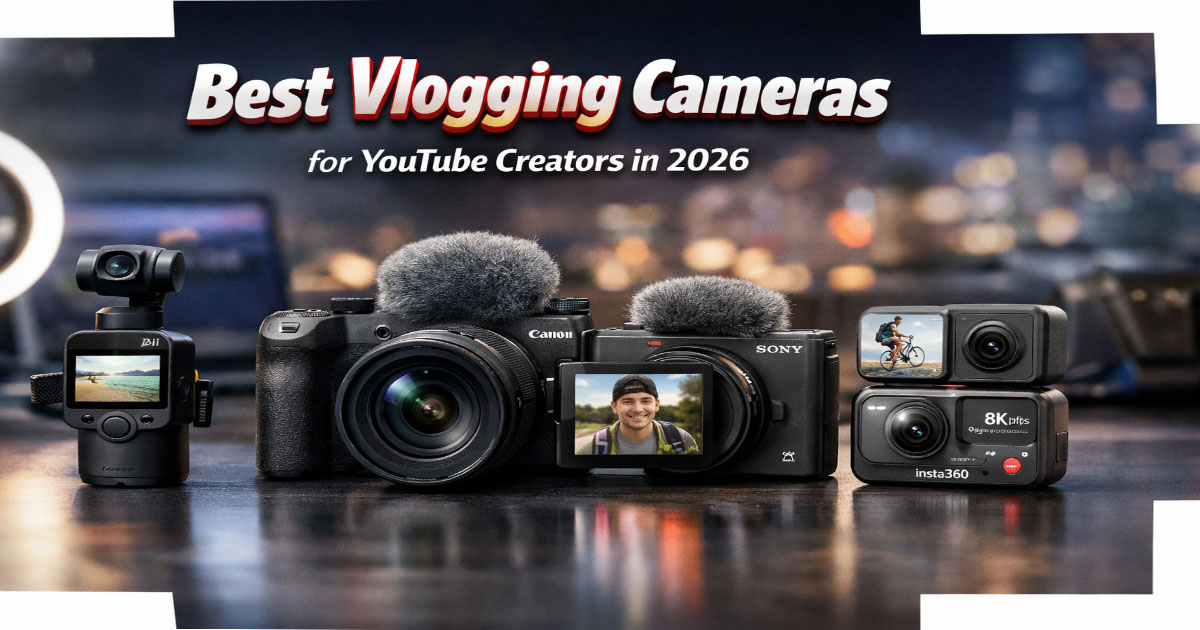
If 2026 is the year you plan to finally get your YouTube channel off the ground, one of the best vlogging cameras will help you make it happen. Providing a demonstrable upgrade in video quality and shooting versatility compared to a smartphone, a good vlogging camera will kit you out with everything you need to create video content that looks and sounds professional .
With vlogging on platforms like YouTube and TikTok more popular than ever, the vlogging camera market is a busy place. Pretty much every camera release from a major manufacturer will come bearing claims of how brilliantly suited it is for video, and some of those claims are truer than others . I've pulled together this list to include only vlogging cameras that are genuinely worth your consideration—everything here has been thoroughly tested and reviewed, and scored highly enough to merit inclusion. I've also made sure not to just fill this list with expensive professional options. Many vloggers are working to tight budgets, so this guide includes plenty of cheap and beginner-friendly options, as well as the high-end stuff for those with more cash to splash .
Quick Picks: Best Vlogging Cameras 2026
DJI Osmo Pocket 3
The DJI Osmo Pocket 3 is arguably the most popular camera among YouTubers right now . The formula is a small, 4K-capable camera with a fixed 20mm equivalent lens, giving a natural field of view ideal for vlogging and talking head-type videos. Supported by a motorised 3-axis gimbal for super-smooth stable shooting, the Osmo Pocket 3 delivers smooth footage and cinematic looking shots even when walking or moving . For run-and-gun filmmakers and vloggers, this is a much more cost-effective option than buying a standalone camera and a handheld gimbal .
The larger 1-inch sensor is great for video quality, particularly in low-light shooting situations (the Osmo Pocket 3 has a dedicated Low Light Video mode). The much larger and clearer LCD screen rotates towards you, making it ideal for vlogging . Shooting in vertical mode is a very smooth process, reflecting that more and more people consume content this way. It offers 3-axis motorised stabilisation that physically counteracts motion—no algorithm guessing how to stabilize .
Ideal for: Beginner YouTubers finding their feet, travel vloggers, and anyone who wants buttery-smooth footage without post-stabilization .
Canon PowerShot V1
The Canon PowerShot V1 is the new vlogging compact to beat—an impressively fully featured camera for vlogging that will suit the dedicated content creator . With a 16-50mm equivalent f/2.8-4.5 zoom lens, it offers the ideal level of shooting versatility for day-to-day vlogging, and its new 1.4-inch sensor is a cut above the 1-inch sensors found in comparable premium compacts .
The PowerShot V1 is stacked with video-friendly features including a built-in ND filter (activate it when you want to use a larger aperture without overexposing), a built-in three-capsule mic with windshield, headphone and mic sockets, and Canon's flat C-Log3 profile for colour grading . The screen flips around to face the front, and a tally lamp on the front lets you know when you're recording. The advanced cooling system means recording times are essentially unlimited .
Ideal for: Dedicated content creators who want a fully-featured compact with zoom flexibility and professional video tools .
Sony ZV-E10 II
The Sony ZV-E10 II is designed for creators who want flexible storytelling and simple operation in one compact body . Built for everyday vlogging and serious YouTube production, this best video camera for YouTube videos combines intuitive controls, strong autofocus reliability, and fast sharing tools . It's essentially an A6700 in a lighter, more affordable body with vlogging-specific features .
Key upgrades include a 26MP APS-C sensor (same as the A6700), 4K 60fps recording with 10-bit 4:2:2, S-Cinetone and S-Log3 profiles, and a larger NP-FZ100 battery that lasts around 130 minutes of video . The autofocus features 759-point phase-detection with reliable subject tracking for humans and animals . The directional 3-capsule mic and vertical interface for social media make it creator-ready .
Ideal for: Vloggers who want lens flexibility, excellent video quality, and Sony's reliable autofocus in a lightweight body .
Fujifilm X-S20
While we're focusing on video-centric vlogging cameras, content creators may well get more use out of a camera that shoots both stills and video to a high standard. Video thumbnails, promo shots, behind the scenes imagery—there are loads of reasons a vlogger might want a decent stills camera . The Fujifilm X-S20 is one of the best hybrid cameras for video AND photos.
A handy EVF and excellent stills potential, alongside superb 6.2K open-gate video, makes the Fujifilm X-S20 a top choice . It features a 26.1MP X-Trans BSI sensor, advanced AI subject-detection AF, and impressive battery life. The fully articulated touchscreen and 6.2K/30P, 4K/60p video capabilities make it highly versatile for creators .
Ideal for: Creators who need one camera for both YouTube videos and professional photography .
Panasonic Lumix GH7
The Panasonic Lumix GH7 is built for creators who want a reliable "work camera" for demanding YouTube production. It supports pro-level codecs, high-quality audio workflows, and long recording sessions without shutdowns . This makes it a strong choice for interviews, events, and run-and-gun filming where consistency matters .
Key features include a built-in fan enabling long takes without overheating, internal Apple ProRes RAW recording, and 32-bit float audio to avoid clipped dialogue peaks . The 5.7K video at 30fps and 4K at 120fps provide tremendous flexibility, while 7.5-stop IBIS keeps handheld footage smooth .
Ideal for: Serious video creators, interview shooters, and anyone needing professional audio and recording features .
GoPro Hero 13 Black
The GoPro Hero 13 Black remains the king of action cameras for a reason. Its interchangeable lens system allows you to attach ultra-wide, anamorphic, or macro lenses, expanding creative possibilities beyond any previous GoPro . For vloggers documenting surfing, skiing, mountain biking, or travel adventures, it's the ultimate tool.
HyperSmooth 6.0 stabilization is as good as ever—footage looks like it was shot on a gimbal, even in rough conditions. The 27MP sensor produces up to 5.3K video at 60fps, and the rugged build is waterproof without a housing . Improved HDR makes a big difference when editing, and the new Enduro battery extends recording time .
Ideal for: Adventure vloggers, action sports creators, and anyone filming in extreme conditions .
DJI Osmo 360
DJI Osmo 360 is built for creators who want immersive shots without worrying about framing. This vlogging YouTube camera captures everything around you, then lets you choose the best angle later . For vloggers and YouTube channel owners, it's a powerful way to film travel, sports, and daily life with fewer retakes and faster storytelling .
Key features include the ability to reframe any angle later (fix missed shots), an invisible selfie stick effect that creates third-person videos, and the ability to switch front/rear lenses without stopping recording. It's IP68 waterproof and connects directly to two DJI mic transmitters .
Ideal for: Travel vloggers, group shots, and creators who want to capture everything without worrying about framing .
Nikon Z6 III
The Nikon Z6 III is a fast, creator-friendly hybrid camera for YouTubers who want strong video performance and dependable autofocus. This is the best camera for YouTube vlogging and is built for real shooting conditions like weddings, documentaries, and low-light environments . With advanced stabilization and modern cloud tools, it supports smoother filming and faster publishing workflows .
Features include built-in 5-axis IBIS (8 stops), subject detection tracking nine subject types automatically, internal N-RAW recording, and USB power delivery for long streaming sessions .
Ideal for: Professional YouTubers, documentary filmmakers, and hybrid shooters needing full-frame quality .
Smartphone vs Dedicated Vlogging Camera: Is It Worth It?
Modern smartphones like the iPhone 16 Pro are astonishingly capable—they capture stunning 4K HDR video with computational photography and Dolby Vision . For casual creators, they may be "good enough." But "good enough" shouldn't be the goal for creators aiming to stand out .
The DJI Osmo Pocket 3 packs a larger 1-inch sensor, significantly outperforming smartphones in low-light environments . This physical advantage translates to cleaner shadows, less noise, and greater dynamic range when lighting conditions aren't ideal. The 3-axis mechanical gimbal delivers near tripod-level stability that no amount of digital stabilization can truly match—there's no cropping into the frame, no jankiness .
The Verdict: Smartphones excel in immediacy and all-in-one convenience. Dedicated vlogging cameras win on consistency, low-light quality, stabilization, and audio control . Many creators now adopt a hybrid approach—using the phone for quick stories and behind-the-scenes, and a dedicated camera for primary narrative footage .
How to Choose Your Vlogging Camera
1. Video Resolution & Frame Rate
4K video is the standard. Many creators are even moving to 6K or 8K for better editing flexibility. If you want your videos to look sharp and future-proof, choose a camera that records at least 4K at 60fps .
2. Autofocus Performance
When filming yourself, you need fast and accurate autofocus. Eye-tracking and face detection are very important. A good YouTube camera should keep your face sharp even when you move around .
3. Audio Quality
A great video is useless without clear sound. Look for cameras with built-in directional microphones and a microphone input. Many vloggers use external mics for better audio quality .
4. Stabilization
Stabilization matters most for handheld vlogging. Digital stabilization can crop the image, while in-body stabilization usually looks more natural. If you walk while filming, good stabilization makes your videos smoother and more professional .
5. Battery Life
Recording 4K drains batteries fast. If you film long videos or travel, look for strong battery life and USB-C charging so you can use a power bank .
Comparison: Best Vlogging Cameras 2026
Key Specs at a Glance
Final Thoughts
The best vlogging camera for you depends on your style, budget, and where you create. For most YouTubers, especially beginners, the DJI Osmo Pocket 3 is the ultimate all-rounder—its gimbal stabilization and ease of use are unmatched .
If you need zoom flexibility and professional video tools, the Canon PowerShot V1 is the compact to beat . For those who want interchangeable lenses and the E-mount ecosystem, the Sony ZV-E10 II delivers excellent value . Adventure vloggers should look at the GoPro Hero 13 Black , while serious hybrid creators will love the Fujifilm X-S20 .
Remember: the best camera is the one you'll actually carry and use. Choose the tool that fits your workflow, and then go create something amazing.