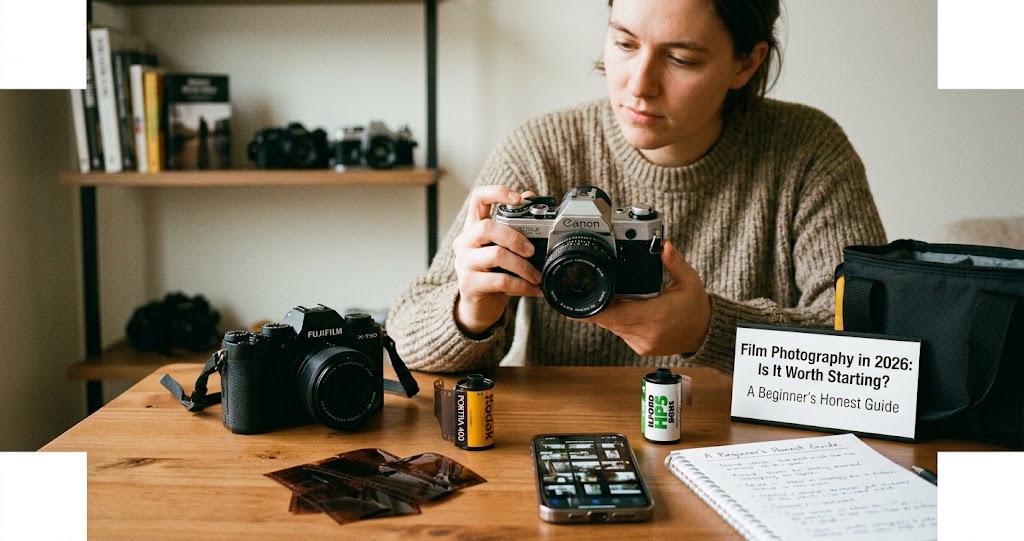
Film photography in 2026 is absolutely worth starting — if you go in with your eyes open about the costs, the slower pace, and the reasons why. The analog resurgence is not a passing trend. Since 2020, interest in film photography has more than tripled, driven largely by Gen Z photographers discovering the format for the first time . Kodak has invested millions in expanding production, new film stocks are appearing on the market, and even luxury brands like Leica continue to produce brand-new 35mm film cameras .
Why Film Is Back: The 2026 Analog Renaissance
The numbers don't lie. Since 2020, interest in film photography has more than tripled . Kodak has gone from running a single shift to 24/7 operation, quadrupling its output. The company has hired hundreds of workers and invested in major plant renovations to keep up with demand . Harman-Ilford (makers of Ilford black-and-white film) has spent millions on new manufacturing equipment .
Who's driving the revival? The strongest growth is coming from younger photographers — Gen Z and younger millennials who grew up with smartphones and are discovering analog for the first time . They're drawn to film's unique look, the deliberate process, and what one observer calls "an imperfect aesthetic" that stands in deliberate contrast to the overly perfect look of AI-generated and heavily edited digital images .
Even Hollywood has noticed. At the 2026 Oscars, films shot on actual film won Best Picture and Best Cinematography — for the second year running . VistaVision, a large-format film process from the 1950s, has been revived for major productions including Paul Thomas Anderson's "One Battle After Another" .
The Honest Cost Breakdown: What You'll Actually Spend
Let's get this out of the way first: film is not cheap. Unlike digital, where your per-shot cost after buying the camera is effectively zero, every frame of film costs money — from the roll itself to development to scanning or printing. Here's what you'll actually spend.
Camera Body (Used)
Entry-level SLR: $50–200 (Pentax K1000, Canon AE-1, Minolta X-700)
Mid-range SLR: $200–600 (Nikon FM2, Olympus OM-1)
Point & Shoot: $100–400 (Olympus XA2, Nikon L35AF)
Luxury (Leica M6): $7,000+
Per-Roll Costs
Film (36 exp): $10–22 (Kodak Gold $10, Portra $18–22)
Development: $10–18 for color, $12–20 for black and white
Scanning: $5–30 depending on resolution
Total per roll: $35–60 → $1–2 per frame
1 The Break-Even Reality
Low-volume shooter (1–2 rolls/month): Annual film cost of $600–1,200. A good used film camera adds $200–500. Total first-year cost: $800–1,700 — less than many digital camera bodies . For casual, deliberate photographers, film can be cost-competitive.
High-volume shooter (10+ rolls/month): Annual film cost of $6,000–7,000. Over three years, that's $18,000–21,000 — enough to buy a professional digital kit that will last 5–10 years. At this volume, digital becomes dramatically more economical .
The hidden cost: time. Dropping off rolls, waiting for development (1–7 days), scanning or picking up prints. Home development takes 1–3 hours per roll. This time is invisible in financial analysis but very real in practice .
Choosing Your First Film Camera in 2026
In 2026, your options fall into three categories: used vintage SLRs, modern point-and-shoots, and the handful of new film cameras still in production. The used market is where most beginners should start .
Manual vs. Automatic: If you want to learn photography fundamentals, a fully manual camera (Pentax K1000, Nikon FM2) forces you to understand aperture, shutter speed, and ISO. If you just want the film look without the learning curve, a point-and-shoot or an aperture-priority camera (Canon AE-1) is a gentler introduction .
What about new film cameras? Surprisingly, there are still new 35mm cameras in production. Leica offers the MP, M6, and M-A — all fully mechanical, all priced at $6,600–7,100 . The Rollei 35AF ($828) and Lomography Lomo MC-A ($549) offer modern features like LIDAR autofocus . But for beginners, the used market is where you'll find the best value by far.
Understanding Film Stock: ISO, Color vs B&W, and What to Buy First
When you buy film, pay attention to the ISO rating (also called film speed). The higher the number, the more sensitive the film is to light — and the more grain you'll see .
- ISO 100–200: Best for bright sunlight, landscapes, studio work. Finest grain. (Kodak Ektar 100, Fujifilm Velvia 50)
- ISO 400: The versatile all-rounder. Works in overcast conditions, indoor with flash, general photography. (Kodak Portra 400, Kodak Gold 200, Ilford HP5+ for B&W)
- ISO 800–1600: Low-light situations — concerts, night photography, indoor sports. More grain, but usable in dim conditions. (Kodak Portra 800, Ilford Delta 3200)
Black and white film is often recommended for beginners because it's more forgiving of exposure errors and forces you to focus on composition and lighting rather than color . It's also easier to develop at home if you decide to go that route.
Color negative film (C-41 process) is the standard for most casual photographers. It's forgiving of exposure errors and produces beautiful, warm tones. Kodak Portra 400 is the professional gold standard — expensive but gorgeous. Kodak Gold 200 is the affordable entry point .
How to Load, Shoot, and Develop Your First Roll
The process is different from digital, but not difficult. Here's what you need to know.
Film vs Digital: The 2026 Reality Check
The 2026 Film Market: What's Available and What's Coming
The film market in 2026 is healthier than it's been in two decades. Kodak has invested millions in expanding production, and new affordable film stocks like Kodacolor 100 and Kodacolor 200 have been introduced specifically to make film more accessible .
Popular film stocks in 2026:
- Kodak Portra 400: The professional standard for color negative. Beautiful skin tones, wide exposure latitude. $18–22/roll
- Kodak Gold 200: The affordable entry point. Classic warm colors, nostalgic look. $10–12/roll
- Kodak Ektar 100: Fine-grain, saturated color for landscapes. $15–18/roll
- Ilford HP5 Plus: The classic black-and-white film. Forgiving, beautiful grain, affordable. $8–12/roll
- Fujifilm Superia X-TRA 400: Still available (though made by other companies now). Punchy colors, good for everyday shooting. $10–15/roll
Kodak's investment is significant: The company has gone from a single shift to 24/7 operation, quadrupled its output, and carried out a major renovation of its Rochester plant in 2024 . While Kodak is a shadow of its former self (3,500 employees now vs 75,000–90,000 in film's heyday), consumer photography film still represents about a third of its chemical division's sales — roughly $100 million per year .
Supply chain challenges remain: Key chemicals for film development are now made only in China and India, creating longer lead times and occasional shortages . This is one reason film prices have increased 50–100% since 2020.
The Film Look: Why People Love Analog in a Digital World
There's a reason film is experiencing a renaissance while digital cameras get more advanced every year. The appeal isn't just nostalgia — it's a different way of seeing and creating.
Imperfection as a feature: In an era of AI-generated perfection, film's grain, color shifts, and subtle unpredictability feel refreshingly human . The distinctive grainy or unfiltered feel attracts analog fans turned off by digital photos that seem "too perfect" .
Slowing down: "You have a finite number of frames on a roll of 35mm film, usually 24 or 36. And you should make those pictures count," says AP photojournalist George Walker IV . That constraint forces you to be more deliberate about composition, lighting, and timing — skills that translate directly to better digital photography as well.
The physical object: A roll of film produces a physical negative you can hold. For many photographers, that tangible artifact is meaningful in a way that digital files aren't .
Who Should Start Film Photography in 2026?
✅ Film is for you if:
- You're a beginner who wants to learn photography fundamentals — the discipline of limited frames will make you a better photographer
- You're a digital photographer looking to slow down and reconnect with the craft
- You're drawn to the unique aesthetic of film — grain, color rendering, imperfection
- You enjoy process as much as results — loading film, advancing frames, the anticipation of development
- You're willing to spend $600–1,200 per year on a hobby (low-volume shooting)
- You want to own a beautiful mechanical object that doesn't need firmware updates
❌ Skip film and stick with digital if:
- You shoot high volume (10+ rolls per month) — digital will save you thousands per year
- You need instant feedback for work or learning — digital's instant review is a powerful teaching tool
- You're on a very tight budget — the per-shot cost of film adds up quickly
- You dislike waiting for results — film means days between shooting and seeing your images
- You shoot in rapidly changing conditions where you need to adjust settings on the fly
Final Verdict (2026)
Film photography in 2026 is absolutely worth starting — but it's a different kind of photography, not a replacement for digital. It's slower, more expensive, and less forgiving. But it's also more tactile, more intentional, and for many photographers, more rewarding .
The analog renaissance is real and durable. Kodak is investing millions in production. New film stocks are appearing. Young photographers are discovering the format for the first time . Film isn't coming back as the dominant medium — but it's carving out a sustainable niche as a deliberate creative choice.
If you're a beginner looking to learn photography, starting with film will teach you fundamentals faster than digital. Every frame costs money, so you'll learn to meter, compose, and focus before pressing the shutter. Those skills transfer directly to digital — but digital's instant feedback and unlimited frames can encourage bad habits.
At $600–1,200 per year for a low-volume shooter, film is comparable to many hobbies. If you can afford it and you're drawn to the process, don't let the naysayers discourage you. As one observer put it: "Shooting film encourages a slower, more deliberate approach" . In our era of infinite digital shots and AI-generated perfection, that slowness might be exactly what you need.
Getting Started: Your First Month With Film
- Week 1: Buy a used camera ($100–200), one roll of Kodak Gold 200 ($10–12), and have a local lab develop and scan it. Shoot the roll in one weekend. Learn from the results.
- Week 2: Buy three rolls of the same film. Practice metering intentionally. Keep a notebook of your settings for each shot.
- Week 3: Try a different film stock — Ilford HP5+ for black and white, or Kodak Portra 400 for color. Compare the results.
- Week 4: Research home developing if you're enjoying the process. The one-time equipment investment is $30–60, and chemicals cost $1–3 per roll .