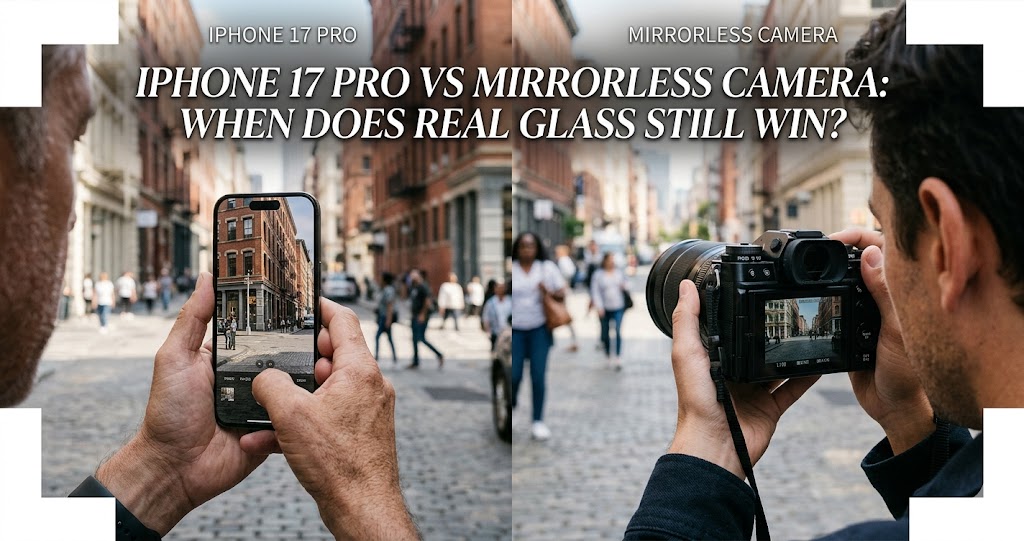
The iPhone 17 Pro has closed the gap with professional mirrorless cameras more than ever before — but "real glass" still wins in three critical areas: optical zoom beyond 8x, natural background blur (bokeh) from fast apertures, and low-light telephoto performance. In a head-to-head test with a Canon EOS R6 II, the iPhone produced warmer, more processed images that many casual users will prefer. But the mirrorless camera delivered more natural, gradable footage with authentic depth-of-field separation . A professional cinema camera test reached a similar conclusion: the iPhone is not yet ready to be the only camera on a professional set — but as a B-cam for impossible angles, it's revolutionary .
The 2026 Smartphone Camera Benchmark: iPhone 17 Pro Specs
Apple's 2026 flagship represents the company's most ambitious camera system yet. For the first time, all three rear cameras feature 48MP sensors, and the telephoto system has been completely re-engineered .
1 iPhone 17 Pro Camera Specifications (2026)
Round 1: Still Image Quality — The Processed vs Natural Divide
2 iPhone's Computational Look vs Mirrorless Authenticity
PhoneArena journalist Viktor Khristov compared the iPhone 17 Pro directly with a Canon EOS R6 Mark II in various lighting conditions . The results reveal the fundamental philosophical difference between smartphone and dedicated camera imaging.
In backlit scenes: The Canon in automatic mode produced darker shots with nearly black shadows — a technically accurate rendering of the scene's contrast. The iPhone 17 Pro, however, applied aggressive HDR processing to brighten shadows and balance the exposure . Which is "better" depends entirely on your preference. The Canon gives you more grading flexibility; the iPhone gives you a ready-to-share image.
Color temperature: The Canon consistently produced cooler, more neutral images. The iPhone produced warmer tones that many users find more pleasing for portraits and lifestyle photography .
Overall impression: The journalist concluded that photos from the Canon "come out more natural and closer to reality," while the iPhone's images are processed and enhanced. However, he acknowledged that the iPhone's portrait shots appeared "of higher quality" to his eye, and the shooting process is dramatically simplified .
Round 2: The Telephoto Trade-Off — 8x Zoom vs Missing 3x/5x Focal Lengths
3 How Apple Achieves 8x Zoom — And What You Lose
The iPhone 17 Pro's headline feature is its "8x optical-quality zoom." But understanding what this actually means is crucial. The phone has a 4x optical telephoto lens (100mm equivalent). The 8x zoom is achieved by cropping into the 48MP sensor's central area and applying computational enhancement — not by moving glass elements .
When it works brilliantly: In good light, the 8x zoom produces sharp, detailed images that rival dedicated telephoto lenses. The 48MP sensor provides enough resolution for usable crops, and Apple's Photonic Engine intelligently reconstructs detail .
Where it struggles: In low light, the effective sensor area for 8x zoom is dramatically reduced, leading to visible noise and softness. Multiple reviewers note that the telephoto "very much eats light" .
The missing focal lengths problem: The iPhone 17 Pro removed the 3x and 5x optical zoom options from previous models. This creates a frustrating gap for portrait photographers: 2x is too close (distortion), and 4x is often too tight for indoor or environmental portraits .
The verdict on zoom: For distant subjects in good light, the iPhone 17 Pro's 8x zoom is genuinely impressive. For portrait photography, the missing 3x-5x range is a significant compromise. A mirrorless camera with a 70-200mm f/2.8 zoom offers continuous, high-quality optical zoom throughout the range — no gaps, no computational compromises.
iPhone 17 Pro vs Mirrorless Camera — Head-to-Head Comparison
Round 3: Video — Where the iPhone Comes Closest
4 4K 120fps, Apple Log 2, and the Cinema Camera Test
CNET conducted the most revealing test: pitting the iPhone 17 Pro against a BlackMagic Pyxis 6K cinema camera with professional cine lenses on a commercial shoot . The results were surprising.
Where the iPhone excelled: In controlled lighting, the iPhone's ProRes RAW footage was "every bit as striking" as the BlackMagic's. The colorist, Cal Hallows, noted that while grading required "a lot of little workarounds," the footage integrated well into the final edit .
The iPhone's secret weapon: size. The tiny dimensions of the iPhone allowed shots that were impossible with the cinema camera — rigging it inside a coffee roasting machine, mounting it to moving arms, capturing angles that would have required hours of setup time .
Where the cinema camera won: The DZO Arles Primes and other cine lenses provided natural, gorgeous bokeh that the iPhone cannot replicate. "The depth of field and the overall look of the cinema lenses still come out on top — you're just not going to get that on a phone," Hallows concluded .
Final verdict from the shoot: "Our days of shooting, editing and grading have proven that the iPhone isn't yet ready to be the only camera you need on a professional set. But mix its small size in with your other cameras, and then you've got yourself a truly powerful production setup" .
Round 4: The Portrait Problem — Physics Still Matters
5 Natural Bokeh vs Computational Background Blur
This is where the gap between smartphone and mirrorless remains widest. A full-frame camera with an 85mm f/1.2 lens produces background blur that is optically perfect, with smooth transitions and natural fall-off. The iPhone 17 Pro's Portrait mode uses computational methods to simulate this effect — and while it's remarkably good with simple backgrounds, it still struggles with complex edges (hair, glasses, fine details) and produces a "cut-out" look that trained eyes can spot .
The 4x portrait problem: The iPhone's telephoto is now 100mm equivalent (4x). For many indoor or environmental portraits, this is too long. You have to stand far back, which changes the perspective and makes communication with your subject difficult . The missing 50-85mm range (2x-3.5x) is the classic portrait sweet spot — and it's gone.
The missing night portrait mode: In a controversial move, Apple removed the night mode portrait feature that had been present since the iPhone 12 Pro. The official reason is hardware: the new telephoto module's distance from the LiDAR sensor makes accurate depth mapping in low light unreliable . For photographers who shoot evening events or candlelit dinners, this is a genuine regression.
Round 5: Low-Light Performance — The Nighttime Divide
6 When the Sun Goes Down, Mirrorless Pulls Ahead
DXOMARK ranked the iPhone 17 Pro as the top smartphone camera globally, with particular praise for its low-light performance . The main camera captures clean, vibrant images with minimal visible processing. The ultra-wide holds its own, though fine details fade a little. The telephoto, however, is where the limitations become apparent .
iPhone 17 Pro low-light strengths: Main camera images are sharp, noise-free, and color-accurate. The new ALD coating dramatically reduces lens flare when shooting directly into light sources .
iPhone 17 Pro low-light weaknesses: At 8x zoom in dim conditions, the effective sensor area shrinks dramatically, leading to noise and softness . Android flagships like the Huawei Pura 80 Ultra and vivo X300 Pro with larger telephoto sensors outperform the iPhone in this specific scenario .
Mirrorless advantage: A full-frame camera with an f/1.4 prime lens gathers 4-8 times more light than the iPhone's main sensor. In real-world terms, this means cleaner images at higher shutter speeds — less motion blur, more detail, and the ability to shoot in conditions where the iPhone would struggle.
The Secret Weapon: iPhone's Computational Photography Edge
7 Where the iPhone Actually Wins
In several scenarios, the iPhone 17 Pro produces images that many users will genuinely prefer over mirrorless cameras — even when the mirrorless is technically more capable.
Backlit scenes: The iPhone's HDR processing lifts shadows and balances exposure automatically, producing a usable image where a mirrorless in auto mode might deliver a silhouette . A skilled photographer can achieve the same result with manual exposure and post-processing, but the iPhone does it instantly.
Portrait skin tones: Multiple reviewers noted that the iPhone's portrait shots appeared "higher quality" than mirrorless equivalents, with pleasing warmth and flattering skin rendering . Apple's Photonic Engine uses machine learning to preserve natural detail while reducing noise and improving color accuracy .
Video dynamic range: The iPhone 17 Pro's Apple Log 2 format provides 14+ stops of dynamic range — comparable to many mirrorless cameras. For run-and-gun video creators, the combination of Log capture, ProRes RAW, and 4K 120fps makes the iPhone a legitimate B-cam .
Dual Capture mode: The ability to record from front and rear cameras simultaneously is a vlogger's dream, impossible on most mirrorless systems without complex rigging .
Real-World Use Cases: Which Tool for Which Job?
8 The Practical Guide to Choosing Your Camera
Choose the iPhone 17 Pro when:
- You need ultimate portability and discretion
- You're shooting in good light and sharing directly to social media
- You want point-and-shoot simplicity with excellent results
- You need to capture impossible angles (inside machines, tight spaces)
- You're a vlogger who benefits from Dual Capture and Center Stage
- You value the "look" of Apple's processed images over raw authenticity
Choose a mirrorless camera when:
- You need true shallow depth of field with natural bokeh
- You're shooting in low light and need clean high-ISO performance
- You require continuous optical zoom throughout the range (not fixed focal lengths)
- You're printing large (24"+) or need maximum cropping flexibility
- You need complete control over the raw file for heavy grading
- You're shooting telephoto in low light (concerts, evening events)
Final Verdict (2026)
The iPhone 17 Pro vs mirrorless debate isn't about which is "better" — it's about which tool is right for the specific job. Apple's 2026 flagship is the most capable smartphone camera ever made. Its triple 48MP sensors, 8x optical-quality zoom, and Apple Log 2 video have genuinely closed the gap with dedicated cameras in many scenarios .
But physics still matters. The missing 3x-5x optical zoom range is a genuine compromise for portrait photographers. The removal of night mode portraits is a regression . And while computational bokeh is impressive, it cannot yet match the natural beauty of a fast prime lens on a full-frame body .
The smartest approach for serious photographers? Use both. As the CNET test concluded: "The iPhone isn't yet ready to be the only camera you need on a professional set. But mix its small size in with your other cameras, and then you've got yourself a truly powerful production setup" .
For everyday shooting, travel, and social media content, the iPhone 17 Pro is more than enough. For professional work where natural bokeh, low-light telephoto, and ultimate image quality matter, real glass and large sensors still win — but the gap has never been narrower.