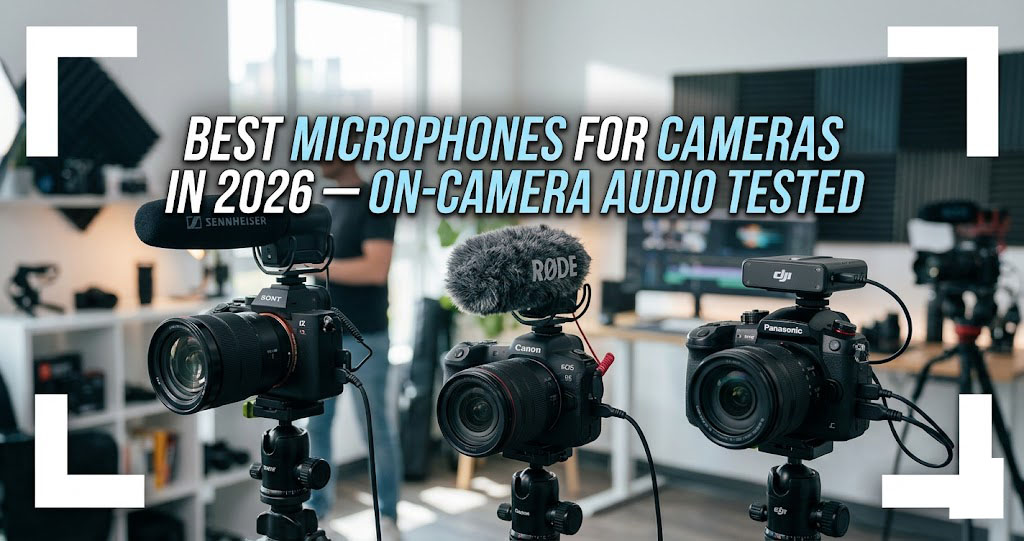
Great video with terrible audio is unwatchable. Your audience will forgive shaky camera work or imperfect lighting, but muddy sound makes people click away within seconds . After spending years recording audio for documentaries, corporate videos, and content creation, I've learned that a quality shotgun microphone mounted on your camera is the single most effective upgrade you can make for better video audio.
In 2026, the microphone market has exploded with options — from ultra-compact shotgun mics to sophisticated wireless systems with 32-bit float recording. This guide cuts through the noise. We've tested dozens of microphones in real-world conditions: interviews in noisy cafes, outdoor run-and-gun shoots, and quiet studio recordings. Here are the best camera microphones for every budget and use case.
Quick Reference: Best Camera Microphones 2026
Shotgun Microphones: The On-Camera Standard
🎤 Rode VideoMic GO II Helix
The Rode VideoMic GO II Helix represents the third generation of Rode's entry-level shotgun microphone, and after extensive field testing, it's the most versatile option for creators who need to record with multiple devices . The dual output design lets you plug directly into your camera via 3.5mm, then switch to USB-C for recording voiceovers on your laptop without changing microphones — this flexibility alone saves carrying multiple mics in your field bag.
At just 2.01 ounces (57g), you'll barely notice it mounted on smaller mirrorless cameras during long shooting days. The HELIX isolation mount system effectively handles noise from camera adjustments and lens focus motors that used to ruin audio takes with cheaper shock mounts .
Pros
- Ultra-compact, lightweight design
- Dual 3.5mm and USB output
- No battery required — plug and play
- HELIX isolation mount
- Compatible with RODE software
Cons
- No physical gain controls
- May need deadcat for windy outdoors
- Not XLR compatible
Ideal for: Content creators who use multiple devices (cameras, smartphones, computers), beginners wanting professional audio without technical complexity, and anyone needing an ultra-lightweight microphone for gimbal or handheld shooting .
🎤 Sennheiser MKE 600
The Sennheiser MKE 600 is the industry standard for serious filmmakers and broadcast professionals . With 15 years of audio engineering experience, I've used this microphone on countless sets, and its broadcast-grade quality never disappoints. The super-cardioid pickup pattern focuses tightly on your subject while rejecting ambient noise from the sides and rear.
The MKE 600 offers flexible power options — either phantom power from your camera or a single AA battery that lasts approximately 150 hours . This makes it incredibly versatile for different shooting scenarios. The high directivity and robust build quality have made it a favorite among documentary filmmakers and ENG crews worldwide.
Pros
- Broadcast-quality audio
- Dual power options (phantom/battery)
- Excellent off-axis rejection
- Professional build quality
- Low self-noise
Cons
- Requires XLR input (external recorder needed for many cameras)
- Heavier than compact options
- Premium pricing
Ideal for: Professional videographers, documentary filmmakers, and anyone serious about audio quality who doesn't mind rigging for XLR input.
🎤 Audio-Technica ATV-SG1
Audio-Technica launched two new on-camera shotgun microphones in March 2026: the ATV-SG1 (professional) and ATV-SG1LE (streamlined) . Both feature a newly designed 14 mm large-diameter diaphragm and a highly directional 100 mm acoustic tube that keeps pickup focused on the sound source while blocking unwanted background noise.
The ATV-SG1 stands out with professional features including a low-cut filter switch, stepless gain knob on the rear for on-the-fly adjustment, and a safety track feature that records the main audio level to the left channel and a backup track at -6 dB to the right channel — a lifesaver when unexpected volume spikes occur .
The built-in USB rechargeable battery provides up to 24 hours of continuous operation, and the external input jack allows you to mount a wireless lavalier mic receiver while simultaneously recording with the shotgun .
Pros
- New 14 mm large-diameter diaphragm
- Safety track feature prevents clipping
- External input for second mic
- 24-hour battery life
- Headphone monitoring with volume control
Cons
- New product — limited long-term reviews
- Requires USB charging
- Premium price point
Ideal for: Professional videographers who need advanced features like safety tracks, dual-channel recording, and real-time monitoring .
🎤 Movo VXR10
With over 100,000 creators purchasing the Movo VXR10, it's become the go-to starter microphone for budget filmmakers . At a fraction of the cost of bigger brands, this microphone delivers a dramatic improvement over any camera's built-in audio, making it perfect for beginners who want better sound without a significant investment.
The build quality is surprisingly robust — solid aluminum construction that withstands field use . The VXR10 includes cables for both cameras and smartphones, with adapters for newer phones. The built-in shock absorption helps maintain clean audio in dynamic shooting environments .
Pros
- Ultra-affordable entry point
- Solid aluminum construction
- Complete accessory kit included
- Universal device compatibility
- Ultra-lightweight 1.8 oz
Cons
- Not professional broadcast quality
- Limited in noisy environments
- Lower output than premium mics
Ideal for: Budget-conscious beginners, vloggers, and anyone upgrading from built-in camera audio without breaking the bank.
Wireless Lavalier Systems: Freedom and Flexibility
🎙️ DJI Mic Mini
The DJI Mic Mini combines ultra-lightweight transmitters (approximately 10g each) with a robust receiver, delivering detailed, noise-controlled audio . The 400m transmission range ensures stable audio in dynamic environments, making it ideal for run-and-gun shoots, interviews, and live streaming where mobility matters.
The system supports 48 kHz/24-bit sampling and up to 120 dB SPL for clear dialogue and vibrant sound . The charging case extends total use to up to 48 hours, making it well-suited for extended shoots. Automatic limiting helps protect against unexpected loud sounds, ensuring consistent recording quality in varying outdoor and indoor settings .
Ideal for: Two-person recordings, interviews, vlogs, and on-the-go productions where mobility and clean audio are essential .
🎙️ SmallRig S70
SmallRig expanded its audio lineup in 2026 with the S70 wireless microphone system, designed to compete directly with the DJI Mic Mini . Tuned by Grammy Award-winning engineer Luca Bignardi, the S70 features nine professional EQ presets optimized for vocals, instruments, and general content creation.
The 360° audio capture system operates at 48 kHz/24-bit resolution with a maximum SPL of 120 dB and SNR of 70 dB . Built-in automatic limiting and three levels of noise reduction help prevent clipping and reduce environmental interference, making it effective in indoor, outdoor, and noisy settings.
Ideal for: Budget-conscious creators who want professional wireless audio with Grammy-tuned EQ presets .
Specialty Microphones
🎤 Rode VideoMicro II
The VideoMicro II offers a highly directional pickup pattern in an ultra-compact form factor — just 80mm long and about 39g . It's designed to instantly improve on-camera audio pickup, focusing on the subject while reducing background noise. The ultra-compact size fits easily in camera bags and makes it ideal for run-and-gun shooting, vlogs, and travel content .
Ideal for: Travel vloggers, gimbal shooters, and anyone needing the smallest possible professional shotgun mic.
How to Choose the Right Microphone
📋 Key Purchase Considerations
- Pickup pattern and directionality: Look for super-cardioid or highly directional mics to minimize side noise and focus on the subject — crucial in busy environments .
- Connectivity: Decide between 3.5mm TRS, USB, XLR, or dual outputs. USB mics are convenient for computers and smartphones, while TRS mics are standard for cameras .
- Power source: Battery-free designs simplify setup but may sacrifice some performance. Battery-powered mics (like the Sennheiser MKE 600) offer more headroom and features .
- Wind protection: If shooting outdoors, a microphone with included deadcat or windscreen is essential. Many come with foam windscreens, but for windier conditions, a furry deadcat is recommended .
- Budget vs performance: Higher-priced units offer better directivity, lower self-noise, and more features. But entry-level options like the Movo VXR10 can be excellent for beginners .
- Wireless vs wired: Wireless systems offer freedom of movement but require battery management. Wired shotgun mics are simpler and more reliable for stationary shoots .