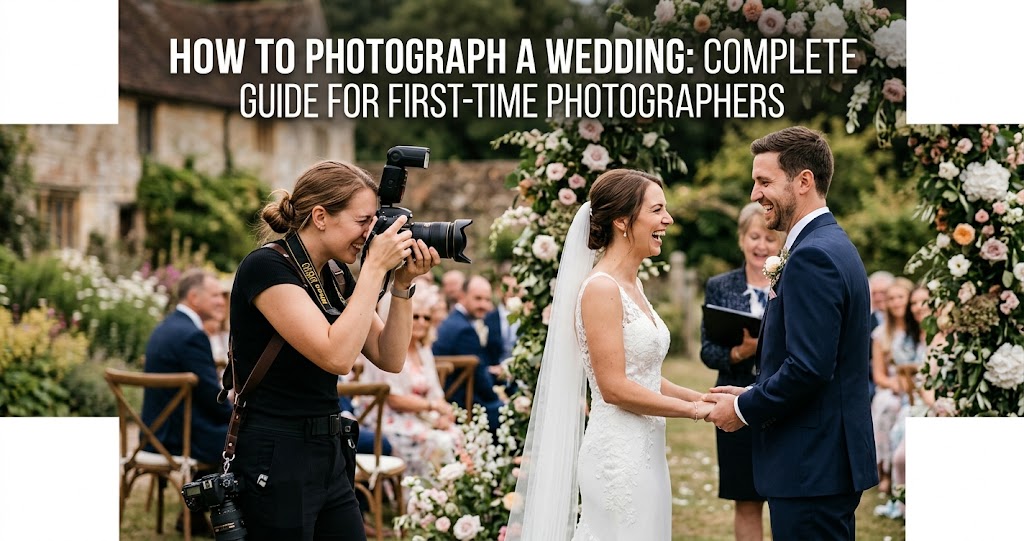
You've been asked to photograph a wedding. Your heart races. Your palms sweat. And somewhere in the back of your mind, you're asking: "What have I gotten myself into?" This is normal. Wedding photography is the most demanding genre in our field. There are no second chances. The first kiss happens once. The father-daughter dance happens once. And the couple is trusting you to capture moments that will be treasured for generations .
This guide is for first-time wedding photographers — whether you're shooting a friend's wedding as a favor or booking your first paid gig. We'll cover everything: pre-wedding preparation, gear checklists, timeline management, lighting strategies for dark venues, posing tips, backup workflows, and post-processing. By the end, you'll have a complete roadmap to shooting your first wedding with confidence.
The Hard Truth: First Wedding Solo Is a Big Mistake
Before we dive into techniques, an honest warning from the wedding photography community: "First wedding shoot solo is a big mistake" . If at all possible, second-shoot for an experienced wedding photographer first. Watch how they manage timelines, wrangle family members for portraits, handle difficult lighting, and stay calm when things go wrong.
If you cannot second-shoot, at least attend weddings as a guest with your camera. Observe the flow. Practice in similar conditions. And be transparent with your couple: "Does your client know this is your first wedding?" . Honesty about your experience level sets appropriate expectations and reduces pressure.
Part 1: Pre-Wedding Preparation (2–4 Weeks Before)
1 Prepare Your Gear Like Your Career Depends On It
Wedding photographers live by one rule: redundancy. Professional wedding photographer Vanessa Joy shoots with dual-slot cameras specifically for this reason — both slots record simultaneously. If one card develops issues, the second contains complete backup coverage .
📷 Gear Checklist (2-4 Weeks Before)
Critical gear rule: "Choose a camera that comes with two card slots — they also come with redundant recording features. When shooting RAWs, choose the duplicate option to have a second copy of pictures on the second card. If one card fails, you still have the full set" . This is non-negotiable for professional wedding work.
2 Scout the Venue Before the Wedding Day
Schedule a venue visit at the same time of day as the ceremony and reception. Pay attention to window directions, overhead lighting fixtures, potential reflections, and exit routes between ceremony and portrait locations .
3 Build a Realistic Timeline and Shot List
Work with the couple and planner to create an hour-by-hour timeline. Allow 60–90 minutes for couple portraits, 30 minutes for family formals, and 15-minute buffers between major events .
Sample 10-Hour Wedding Timeline (4 PM Ceremony)
Golden hour is non-negotiable: "Check the exact sunset time and schedule couple portraits 60–90 minutes before. This is the single most impactful lighting window of the entire day" . If the timeline doesn't allow pre-ceremony portraits, plan a 'sunset steal' — pull the couple away from cocktail hour for 15-20 minutes of golden hour portraits .
Part 2: Camera Settings and Lighting Strategies
4 Master Your Camera Settings
"Know your gear by heart. A wedding is not a place to experiment with your camera. You have to be able to change settings without thinking" . Here are your baseline settings:
For low-light ceremonies: "Use a fast lens with a high ISO setting, stabilize your camera, and shoot in RAW for better shadow recovery" . Modern cameras can handle up to ISO 6400 or higher — a sharp image with some grain is better than a blurry image with no noise.
5 Conquer Small, Dark Wedding Venues
Small dark venues — historic buildings, basements, barns, or churches — are dimly lit and offer limited space, restricting how you position lights or move freely . Here's how to handle them:
Alternative to flash: "Indoor wedding photography without flash may sound intimidating, but it is one of the most rewarding ways to capture authentic moments. Couples often choose venues with beautiful atmospheres — historic halls, churches, or candlelit receptions — where flash can disrupt the mood" .
If shooting without flash, use a full-frame camera, wide-aperture lenses (f/1.2–f/1.8), raise ISO, and stabilize your shots with proper technique . Bracing against walls or pillars can dramatically improve sharpness.
6 Master Available Light Techniques
"Shooting without flash depends heavily on your gear. Professional photographers often choose equipment that excels in low light" . Here's how to make the most of available light:
- Window light: Position subjects near large windows. Overcast days provide the softest, most flattering light
- Candles and string lights: These create beautiful ambient backlighting. Use them as background elements while adding subtle fill from the front
- Uplighting: Many venues have uplighting around walls. Use it as an accent light or as your primary ilSHOTAVIXtion for wide shots
- Chandeliers: Great for establishing shots and as a light source, but watch for harsh shadows directly underneath
Post-processing for low-light images: "Editing can transform low-light shots into professional-quality images. Use noise reduction carefully — too much kills detail. Lift shadows subtly, and consider converting some images to black and white, which handles grain beautifully" .
Part 3: The Wedding Day — Hour by Hour
7 Getting Ready (11 AM – 1:30 PM)
Arrive at the bride's suite first. Capture dress details, shoes, jewelry, invitation suite, and perfume. Document hair and makeup in progress, bridesmaids helping with the dress, and emotional moments with parents . Split time with the groom's prep — cufflinks, boutonniere, first look with groomsmen.
Detail flat lay tip: "Arrive 30 minutes before you need to start shooting people. Use that time to style and photograph rings, invitations, shoes, and accessories in beautiful light" .
8 First Look & Couple Portraits
If doing a first look, position yourself to capture both reactions. Allow 60–90 minutes for couple portraits at your scouted locations. Vary poses, distances, and backgrounds. Capture wide establishing shots, tight emotional moments, and creative details .
Golden hour strategy: "Check the exact sunset time for the wedding date and location. Schedule couple portraits to start 75 minutes before sunset so you have time to walk to your location and settle in" .
For posing help, search for tutorials on how to pose couples. "Because if you're a bit shy/awkward, the couple will also be awkward" . Direct with confidence, show them what you want, and keep the energy positive and fun.
9 Family Formals (The Most Stressful Part)
Family formals are often the most stressful part of the day, but proper preparation makes them smooth. "Work through your pre-planned family grouping list efficiently. Start with the largest groups and release people as you go. Have an assistant or planner call out names. Allow 2–3 minutes per grouping — speed keeps energy high" .
📋 Essential Family Formal Combinations
Pro tip: Have the couple provide a printed family shot list ahead of time with names and relationships. This prevents confusion and ensures no one is missed .
10 Ceremony — The Unrepeatable Moments
The ceremony is the emotional heart of the wedding day. These are the shots you cannot miss . Position yourself for the processional, then move to capture vows, ring exchange, first kiss, and recessional.
📋 Ceremony Must-Haves
"Don't stand at the other side of the room when the ring moment begins" . Anticipate key moments and be in position before they happen. Know your routes during the ceremony so you can move seamlessly and quietly without blocking guests .
11 Reception — Details, Toasts, and Dancing
Photograph venue details and decor before guests enter . Table settings, centerpieces, cake, lighting, signage — these small details define the style and mood of the wedding .
📋 Reception Must-Haves
During dinner, take a break. "I always try to find a small room next to the dining room where I can take a break and go through the pictures. Try to always hear the people — if there is suddenly a speech, you can be there in time" .
Part 4: Backup Workflow — Protecting the Memories
12 Execute Your On-Site Backup Workflow
"The moment you finish shooting, your mission changes from capturing memories to protecting them. Never wait until the next day to transfer your files, do it on-site on a laptop to two separate hard drives, while keeping the data on the cards" .
The 3-2-1 backup rule: "Keep 3 copies of your data, store them on 2 different types of media, have 1 copy stored off-site" . This combination gives you protection from drive failure, theft, and disasters.
13 Post-Wedding Processing and Delivery
After the wedding, maintain your backup discipline:
- Import from portable SSD to primary editing drive
- Keep original memory cards untouched until import is verified
- Spot-check random images from each backup
- Create a secondary backup on an external drive
- Consider cloud backup for long-term security
Deliver a preview the day after the wedding: "This is always a nice surprise for the couple" . A small gallery of 10-20 highlight images builds excitement and shows you're working on their memories.
Common Mistakes to Avoid
Do
- Use two cameras with dual card slots
- Scout the venue beforehand
- Have a written contract
- Wear comfortable, professional attire
- Stay hydrated and eat — it's a long day
- Backup on-site before leaving the venue
- Communicate with the couple about must-have shots
Don't
- Shoot a wedding solo as your first wedding if you can avoid it
- Experiment with new gear on wedding day
- Forget to charge batteries or bring backups
- Set your gear down and leave it unattended
- Wait until the next day to backup files
- Use direct flash that ruins the ambient atmosphere