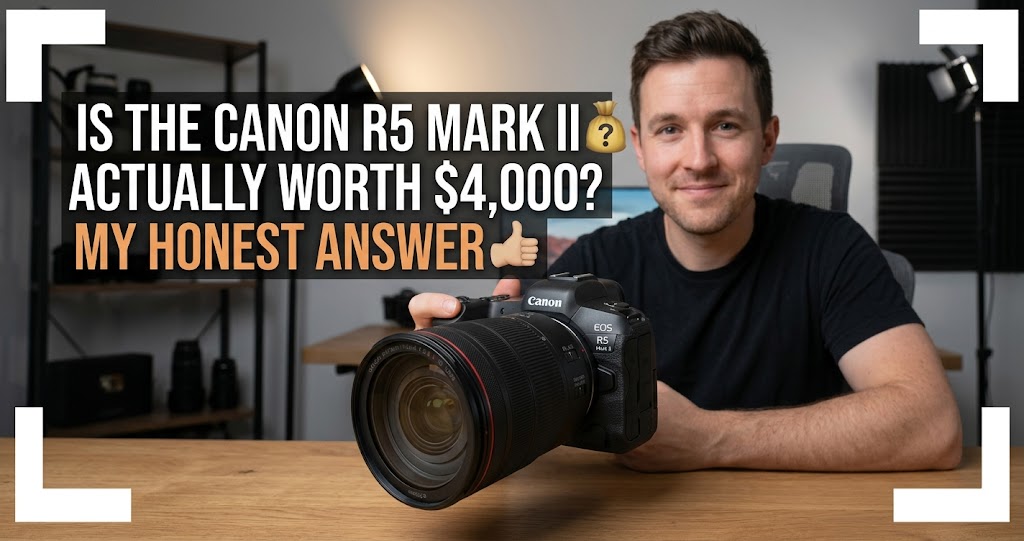
I've owned the Canon EOS R5 Mark II for six months now. I've shot weddings, portraits, corporate events, and a few personal projects. And I've asked myself the same question every time I looked at my bank account: was this really worth $4,000?
The short answer is complicated. The long answer is what you're about to read.
I upgraded from the original EOS R5 — a camera that was so ahead of its time in 2020 that even in 2026, it remains one of the best full-frame mirrorless cameras money can buy . The R5 was a revolution. The R5 Mark II is an evolution. And whether that evolution is worth the price of admission depends entirely on what you shoot and how you shoot it.
Let me break down my experience, dollar by dollar.
My R5 Mark II Stats
months of use
shutter actuations
weddings shot
The Price Tag Reality Check
Let's start with the numbers. The Canon EOS R5 Mark II launched at around $4,000 (roughly 589,050円 in Japan) . Today, in April 2026, the camera is selling for about ¥508,870 in Japan — a 13.6% drop from its launch price . That's still a serious investment.
💰 Current Pricing (April 2026)
- Launch Price (Aug 2024): ~$4,000 / ¥589,050
- Current Used (Japan): ~¥508,870 ($3,400)
- Current New (US): ~$3,800-4,000
Canon is even running a promotion as of April 2026: buy an R5 Mark II and get a free limited-edition camera bag (worth about $60) . It's a nice bonus, but it doesn't move the needle on the core value question.
The original R5, by comparison, can be found used for around $2,500-3,000. That's a significant savings — and for many photographers, the original R5 is still more than enough camera .
So the first question you need to ask yourself is: is the Mark II $1,000-1,500 better than the original?
What I Love: The Things That Surprised Me
1 The Stacked Sensor Changes Everything
On paper, the R5 Mark II has the same 45-megapixel resolution as its predecessor. But the new back-ilSHOTAVIXted stacked CMOS sensor is a completely different animal . The stacked design places processing circuitry directly beneath the photosites, enabling a 2.7× faster readout speed than the previous sensor .
What does that mean in real life? Virtually no rolling shutter. I shot a wedding reception where the bride was twirling under string lights, and the electronic shutter captured every moment without any of that "jello effect" distortion. I also shot a high school graduation ceremony where the lighting was terrible, and the camera locked focus quickly and held it even with moving subjects at a distance .
This is the single biggest reason to buy the Mark II over the original. If you shoot fast action — sports, wildlife, dancing at events — the stacked sensor is a revelation.
2 Eye Control AF: Not a Gimmick
I was skeptical about Eye Control AF. It sounded like a feature designed for press events and marketing videos, not real-world photography. But after calibrating the system (which takes about 2 minutes), I found myself using it constantly .
The principle is simple: the camera tracks your iris movement within the viewfinder and places the AF point where you're looking . During a wedding ceremony, I could shift focus from the bride to the groom to the officiant with just a glance. It's not perfect — the system is sensitive to eye fatigue and can lose accuracy towards the end of a long day — but when it works, it feels like magic .
3 Register People Priority is a Wedding Game-Changer
Here's a feature I didn't expect to love: Register People Priority. You can store up to 10 faces with a priority order, and the camera will always favor registered faces, even in a crowd .
At a wedding, I set the bride's face as priority 1, the groom as priority 2, and key family members as priorities 3-5. The result? The camera never lost focus on the people who mattered most. It sounds like a small thing, but when you're shooting a fast-paced event, it removes one more variable from your mental load .
4 Pre-Capture: Never Miss the Moment
The pre-capture function is one of the R5 Mark II's standout new features . When enabled, the camera continuously records into its buffer memory as soon as you half-press the shutter button. When you fully press, the previous 15 frames are saved to the card — roughly half a second of look-back time at 30 fps .
I used this during a cake-cutting ceremony where the couple smashed cake into each other's faces. I pressed the shutter a split second after the action started, but the camera had already captured the previous 15 frames — including the exact moment of impact. Without pre-capture, I would have missed it.
What Frustrates Me: The Compromises
5 The Heat Management is Better, But Not Perfect
The original R5 had well-documented overheating issues. The Mark II adds ventilation holes and an optional cooling fan accessory, but it's not a magic bullet .
Canon's own documentation warns: "Shooting in hot environments over extended periods will cause the white [] or red [] icon to appear sooner. If the camera's internal temperature is high, the quality of images shot with a high ISO speed or long exposure may decline even before the white [] icon is displayed" .
During an outdoor summer wedding in 90-degree heat, I noticed the temperature warning icon after about 45 minutes of continuous shooting. I didn't experience any shutdowns, but the camera was noticeably warm to the touch. For videographers, this is still a concern — though firmware updates have improved stability .
6 The Body is Bigger
To house all of the new tech, Canon had to make the body larger than the original R5 . The additional space behind the LCD screen houses the air vents for better passive cooling. There's also a larger viewfinder which features the sensor for eye tracking AF .
I prefer the smaller original R5 body — it attracts a little less attention when shooting street photography, and every bit of space saved in my kit bag is a win . The Mark II isn't dramatically larger, but it's noticeable.
7 Early Firmware Issues (Mostly Resolved)
When the R5 Mark II first launched, there were reports of autofocus issues, particularly with focusing on people of color . Canon has since released firmware updates (versions 1.0.2 and 1.0.3) that address these problems .
I experienced a minor bug where the camera locked up when writing to a specific SD card — a SanDisk Extreme Pro rated for 280mb/s write speeds . Swapping to a different card resolved the issue, and I haven't encountered it since. But it shook my confidence in the camera for a few days.
8 It's Too Centered on Video
This is a philosophical complaint more than a technical one. The R5 Mark II feels like it was designed primarily for videographers who also shoot stills, rather than stills photographers who also shoot video .
Canon added features like 8K 60p RAW recording, C-Log 2, and improved cooling for extended video capture. But they removed or neglected features that stills photographers care about — like multiple exposure modes for RAW files and a good timelapse mode .
"If you look at the two, you'll see the R5 scored higher in our tests because it not only delivered good images but also offered multiple exposure modes for RAW files, a good timelapse mode, and didn't heat the way people were accusing it of doing" .
The Firmware Update That Changed Things
In late 2025, Canon released firmware version 1.0.3, which addressed a number of issues . The most important fixes for me were:
- Optimized timing of the camera's display of its internal temperature warning indicator
- Fixed an issue that may interfere with the camera's ability to focus properly when using AF in certain zoom ranges
I also noticed improved autofocus performance with subjects of color — a problem that had been noted in early reviews . The camera got a lot more keepers than not after the update .
That said, I still encountered occasional lockups with certain SD cards . The issue didn't happen consistently enough to reproduce, but it happened twice, and that's twice too many for a professional camera .
The Keeper Rate
AF hit rate in good light
AF hit rate in challenging conditions
Times I wished I had the original R5 instead
What Professional Photographers Are Saying
I'm not the only one with strong opinions about this camera. Commercial photographer Maggie, who has over thirty years of experience, tested the R5 Mark II extensively and was impressed by its low-light performance and autofocus accuracy .
She also tested the camera's high-frequency flicker reduction function, which she found useful when shooting under LED or fluorescent lighting . And she was amazed by the camera's ability to focus on a model's eye even when partially obscured by mesh or decorative elements — a testament to the AI autofocus system's sophistication .
On the other hand, TechRadar's Dan Mold, who has been happily using the original R5 for four years, decided to skip the Mark II entirely . His reasoning: the original R5 is still good enough, the Mark II is bigger, and the new features aren't essential for his work .
The Verdict: Who Should Buy This Camera?
After six months of real-world use, here's my honest advice.
✅ Buy the R5 Mark II if:
- You're a professional wedding or event photographer who needs reliable autofocus in challenging conditions
- You're a sports or wildlife photographer who will use the 30fps burst and pre-capture features
- You're a hybrid shooter who needs 8K 60p video and professional color tools (C-Log 2, Custom Picture)
- You upgrade every generation and want the latest technology
- You're invested in the RF lens ecosystem and want the best body available
- You can write off the cost as a business expense
❌ Skip the R5 Mark II and buy the original R5 (used) if:
- You're primarily a stills photographer who doesn't need 8K video or 30fps burst
- You're on a tighter budget ($2,500-3,000 vs $3,800-4,000)
- You don't need Eye Control AF or Action Priority
- You're happy with the original R5's video capabilities (8K 30p, Canon Log 3)
❌ Consider the R6 Mark III if:
- You don't need 45MP resolution (24-33MP is sufficient)
- You want to save money while keeping similar autofocus features
- You don't need 8K video
My Final Verdict
For hybrid shooters
For stills-only photographers
For sports/wildlife shooters
Is It Worth $4,000? Here's My Honest Answer
If you're a working professional whose income depends on capturing moments that can't be repeated — weddings, sports, wildlife — the R5 Mark II is worth every penny. The combination of the stacked sensor, pre-capture, and AI autofocus will pay for itself in shots you would have missed with any other camera.
If you're an enthusiast or a photographer whose work is more controlled — studio portraits, landscapes, product photography — the original R5 is probably the smarter buy. Put that $1,500 savings toward a lens or a lighting setup. You won't miss the extra features.
And if you're a videographer? The R5 Mark II is a genuine cinema tool in a compact body. But if you don't need 8K 60p RAW or C-Log 2, the original R5's video capabilities are still excellent .
The R5 Mark II is Canon's most technically advanced camera. But "best" doesn't always mean "best for you." Know your needs, know your budget, and choose accordingly.
What About the R5 Mark III?
If you're reading this in April 2026 and wondering whether to wait for the next model, consider this: the original R5 launched in July 2020. The R5 Mark II launched in August 2024. That's a four-year gap. If Canon follows a similar timeline, the R5 Mark III might not arrive until 2028 — around the Summer Olympics .
Do you want to wait two more years? If yes, keep your current camera. If no, the R5 Mark II is here now, and it's excellent.
As one reviewer noted, "The R5 was so future-proof when it launched all the way back in July 2020, that even now it's considered one of the best full-frame mirrorless cameras money can buy" . The Mark II is likely to enjoy a similarly long life.