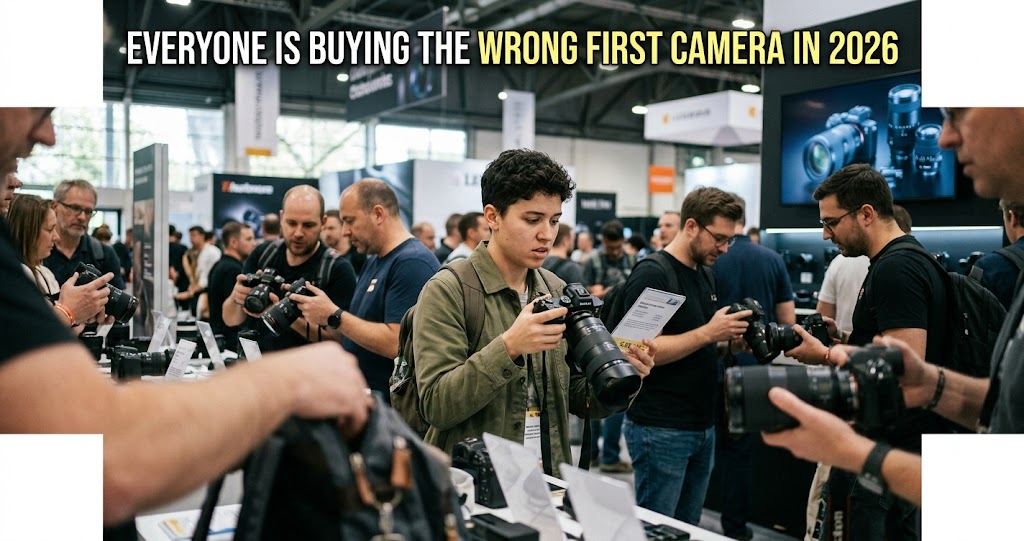
I've been teaching photography for years. I've watched hundreds of beginners buy their first "real" camera. And I've seen the same mistake repeated more times than I can count.
They walk into a camera store (or, more likely these days, open a browser tab) with a budget, a vague idea of what they want to shoot, and a deep-seated belief that more money equals better photos. They leave with a $2,000 full-frame mirrorless camera, a kit lens they'll outgrow in three months, and no money left for the lenses, lighting, or education that would actually make a difference.
Six months later, their expensive camera is collecting dust on a shelf. They're back to using their phone. And they're convinced that photography just isn't for them.
This is a tragedy. And it's completely avoidable.
Here's what I've learned about buying your first camera in 2026 — the hard way, from my own mistakes and from watching hundreds of others make theirs.
By The Numbers
years teaching photography
students guided
who overspent on their first camera
My Own First Camera Disaster
Let me start with a confession. I made the same mistake I'm warning you about.
In 2018, I decided I wanted to get serious about photography. I'd been using my phone and a hand-me-down point-and-shoot, and I was ready to upgrade. I did what everyone does: I read reviews, watched YouTube videos, and convinced myself that I needed the best.
I bought a Sony A7 III. It was $2,000 — way over my budget. I paired it with the kit lens because that's all I could afford after the body. I was thrilled. I had a full-frame camera. I was a real photographer now.
Then reality set in.
The camera was overwhelming. There were too many buttons, too many menus, too many options. I didn't understand exposure, but the camera had three dials I was supposed to adjust. I didn't know how to compose a portrait, but the autofocus had ten different modes. I was drowning in features I didn't need and ignoring the fundamentals I desperately needed to learn.
I took maybe 500 photos with that camera in the first year. Then I put it in a drawer and went back to my phone.
It wasn't until two years later, when a friend lent me his old Canon Rebel T6 — a $300 entry-level DSLR — that I finally started to learn. The Rebel had fewer buttons. The menu was simpler. The autofocus was basic, which forced me to actually think about where I was focusing instead of just trusting the camera to figure it out.
Within six months, I'd outgrown the Rebel. But by then, I knew what I actually needed. I sold the A7 III (taking a massive loss) and bought a camera that fit my actual needs, not my imagined ones.
1 The "Full-Frame Trap"
The biggest mistake I see beginners make is buying a full-frame camera as their first interchangeable-lens camera. They've read that full-frame is "better" — better low-light performance, better dynamic range, better depth of field — so they assume they need it.
Here's what they don't realize: APS-C cameras are also excellent. A modern APS-C camera like the Sony A6700, Fujifilm X-T5, or Canon R7 produces images that are indistinguishable from full-frame in good light. The difference only becomes noticeable in very low light or at very large print sizes — scenarios that beginners rarely encounter.
More importantly, APS-C cameras are smaller, lighter, and significantly cheaper. They also have smaller, lighter, cheaper lenses. A full-frame body might cost $2,000, but a full-frame 70-200mm f/2.8 zoom costs another $2,500. An APS-C 50-140mm f/2.8 equivalent might cost $1,200. That's a massive difference.
2 The "Body Over Lens" Mistake
Beginners almost always spend too much on the camera body and too little on lenses. I did this. You probably will too. It's natural — the body is the shiny thing, the thing reviewers talk about, the thing that gets upgraded every year. Lenses are boring in comparison.
But lenses are where the magic happens. A $500 camera with a $1,000 lens will produce better images than a $2,000 camera with a $200 kit lens. Every time. The lens determines sharpness, color rendering, bokeh, low-light performance, and versatility. The body just records what the lens sees.
Here's my rule of thumb: allocate 60% of your budget to lenses and 40% to the body. Buy a cheaper body and a better lens. You'll be much happier.
3 The "Future-Proofing" Fallacy
Beginners love to future-proof. They buy a more expensive camera because they "might need the features someday." They spend extra on 8K video, 30fps burst, or 61 megapixels because they're worried about being left behind.
Here's the truth: you won't need those features. By the time you're skilled enough to benefit from them, the camera you buy today will be obsolete anyway. Technology improves too fast. The best way to future-proof is to buy a cheaper camera now and put the savings toward future upgrades.
As one Reddit user wisely noted: "Things like focusing speed, low-light AF, dynamic range, video features, fps, resolution, stabilization, etc... These are all nice to have, but they don't matter nearly as much as people think. The vast majority of people buying a camera today will be fine with a camera from 8+ years ago" .
4 The "YouTube Reviewer" Problem
YouTube reviewers are paid to make you want new gear. They make a living from affiliate links and sponsorships. Their entire business model depends on convincing you that your current camera is inadequate and that the latest model will change your photography forever.
It won't. I've watched countless review videos where the reviewer is comparing a $2,000 lens to a $2,500 lens, pixel-peeping at 400% zoom to find differences that literally no one will ever see. These videos are entertainment, not education.
Take YouTube reviews with a massive grain of salt. The best camera reviewers are the ones who emphasize that gear doesn't matter as much as technique — and those reviewers are rare.
The Real Problem
of beginners buy a camera above their skill level
of those cameras end up collecting dust
would have been happier with a cheaper camera and better lenses
What You Should Actually Buy (Based on Real Experience)
🎯 Best Beginner Setup (Under $1,000)
Camera: Sony A6400 (used) or Canon R50 (new)
Lens: Sigma 18-50mm f/2.8 DC DN (used) or a 50mm f/1.8 prime
Why: This gives you a compact, capable camera with a fast, sharp lens. You'll learn about depth of field, low-light performance, and composition without being overwhelmed. The whole kit costs around $800-1,000 and will serve you well for years.
🎯 Best Intermediate Setup ($1,500-$2,000)
Camera: Fujifilm X-T30 II or Sony A6600 (used)
Lenses: Sigma 16mm f/1.4 + Sigma 56mm f/1.4
Why: The two-lens kit gives you wide-angle and portrait coverage, both at f/1.4 for excellent low-light performance and beautiful bokeh. You'll learn to work with primes, which will make you a better photographer.
🎯 What Not to Buy
Don't buy: A full-frame camera as your first interchangeable-lens camera.
Don't buy: The most expensive body you can afford.
Don't buy: A camera because a YouTuber said it was "the best."
Don't buy: A camera with features you don't understand yet.
5 Buy Used, Not New
This is the single best piece of advice I can give you. Buy used.
Camera bodies depreciate like cars. The moment you take a new camera out of the box, it loses 20-30% of its value. A camera that cost $1,000 new can be found for $600-700 used in excellent condition.
I've bought most of my gear from reputable used dealers like MPB and KEH. They inspect, grade, and warranty their equipment. I've never had a problem. Buying used also lets you afford better lenses — see point #2.
6 Rent Before You Buy
If you're considering an expensive camera, rent it first. Lensrentals and other services let you try a camera for a weekend for a fraction of the purchase price.
I wish I'd rented the A7 III before buying it. One weekend with that camera would have shown me that it was too advanced for my skill level. I would have saved thousands of dollars and years of frustration.
What Beginners Actually Need (And What They Don't)
You need:
- A camera that fits comfortably in your hands
- Intuitive controls that you can learn to use without looking
- Good autofocus (most modern cameras have this)
- Decent low-light performance (most modern APS-C cameras have this)
- A fast prime lens (50mm f/1.8 or equivalent)
- A basic zoom lens to learn what focal lengths you prefer
- Time and patience to practice
You don't need:
- 8K video
- 30fps burst shooting
- 40+ megapixels
- Eye-tracking autofocus (nice to have, not essential)
- In-body image stabilization (lens stabilization is often sufficient)
- The latest processor
- A full-frame sensor
7 The Smartphone Option
Here's a radical suggestion: before buying any camera, spend six months learning photography with just your smartphone. Modern smartphones have manual controls, RAW shooting, and excellent cameras. They're also always with you.
Learn composition. Learn to see light. Learn to tell stories with images. Then, when you've hit the limits of what your phone can do, buy a camera. You'll know exactly what features you need, and you'll have the foundational skills to use them effectively.
My Challenge to You
days of phone-only photography
spent on gear during that time
skills gained that transfer to any camera
Real Stories from Real Beginners
8 The Lens You Should Actually Buy
If you take only one piece of advice from this article, take this: buy a 50mm f/1.8 (or equivalent) prime lens as your second lens. On APS-C, that's a 35mm f/1.8 or 35mm f/2.
This lens will teach you more than any camera body ever could. The fixed focal length forces you to move your feet and think about composition. The wide aperture (f/1.8) lets you blur backgrounds and shoot in low light. And they're cheap — usually $150-250 new, even less used.
Every major system has a "nifty fifty": Canon's RF 50mm f/1.8, Nikon's Z 50mm f/1.8 S, Sony's FE 50mm f/1.8. Buy one. Use it for a month. You'll be amazed at how much you learn.
Your 30-Day Beginner Action Plan
- Week 1: Use only your phone. Learn the rule of thirds. Learn to see light. Take 50 photos every day.
- Week 2: Research cameras, but don't buy anything yet. Look at used options. Read reviews from real users, not influencers.
- Week 3: Set a budget that includes at least one good lens (60% lens, 40% body). Buy used from a reputable dealer.
- Week 4: Learn your new camera. Shoot in auto mode for a week, then aperture priority, then shutter priority. Don't touch manual mode until you understand why you'd want to.
By the end of this month, you'll have spent less than $1,000, learned more than most beginners learn in a year, and be ready to grow your skills without being held back by gear.
The Bottom Line
Your first camera should be the camera you can afford to carry everywhere, not the camera you have to protect from the elements. It should be the camera you're not afraid to learn on, not the camera that intimidates you with its complexity. It should be the camera that makes you want to shoot, not the camera that makes you want to upgrade.
Buy used. Buy APS-C. Buy a fast prime lens. Spend the rest on education, travel, and experiences that will actually improve your photography.
And remember: the best camera is the one you have with you. So make sure you actually want to carry it.