The Photography Advice I Wish Someone Had Told Me 10 Years Ago
Published: May 14, 2026
by Oli Sa
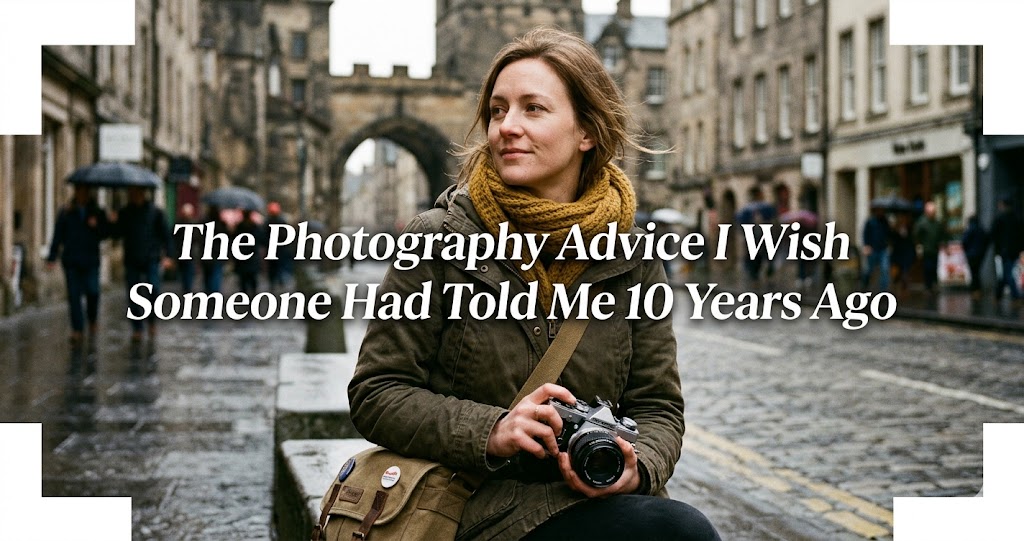
A decade behind the lens taught me more than any gear ever could
Ten years ago, I bought my first "real" camera. I thought I needed the best gear, the biggest lights, and the latest tools to create something special . I was convinced that the magic of photography was locked behind expensive equipment .
I was wrong.
Today, after a decade of shooting — through weddings, portraits, travel, and countless personal projects — I've learned a valuable truth: less is often more . Some of my favorite images came from working with the simplest setups. Two lights and a reflector, one single light source, or even just the flash on my phone have been more than enough to create impactful, emotional portraits .
This article isn't about camera specs or pixel-peeping. It's about the hard-won lessons I wish someone had shared with me when I was just starting out — the advice that would have saved me years of frustration, thousands of dollars, and more than a few sleepless nights.
The Hard Truth: "What I've discovered over the years is that creativity thrives within limitations. Instead of focusing on the gear I don't have, I've leaned into problem-solving with what I do have" .
10 Years, By The Numbers
10+
cameras owned
15+
lenses bought and sold
50k+
photos taken
∞
lessons learned the hard way
Lesson 1: Gear Doesn't Matter Nearly as Much as You Think
1 The Gear Trap
When I first started, I was convinced that upgrading my camera would instantly improve my photography. I spent hours watching lens reviews, comparing sensor sizes, and obsessing over specs .
Here's what I learned: "A photographer with 10,000 hours of practice and a $100 camera will beat a photographer with 100 hours of practice and a $10,000 camera any day" .
Varina Patel's experience proves this perfectly. One of her most successful images — published in Popular Photography Magazine and sold as prints countless times — was taken with a Canon 20D, an older, consumer-level camera . No publisher or buyer ever asked what camera she used; they only cared about the image quality .
2 Skill Beats Specs
"A new camera won't magically make your photos better," I've learned. If you're struggling with muddy lighting, a 50mm f/1.2 lens won't suddenly produce luminous portraits . "Tools magnify strengths, but they don't substitute for skills" .
What actually improves your photography? Mastering fundamentals — composition, lighting, timing, storytelling — matters infinitely more than the name on your camera .
"Buying a Nikon doesn't make you a photographer. It makes you a Nikon owner." — Anonymous
3 The "Gear Acquisition Syndrome" Trap
Psychologists describe the compulsive urge to buy equipment as a form of retail therapy or a "hedonic treadmill" — each purchase gives a short-lived high but soon returns you to your baseline satisfaction .
I've lived this cycle more times than I care to admit. The excitement of unboxing new gear can feel like progress. But after the honeymoon period, those nagging creative problems remained unsolved .
What I Wish I'd Known
80%
of my best photos used one lens
90%
of my early gear purchases were unnecessary
100%
of my skill came from practice, not purchases
Lesson 2: Composition Is Everything
4 The Crooked Horizon
A crooked horizon is one of the clearest signs of an amateur photo . It's not that professionals have a perfectly trained hand — they just straighten the image later in post-production .
I wish I'd learned earlier to use my camera's electronic level. I use mine almost all the time now .
5 Move Closer, Eliminate Distractions
Another common beginner mistake is shooting from too far away. Moving in closer or zooming in lets you focus more on your main subject and eliminate areas that might otherwise contain distractions .
And always check the edges of your frame. That red poster in the corner? The patch of lawn that randomly cuts into the frame? They're distractions. Get rid of them .
6 Get Low
Tourist photos tend to look like they were taken by tourists, mostly because they're shot from eye level . But if you simply squat down, you get a different, more interesting perspective .
This one simple change transformed my street photography overnight.
"The best zoom lens is your legs." — Ernst Haas
⚠️ The Composition Mistakes I Made For Years
- Centering everything: Putting your subject in the middle of the frame helps viewers find it, but it doesn't give them much else to look at .
- Ignoring leading lines: Paving stones, roads, fences — they guide the eye. Use them.
- Forgetting foregrounds: The best landscapes have something interesting in the foreground .
Lesson 3: Light Is Everything
7 Great Light Beats a Great Subject
You've probably had the experience of visiting a gorgeous location with grand visions of stunning photos, only to be bitterly disappointed. On the flip side, you've likely been pleasantly surprised by beautiful photos of a very ordinary scene .
The difference is light. This is why I will often return to the same location to photograph the same scene repeatedly. The scene hasn't changed, but the light will never be the same twice .
8 Expose to Preserve Highlights
If I had to name a single change to my technique that has most consistently yielded better images, it's this: exposing to preserve highlights .
Blown highlights are generally a bigger danger than blocked-up shadows . Shooting RAW rather than JPEG will give you better latitude to adjust both, but a bit of shadow that's "lost" to pure black is generally less offensive than a section of sky that's burned to a white blob .
Combining the in-viewfinder histogram with exposure compensation to ensure the histogram isn't "off the scale" to the right has saved countless images .
The Light Lesson
5
years to truly understand light
100+
times I've revisited the same location
∞
different lighting conditions
Lesson 4: Edit with Restraint
9 Don't Over-Process
I've been guilty of this. When I first discovered editing software, I was "drunk with power" and sometimes went too far . Call it the "Instagram filter effect" — none of us are immune to it .
There's a point — whether through too much saturation, too much contrast, or heavy use of vignettes — where a photograph ceases to properly resemble reality . And when you hit that point, everyone will notice, and not in a good way .
Before you hit export, do a quick reality check. Have you wandered too far from reality? Consider dialing it back .
10 Master the Basics First
"Post-processing is part of your artistic expression — learn it well" . Capturing your photos well in-camera is only half of the process. As a visual artist, what happens to those RAW images is entirely up to you .
The most important adjustments are simple: Exposure and Contrast, followed by Lights and Shadows . Start there. Master those. Then explore further .
The Editing Advice I Wish I'd Heard: "Learn the difference between enhancing and fabricating. Your job as an editor is to reveal what was already there, not to create something that never existed."
Lesson 5: The Mindset Shift
11 Shoot for Love, Not Likes
Social media has changed the world we live in, which is a great thing for photographers. Of course, there are negatives as well. The biggest drawback? The eternal quest for likes . Not a single one of us is immune to it .
It's flattering when someone likes your photo. But it can become a dangerous obsession when you begin to shoot or edit your photos with the motivation of getting more likes .
Stay focused on shooting what you love. Don't let the desire for validation on social media make you shoot for likes .
12 Create for Yourself
Here's what I've learned: "Nobody is really paying close attention, so do what you want. If you like it, it's a good photo" .
Don't copy someone or something that's popular — shoot and edit however you like . Follower counts don't matter. Everybody takes a lot of terrible photos . Photographers are only showing their good shots. Social media is just a highlight reel — it's not even close to reality most of the time .
"Comparison will cripple you and steal your passion." — Darren Rowse, Digital Photography School
13 Your Best Image Is Yet to Be Made
It's easy to get discouraged from time to time in photography. This happens for a number of reasons, but there's one thing I've learned that helps me get back on the horse: I remember that I still haven't made my best photo yet .
If you keep going, keep learning, keep practicing, you will keep making images that you think might be your best yet. There will be dry periods, but push through them, try something different, get out of the rut, and you'll come out the other side .
The Mindset Shift
5
years to stop caring about likes
∞
happiness from creating for myself
Lesson 6: Practical Habits That Changed Everything
14 Keep Your Gear Simple
When I switched from a large DSLR kit to a smaller mirrorless system a few years ago, I intentionally simplified my gear . There are three reasons for this: I don't want or need large or heavy gear, I'm more likely to consider new purchases more seriously, and simplifying your gear forces you to develop your creativity .
One of the best exercises you can do is go out with your camera and only one prime lens. You don't need anywhere near as much gear as you think .
15 Slow Down
Your shots will be better when you slow down and think about the shot more . Learn the buttons and dials on your camera as well as you can, so you don't always have to look at them .
The best photos rarely come from the easiest days. Some of my favorite images are from difficult times — hiking mountains in freezing conditions, lugging gear through monsoon rain, sitting for hours in the middle of the night . Those shots had a story .
The Advice I'd Give My Younger Self: "Start a blog. Not for anyone else — for you. When I started my photography blog, I never had visions of millions of readers, I just wanted somewhere I could share my photos and stories. It was one of the best things I have ever done" .
The Mistakes I Made (So You Don't Have To)
❌ The Mistakes That Cost Me Time and Money
- Not learning night photography sooner: Night photography is slow, time-consuming, and largely an exercise in trial and error. But the lessons you'll learn are too numerous to list. Time is the real teacher: the more you laboriously practice, the better you'll get .
- Over-processing my images: In my early years, I was "drunk with power" and went too far with saturation and contrast . Less is almost always more.
- Obsessing over gear instead of skill: I spent more time on camera forums than actually shooting. That was a mistake.
"The single most important component of a camera is the twelve inches behind it." — Ansel Adams
What I'd Tell My Younger Self (And What I'm Telling You)
If I could go back in time and give my younger self one piece of advice, it would be this:
- Stop chasing gear. The camera you have is good enough. Learn to use it.
- Master composition before you worry about anything else. A well-composed photo from a phone beats a poorly composed photo from a $5,000 camera.
- Pay attention to light above all else. "Great light beats a great subject every time" .
- Edit with restraint. The goal is to enhance, not to fabricate.
- Shoot for yourself, not for likes. Social media is a highlight reel. Don't let it dictate your art .
- Be patient. "Overnight success is a myth. The slow burn gives you perspective. It builds resilience. The low points make the highs even better" .
The Final Lesson
10
years of lessons
∞
more to learn
Final Thoughts
Photography has taught me patience, perseverance, adaptability, and trust — both in myself and in the process . If you're starting out, don't chase the fast wins. Let your journey unfold slowly. Let the rejections shape you. Let the hard days make you better .
Success isn't something you catch; it's something you grow into . And when (not if) it comes, you'll feel every step it took to get there .
Ten years ago, I thought I needed the best gear to create something special. Today, I know that the most important tool in photography isn't the camera — it's the person behind it.
My Final Advice: "You will never stop learning about photography" . Embrace that. Enjoy every chance you get to work on photography, because it is a joy. And don't take things too seriously .