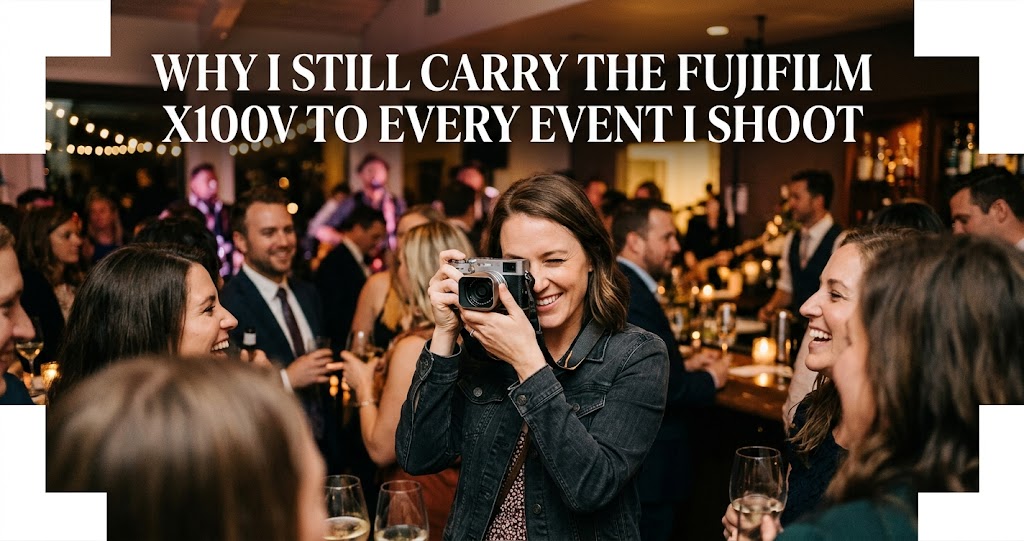
I've shot weddings with $6,000 full-frame cameras. I've used flagship mirrorless bodies with lenses that cost more than my first car. But when I'm heading to any event — a wedding, a family gathering, a behind-the-scenes shoot — I always slip my Fujifilm X100V into my bag.
Not as a backup. As a second shooter. As my secret weapon. And sometimes, for the quiet moments between the formal shots, as my primary camera.
The Fujifilm X100V was released in 2020. In camera years, that's ancient. The X100VI is out now with 40 megapixels and IBIS. Yet I'm still using the V. Not because I can't afford the upgrade, but because this camera does something that newer, higher-resolution bodies can't replicate.
Here's why, after hundreds of events and thousands of frames, the X100V remains the most important camera in my kit .
The Accidental Wedding Camera
1 How a Compact Became My Event Workhorse
I didn't plan to use the X100V for events. I bought it for the same reason everyone does: street photography, everyday carry, the "camera you'll actually bring with you."
But then I brought it to a wedding rehearsal as a lightweight option for behind-the-scenes shots. I shot the couple walking through the venue, the florist arranging centerpieces, the quiet moment before the groom saw his bride for the first time.
When I delivered the gallery, the couple asked about "the photos that feel different" — the candid ones, the ones with atmosphere, the ones that looked like they belonged in a film. Those were all from the X100V .
Professional wedding photographer Alison Conklin described it perfectly: "I fell in love with the simplicity of the design and how I was able to simply focus on the composition. I loved throwing this little camera in my purse, so it was with me whenever I wanted it."
The Secret Weapon: Film Simulations That Save Hours of Editing
2 Why I Almost Never Edit X100V RAWs
The X100V's film simulations are not gimmicks. They're genuine time-savers that produce usable, beautiful images straight out of camera .
For events, I rely on two simulations:
- Classic Negative: My go-to for most event work. It adds a subtle, moody warmth that makes candid moments feel cinematic. Shadows are deepened, highlights are softened, and skin tones stay natural .
- Acros (Monochrome): For black and white event photography, nothing beats Acros. The grain texture is organic, and the contrast curve is perfect for dramatic lighting .
When I'm shooting a wedding, I set the X100V to record RAW+JPEG. The JPEGs go to the couple as sneak peeks — often within an hour of shooting. The RAWs sit untouched unless a client wants a specific edit .
A Taiwanese photographer who uses the X100V for events and portraits explained it well: "I usually shoot with Raw+JPEG together. When editing, I use the JPEG as a reference for color grading, and for daily photos or event shots, I provide the JPEG files directly to those who need them (and I even get asked, 'What camera is this?')"
This workflow has saved me hundreds of hours of editing over the years.
Size Matters: The Disappearing Camera
3 How 478g Changes Everything
At 478g, the X100V is lighter than most mirrorless bodies alone, before you even add a lens . It fits in a coat pocket, a small shoulder bag, or even the large pocket of cargo pants .
For event photographers, this is transformative. Here's why:
- You carry it everywhere. When I'm shooting a wedding with my main system, the X100V is in my bag or around my neck. It's always there for the in-between moments.
- Subjects don't notice it. Point a 70-200mm f/2.8 at someone, and they freeze. Point an X100V at them, and they barely register it. The camera is non-threatening .
- You can shoot one-handed. With a thumb grip, the X100V is perfectly balanced for single-handed operation. This matters when you're holding a drink, opening a door, or directing other subjects .
The Japanese photographer who wrote about using the X100V for travel put it this way: "When traveling, you have a lot of luggage. On the way back, you'll be walking with souvenirs in hand. Being able to hold the camera with one hand was one of my absolute conditions."
The Hybrid Viewfinder: Why I Choose Optical Over Electronic
4 Seeing the Real World, Not a Screen
Most modern cameras have electronic viewfinders. They show you exactly what the sensor sees — exposure preview, white balance, all the information. The X100V has a hybrid viewfinder that can switch between electronic and optical .
For events, I shoot almost exclusively with the optical viewfinder (OVF). Why?
- Zero lag. When a moment happens, it happens in real time. No blackout, no refresh rate issues.
- You see outside the frame. The OVF shows you a wider view than the lens captures. You can see subjects approaching before they enter the frame — a huge advantage for anticipating moments .
- It feels like a rangefinder. The experience is closer to shooting film than any digital camera I've used. You focus on composition and timing, not histograms and focus peaking.
For low-light event situations where the OVF is too dark, I switch to the EVF. It's 3.69 million dots and runs at 120fps — more than adequate . But for 80% of my event shooting, I'm in optical mode.
The 35mm Focal Length: The Storyteller's Perspective
5 Why 35mm (Full-Frame Equivalent) Is Perfect for Events
The X100V's lens is 23mm on APS-C, which translates to 35mm on full-frame . This is not a portrait lens. It's not a landscape lens. It's a storytelling lens.
Here's what 35mm does that other focal lengths can't:
- It captures context. You see the subject and their environment. The bride's expression AND her mother's reaction in the same frame. The groom's nerves AND the best man's reassurance .
- It's intimate without being intrusive. You're close enough to feel the emotion, but not so close that you're in the way .
- It works for almost everything. Environmental portraits, detail shots, group candids, even some food photography at receptions.
A Taiwanese photographer who uses the X100V for events said: "35mm is the focal length best suited for capturing things happening within my three-meter radius. The things I encounter during travel — scenery, meals, the smiles of people I'm with — all happen at an intimate distance."
I've added the TCL-X100 teleconverter to my kit, which turns the 35mm into a 50mm equivalent. It's great for portraits when I need tighter framing. But the 35mm lives on the camera 90% of the time .
The Lens: Sharper Than You'd Expect
6 The New 23mm f/2 Is a Revelation
Earlier X100 models had a reputation for softness at close distances and significant flare when shooting toward light. The X100V's redesigned lens fixes both issues .
Amateur Photographer's Michael Topham noted: "The way the X100V's new lens controls flare is vastly improved over its predecessors, even without a supplementary hood."
In real-world event shooting, this means:
- Wide-open at f/2, the lens is sharp across the frame.
- Backlit scenes (like a couple during golden hour) are usable without veiling flare.
- Close-up detail shots of rings, flowers, and table settings are crisp.
Wedding photographer Alison Conklin was similarly impressed: "This new lens is sharp, fast, and bright. It's wide enough to tell the story, but not so wide that you lose the subject."
The Challenges: What I've Learned to Live With
7 No Camera Is Perfect — Here's What the X100V Gets Wrong
I've been honest about what I love. Now let me be honest about what frustrates me.
Autofocus can hunt in low light. The X100V's AF is good — much better than earlier X100 models — but it's not up to modern Sony or Canon standards. In very dark reception halls, it occasionally hunts or misses .
The camera can get warm. During extended shooting, especially with the EVF, the body heats up. It's never shut down on me, but it's noticeable .
The write speeds are slow. After shooting a burst, the camera takes a moment to clear the buffer. You can't review images immediately. It's frustrating when you're trying to check focus quickly .
It's slippery. The metal body is beautiful but not grippy. I added a thumb grip and a soft shutter button, which transformed the handling .
The Q button is too small. The Quick Menu button is recessed and tiny. I've learned to use the customizable controls instead .
Weather sealing requires a filter. The X100V isn't weather-sealed out of the box. You need to add a filter ring and protective filter to seal it .
One Taiwanese photographer summed up the dilemma perfectly: "The AF speed is better than previous generations, but hunting and missed focus occasionally happen. The read/write speed is even more frustrating — after shooting, the screen goes black before showing the photo, and I want to shake the camera."
Despite these frustrations, I haven't sold it. As that same photographer said: "Using a camera is like using a person — you magnify their strengths to the point where you can accept their weaknesses."
The Real Reason I Still Use It: It Makes Me a Better Photographer
8 Constraints Force Creativity
The X100V has a fixed 35mm lens. No zoom. No 85mm for portraits. No ultra-wide for dramatic landscapes. Just one focal length.
This limitation is its greatest strength.
When I shoot with my full-frame kit, I have options. If a shot isn't working, I change lenses. I zoom. I crop in post. The X100V doesn't allow any of that. You have to move your feet. You have to work the scene. You have to find the composition that works with 35mm .
This discipline has made me a better photographer with every camera I own. I think more about foreground, background, and layers. I anticipate moments rather than reacting to them. I've learned that the best zoom is your legs .
The Phoblographer's review of the X100V put it simply: "The camera is ideal for anyone who wants a good point and shoot. If you are looking for an everyday camera, this one is for you."
But it's more than that. It's a camera that teaches you to see.
Final Verdict: Should You Buy the X100V in 2026?
Yes, but with caveats. The X100V is not the most technically advanced camera you can buy in 2026. The X100VI has more megapixels, better autofocus, and in-body stabilization. But the X100V is available used for half the price of a new VI .
If you're a wedding photographer looking for your primary camera, look elsewhere. The autofocus and low-light performance aren't reliable enough for critical paid work . But as a second body, a candid camera, or a daily companion for personal work, the X100V is unmatched.
It's not a camera that announces itself. It's a camera that disappears — into your bag, into the background, into the moment. And that's exactly why I love it.
The X100V has been discontinued by Fujifilm, but used copies are widely available on MPB and other retailers . Prices have stabilized around $1,000-1,200 — expensive for a compact, but worth it for the right photographer .
As the Taiwanese photographer who sold his X100V and immediately regretted it said: "After buying a new system, I lost the motivation to go out and shoot on the street. Only when working would I carry the full set of gear. At that moment, I missed the X100V that I could take anywhere."
- Thumb grip: The Squarehood thumb grip transforms handling .
- Soft shutter button: Improves feel and reduces shake.
- Lensmate filter adapter + UV filter: Weather-seals the camera .
- Spare batteries: The NP-W126S is rated for 420 shots — carry 2-3 spares .
- TCL-X100 teleconverter: Turns the 35mm into a 50mm equivalent for portraits .
- Classic Negative film simulation: My default for all event work .