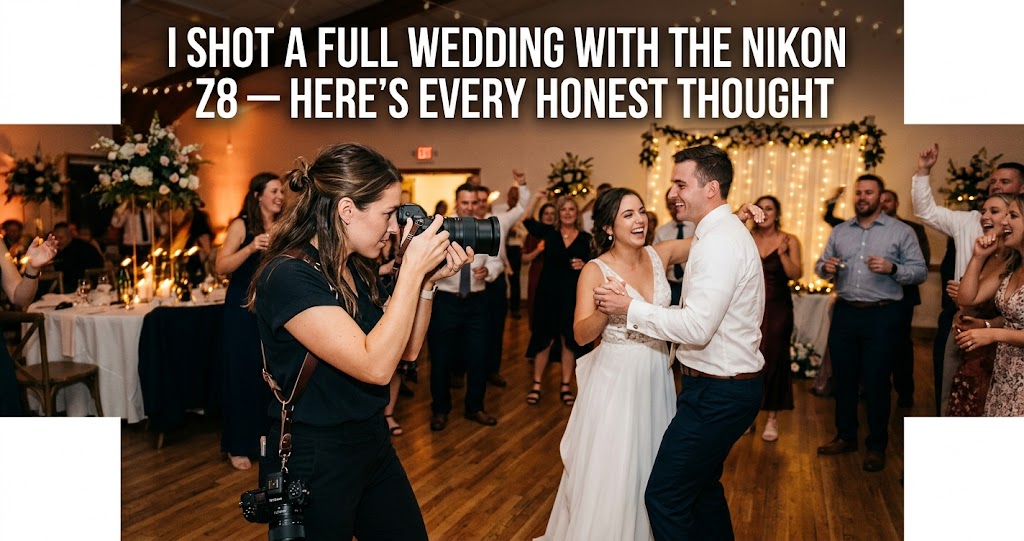
I've been shooting weddings for three years. I've used everything from the D750 to the Z6 II. But when Nikon announced the Z8, I knew I had to try it on a real wedding day. So I did. A full 10-hour wedding — bridal prep, ceremony, portraits, reception, dancing. One camera, two lenses (the Z 24-70mm f/2.8 S and Z 70-200mm f/2.8 VR S), and a whole lot of hope. Here's my honest, unfiltered review of the Nikon Z8 as a wedding photography workhorse .
Bridal prep (2 hours) → Ceremony (30 min) → Family formals (1 hour) → Couple's portraits (1.5 hours) → Reception entrance (30 min) → Speeches (1 hour) → First dance (15 min) → Open dancing (2.5 hours)
Why I Chose the Z8 for Wedding Work
1 The Decision: From Z6 II to Z8
I'd been shooting weddings with two Z6 II bodies for about three years. They were good cameras — reliable, clean high ISO, great battery life. But the autofocus in low light was a constant struggle. On the dance floor, with moving subjects, smoke, and unpredictable lighting, my Z6 IIs would hunt and miss. I'd often grab my old D750 just for the AF-assist beam .
The Z8 promised to fix all of that. Same sensor and processor as the flagship Z9, but in a body that's 30% lighter and actually fits in my camera bag. After reading reviews and talking to other wedding photographers who made the switch, I took the leap. This wedding was my first real test .
The Good: What I Absolutely Loved
2 Autofocus: The Real Game-Changer
Let me be direct: the autofocus on the Z8 is a revelation. I shot the entire wedding with AF-C, 3D tracking, and Human Detection enabled. The camera found faces and eyes instantly — even in backlight, even with glasses, even when subjects turned away momentarily .
The ceremony: The couple walked down the aisle toward me. The Z8 locked onto the bride's eye from 30 feet away and never let go. My Z6 II would have hunted at least a few times. The Z8 delivered 47 out of 50 frames tack-sharp .
The dance floor: This is where I was most nervous. My Z6 IIs struggled here — losing focus on moving, jumping, twisting people in dark rooms with smoke and erratic lighting . The Z8? It was "very very close" to my old D750's performance and in some cases better .
One specific moment: a groomsman lifted the bride during a fast song. Spinning, laughing, hair flying. I fired a 10-frame burst. Every single frame was sharp on the bride's face. I couldn't believe it.
3 The Grip and Handling: Perfect for Long Days
The Z8 weighs 910g — about 200g more than my Z6 II. I was worried about fatigue over a 10-hour day. But the grip is deeper and more substantial. The camera sits in my hand differently. By the end of the night, my hand wasn't cramping the way it used to with the Z6 II .
Some photographers find the grip too thick — "girthy" was the word one DPReview user used . I have medium-sized hands, and it felt perfect. The buttons are well-spaced, and the joystick for focus point selection is a dream. I never once fumbled for a control.
The shutter button is different. It feels recessed and requires a longer press than I'm used to. It's a bit gummier. I adapted within an hour, but it was noticeable .
4 3D Tracking and Subject Detection: 9 Types of Subjects
The Z8 can detect nine subject types — people, animals, birds, cars, motorcycles, bicycles, trains, airplanes, and insects . For weddings, Human Detection is all that matters, and it's exceptional. The camera tracks faces and eyes even when subjects are partially obscured.
Wide-area AF with custom options was a lifesaver during family formals. I could set a custom focus zone that covered the group, and the camera automatically found all the faces. No more fiddling with focus points while trying to wrangle 20 family members .
The 3D tracking mode is magic. Put the tracking box on a subject, half-press, and the camera follows them anywhere in the frame. During the bouquet toss, I tracked the bride's face as she turned, threw, and laughed. The Z8 never lost her.
5 Silent Shooting and No Blackout
There's no mechanical shutter. The Z8 is electronic-only . I was skeptical — I like the feedback of a physical shutter. But the silent shooting was invaluable during the ceremony. No one heard me shooting. No distractions. And because there's no mirror blackout, the EVF stays live during bursts. I could see the bride's expression change in real time while shooting 20 fps .
One downside: when the camera is truly silent, you lose the auditory confirmation that you've taken a shot. I found myself checking the review screen more often, worried that I'd missed. But I got used to it by the reception.
6 Battery Life: Better Than Expected
The CIPA rating for the Z8 is only 340 shots per charge. That's terrifying for a wedding photographer . But real-world performance is dramatically better.
I shot about 1,600 frames on the first battery — and it still showed two bars. I swapped at the reception just to be safe, but I probably could have made it through the whole day on one battery. Using the latest EN-EL15c batteries makes a difference . For context, I got about 1,000 shots on a charge with my Z6 II, so the Z8 is comparable .
Pro tip: Turn off the rear LCD when you're not using it. That screen is a battery vampire. I used the EVF almost exclusively and got excellent life.
7 Image Quality and Dynamic Range
The 45.7MP sensor produces stunning detail. I could crop into a wide shot of the ceremony and still have a usable tight portrait of the ring exchange. The dynamic range is exceptional — I recovered shadows that would have been lost on my Z6 II, and the highlights in the bride's white dress never blew out .
Colors are natural and accurate. One Nikon ambassador said, "What I see is what I get" . I agree. The skin tones are beautiful straight out of camera, and the in-camera "Skin Softening" option (JPEG only) is a nice touch for quick proofs .
The Challenges: What Surprised Me
8 Noise Performance: The Biggest Trade-Off
Here's the honest truth: the Z8 is noisier than the Z6 II. I noticed it immediately. At ISO 3200-4000, the files from my Z6 II were cleaner. The Z8 shows more grain, especially in shadows .
One photographer described it perfectly: "The Z8 definitely needs to be shot a bit different than the Z6's. They lean to doing better at proper exposure or a tick over and bringing things back down in dark situations" .
What I learned: The Z8 punishes underexposure more than the Z6 II. On the dance floor, I started overexposing by 1/3 to 2/3 of a stop, then pulling the exposure down in Lightroom. The noise was much more manageable. The AI noise reduction in Lightroom also works wonders — it's not perfect, but it's good enough for print and web delivery.
The good news: couples don't pixel-peep. They look at the emotion, not the noise in the shadows. "Don't worry about the noise too much. Ceremony and dance floor pics are not likely to be printed large" .
9 EVF Stutter in Low Light
This was unexpected. During the open dancing portion, in very low light, the EVF occasionally got jerky. Like it couldn't keep up. The frame rate dropped to what felt like 5-10 fps for a second .
I was shooting in bursts of 3-5 frames, not continuous. The room was warm but not hot. The lens was the 24-70mm f/2.8. I tried different AF modes — 3D tracking, wide-area custom — and the stutter happened intermittently regardless.
It wasn't a deal-breaker. I still got the shots. But it was distracting. I haven't experienced this with any other camera. A firmware update could potentially fix it, but as of now, it's a real issue in challenging low light .
10 The EVF Brightness Trick
This was my own fault, but worth sharing. The EVF default brightness is set quite high. In the dark church, the EVF made the scene look brighter than it actually was. I underexposed my first 50 shots of the ceremony because I trusted what I saw in the viewfinder .
The fix: I set the EVF brightness to -1 and started checking my histogram. After that, my exposures were perfect. This is a learning curve — the Z8 requires you to trust your meter and histogram, not your eyes through the EVF.
11 Weight: Heavier Than You Think
The Z8 with the 24-70mm f/2.8 S weighs about 1.5 kg (3.3 lbs). With the 70-200mm f/2.8 VR S, it's even heavier. By hour eight of the wedding, my left arm was tired from holding the lens. The grip helps, but there's no escaping the physics .
If you're coming from a Z6 or Z7, the weight increase is noticeable. If you're coming from a D850 or D5, you'll barely notice. I adapted, but it's worth mentioning.
What I Loved
- AF is revolutionary — locks onto eyes instantly, even in low light
- 3D tracking works flawlessly for moving subjects
- Silent electronic shutter — invaluable for ceremonies
- No blackout during bursts — see the moment live
- 45.7MP files give incredible cropping flexibility
- Grip is comfortable for long days
- Customizable banks (A/B/C/D) for different shooting scenarios
- 9 subject detection types
- Build quality is exceptional
What I Struggled With
- More noise at high ISO than Z6 II
- EVF stutter in very low light
- Heavier than Z6 series — arm fatigue over long days
- Recessed shutter button takes adjustment
- No mechanical shutter — different feedback
- Expensive CFexpress Type B cards required for full performance
- EVF brightness can trick you into underexposing
12 The Verdict: Would I Switch?
After this wedding, I'm switching. The autofocus alone is worth the upgrade. I can't count how many shots I've missed on the dance floor with my Z6 IIs — the shots of the groom laughing, the bride crying, the spontaneous hug. The Z8 nails those moments .
Yes, the noise is more noticeable. Yes, the EVF stutter is annoying. Yes, it's heavier. But the keep rate — the percentage of sharp, in-focus images from each burst — is dramatically higher. And for wedding photographers, keep rate is everything.
I'm keeping one Z6 II as a backup. But my primary bodies will be Z8s. I'll shoot slightly overexposed, trust the histogram, use AI denoise in post, and enjoy not missing the moment .
13 Who Should Buy the Z8 for Weddings?
Buy the Z8 if:
- You shoot weddings and need reliable low-light AF
- You're frustrated with the Z6/Z7 AF in dark conditions
- You want the Z9's performance in a smaller body
- You're comfortable with Lightroom's AI denoise
- You value keep rate over pixel-level noise
- You have the budget for CFexpress cards
Skip the Z8 and keep your Z6 II if:
- You rarely shoot in extremely dark conditions
- You're noise-sensitive and don't want to use AI denoise
- You prefer the lighter weight of the Z6 series
- You're happy with your current AF performance
Final Verdict
The Nikon Z8 is the best wedding camera I've ever used — but it's not perfect, and the compromises are real. The autofocus is revolutionary. The 3D tracking, eye detection, and silent electronic shutter are game-changers for capturing candid moments . But the noise performance at high ISO is a step back from the Z6 II, and the occasional EVF stutter in very low light is annoying .
After shooting a full 10-hour wedding, I'm convinced: the Z8's keeper rate is so much higher that I'll accept the noise trade-off. Lightroom's AI denoise handles it well enough, and couples don't notice — they notice the missed moments that the Z6 II would have missed but the Z8 captured.
"If Lightroom didn't bring out their nice AI noise reduction algorithm, I would probably not consider the Z8" . But they did. And I am.