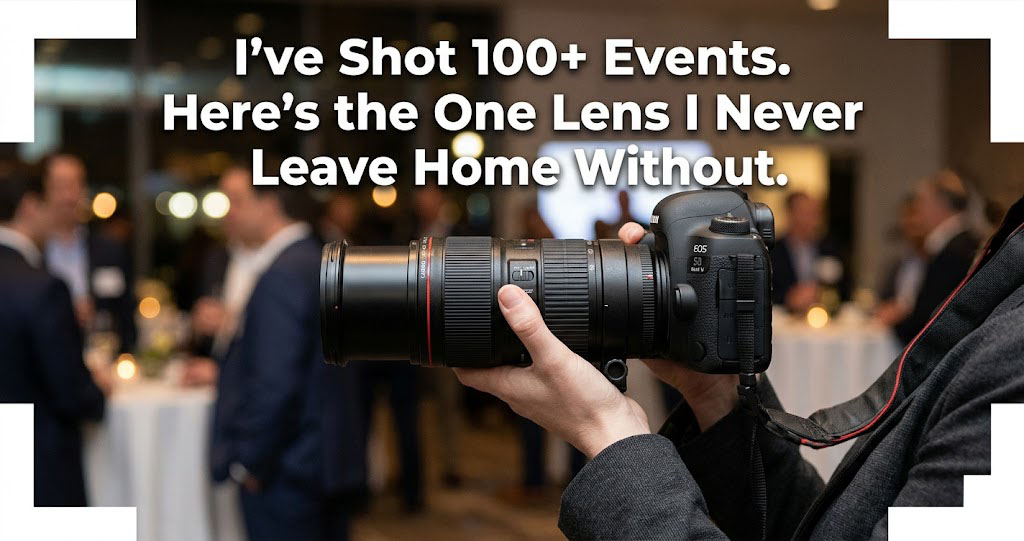
After over 100 weddings, corporate galas, concerts, and conferences, the Tamron 35-150mm F2-2.8 Di III VXD is the single lens I trust to handle it all. It's not perfect — it's heavy and doesn't cover ultra-wide angles. But its unique 35-150mm range with a blazing F2-2.8 aperture has replaced both a 24-70mm and a 70-200mm in my bag for most events . I've taken it to ballroom dance competitions that ran 15 hours straight with 158 events, and it never left my camera body . I've used it at night festivals where switching lenses would have meant missing the shot . And I've shot entire weddings with just this one lens, saving my back and my sanity .
The Moment I Knew: A 15-Hour Dance Competition
1 When One Lens Saved an Entire Shoot
A few years ago, I was hired as the sole official photographer for a ballroom dance competition. 158 events spanning 15 hours, with multiple participants per event, and sometimes multiple events happening simultaneously across split floors . The lighting was dim — typical indoor arena lighting — and I couldn't afford to miss a single moment.
Traditional wisdom says you need two camera bodies with a 24-70mm and a 70-200mm. But that setup means constant lens switching, increased weight, higher cost, and the very real risk of missing critical moments .
I brought backup equipment (you always need spares for a shoot like this!), but I ended up only using the Tamron 35-150mm for the entire duration. The lens did not leave my camera body at all .
Why the 35-150mm Range Is Perfect for Events
2 The Focal Length That Does It All
Event photography is chaotic. You don't know where the action will be. You can't predict if the next moment will require a wide shot of the whole room or a tight close-up of a tear rolling down someone's cheek.
At 35mm, I capture wide environmental shots showing the entire venue, atmosphere, and multiple people interacting. It's wide enough for group photos, establishing shots, and capturing the energy of a room.
At 150mm, I zoom in for intimate close-ups of individual subjects, capturing facial expressions, small details, and candid moments from across the room. The compression at 150mm is beautiful for portraits, making faces look natural and backgrounds melt away.
One event photographer described it perfectly: "This focal range covered the same ground as both a 24-70mm and a 70-200mm lens, which meant I could leave my other lenses behind and avoid frequent lens changes — a big plus during a fast-paced event" .
Here's the thing about the 150-200mm gap: in most event situations, you're close enough to the action that you don't need that extra 50mm. For indoor sports like basketball, volleyball, or dance competitions, 150mm is plenty . And for weddings, the 150mm end gives you beautiful candid shots from across the reception hall.
The Fast Aperture: F2-2.8 Changes Everything
3 How I Shoot in Dim Lighting Without a Flash
Event lighting is rarely ideal. Ballrooms are dark. Concert venues are darker. Church ceremonies are often lit only by natural window light that fades as the sun goes down. I've shot in all of these conditions with this lens, and the fast aperture is why.
The Tamron 35-150mm starts at F2 at 35mm and only closes to F2.8 by 150mm . That's nearly a full stop faster than a constant F4 lens, and about 1/3 stop faster than a constant F2.8 at the wide end. In practical terms, this means:
- I can keep my shutter speed at 1/800s or higher to freeze motion without raising ISO into unusable territory
- I get beautiful background separation (bokeh) even at the 35mm end
- I can shoot in near-darkness without a flash, preserving the natural atmosphere
One wedding photographer on a forum put it simply: "For weddings and events, you need something faster than f2.8 in the 35-50mm range. Ideally f1.4, but the f2 on the 35-150 can work" . And it does work — I've shot entire receptions with just this lens, no flash, and delivered clean, usable images at ISO 6400.
Autofocus That Never Lets Me Down
4 VXD Linear Motor Performance in Real-World Conditions
I've shot dance competitions where subjects move unpredictably, changing direction in an instant. I've shot weddings where the couple walks down the aisle toward me at varying speeds. I've shot festivals at night where lighting was inconsistent and subjects were backlit.
The VXD (Voice-coil eXtreme-torque Drive) linear motor has never let me down. It delivers fast, consistent autofocus for both stills and video . Even when dancers were mostly in shadows or backlit, the autofocus performed flawlessly — a challenge for some third-party lenses, but I can safely say I found no issues while shooting .
One festival photographer noted: "Despite my initial concerns about focusing speed in dim light, the lens performed remarkably well, quickly locking focus when I needed it" .
The Eye AF performance on Sony and Nikon Z remains stable across the zoom range, making this lens particularly strong for weddings, portrait sessions, and unpredictable environments . I've tracked running children, dancing guests, and moving speakers without losing focus once.
No Lens Swapping = No Missed Shots
5 The Productivity Advantage of One Lens
For professional event coverage with back-to-back events, lens changing isn't just inconvenient — it's professionally unacceptable . I've seen fellow photographers miss the bouquet toss because they were switching lenses. I've watched a colleague fumble with a lens change during a first dance and lose the shot forever.
This all-in-one lens stays mounted from start to finish. I never once wished I had brought something else .
As one photographer on DPReview noted: "swapping lenses is not realistic in events and weddings. especially between 24-70 and 70-180" . The 35-150mm eliminates that problem entirely.
This also means I can travel lighter. Instead of carrying two bodies and three lenses, I bring one body, this lens, and maybe an ultra-wide for specific shots. My back has thanked me after every 12-hour wedding day.
Image Quality: Sharp Enough for Professional Work
6 What I've Learned About Sharpness in the Field
I'm not concerned about sharpness test charts on paper. In real-world conditions, sharpness is way more than good enough for a lens of this range and calibre .
This versatile zoom produces very detailed and vibrant images, especially in situations where lighting on subjects was inconsistent. The colors are accurate and vibrant, with excellent micro-contrast throughout the zoom range .
Wide-open sharpness at F2 and F2.8 exceeds expectations for a high-range zoom, while micro contrast and color rendering remain natural and dimensional . Telephoto compression produces crisp detail and flattering skin tone transitions — ideal for portrait and lifestyle work .
One reviewer summed up the optical quality: "The lens flare even wide open looks so nice — I quite like how they appear in my resulting images" .
The Trade-Off: Weight and Handling
7 The Only Real Downside (And How I Manage It)
Let's be honest: this lens is heavy. At 1,165g (Sony E-mount) or 1,190g (Nikon Z), it's about twice the weight of a typical 24-70mm F2.8 . Over the course of a 15-hour shoot where I walked 8km inside an enclosed ballroom, the weight was noticeable .
But here's the counterpoint: it is still lighter and more manageable than carrying two camera bodies with two lenses throughout the day . I'd rather carry one heavy lens than two bodies and three lenses.
My weight management strategies:
- Use a dual camera strap (like the HoldFast Money Maker) to distribute weight across both shoulders
- Take breaks when possible — rest the camera on a table, chair, or your thigh
- Use a monopod for longer events (though I rarely need it)
- Consider a lens skin to improve grip and reduce friction on your hands
One photographer noted: "For people with more sensitive skin, extended use might result in blisters or skin irritation due to friction over time. I would advise getting a lens skin or wearing gloves should you run into this inconvenience" .
Tamron 35-150mm vs Traditional Event Kit
8 What's Missing: The Ultra-Wide Gap
The one thing this lens doesn't cover is the ultra-wide range. At 35mm, it's wide enough for most event photography — group shots of 6-8 people, environmental portraits, establishing shots. But for tight spaces, large group photos (20+ people), or dramatic architectural shots, you'll want something wider.
My solution: I carry a small wide-angle prime or zoom in my bag for the 5-10% of shots that need it. On Sony, I use the Sony 20mm F1.8. On Nikon, the Z 20mm F1.8 S works beautifully. With that combination, I'm covered from 20mm to 150mm with just two lenses .
9 Who This Lens Is For
Based on my experience and the feedback of dozens of event photographers , this lens is ideal for:
- Wedding photographers who need to react instantly to unpredictable moments
- Event shooters covering corporate galas, conferences, and concerts
- Sports photographers shooting indoor venues like basketball courts and dance competitions
- Travel photographers who want professional quality without carrying multiple lenses
- Hybrid creators filming and photographing on the go
- Portrait photographers wanting prime-like background rendering across a zoom range
Final Verdict: The One Lens I'll Never Leave Home Without
The Tamron 35-150mm F2-2.8 is the single most important lens in my event photography kit. After 100+ events, I've learned that the ability to zoom from 35mm to 150mm without swapping lenses — while maintaining a fast F2-2.8 aperture — is transformative . I've captured moments I would have missed with any other lens.
Yes, it's heavy. Yes, it doesn't cover ultra-wide angles. Yes, the 150-200mm gap means you'll need a longer lens for some scenarios. But for the vast majority of event work — weddings, corporate events, concerts, festivals — this lens is all you need .
I've shot ballroom dance competitions, mid-autumn festivals, weddings, and corporate galas with this lens alone. I've walked 8km in a single day with it on my camera. And I've never once wished I had brought something else .
If you shoot events for a living, do yourself a favor: try this lens. It might just change how you work.
- Shooting mode: Manual with Auto ISO (set minimum shutter speed to 1/250s for general events, 1/800s for dance/sports)
- Aperture: F2.8 at 35mm, or open to F2 when you need maximum light
- Focus mode: AF-C with Eye AF enabled for people
- Custom buttons: Assign a button to switch between 35mm and 150mm quickly (not possible physically, but muscle memory helps)
- Carry a wide-angle prime: I use a 20mm F1.8 for the 5% of shots that need it