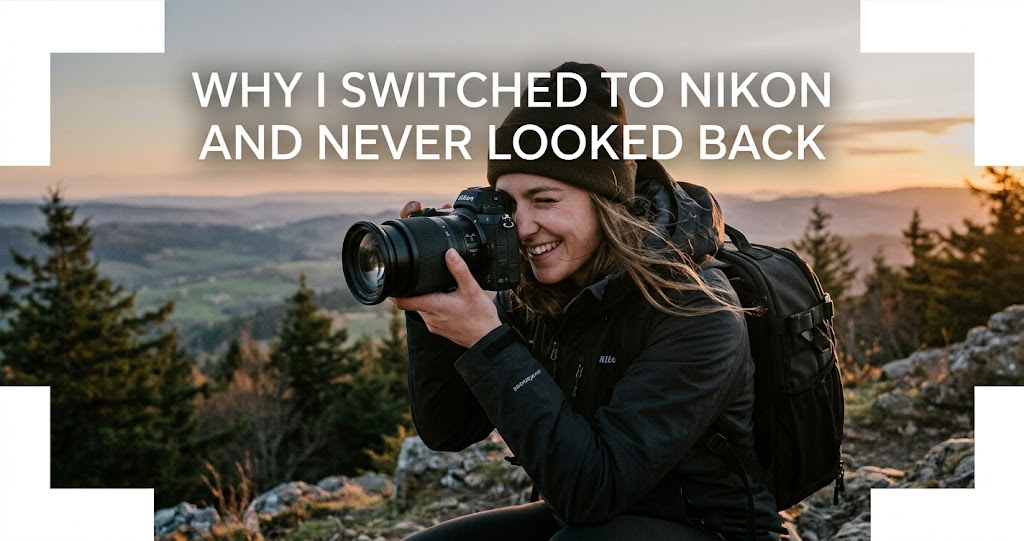
After years of shooting Sony, I switched to Nikon — and I'm not going back. The ergonomics, the Z mount lenses, the color science, and the physical controls all work for me in ways my Sony never did. It wasn't an easy decision, and it cost me thousands of dollars. But after six months of shooting with Nikon Z, my keeper rate is higher, my editing time is lower, and I actually enjoy holding my camera again .
Where I Started: My Life Before Nikon
1 I Was a Sony Shooter for Years — And It Was Fine
I started my professional journey with Sony. The A7 III was my first full-frame camera, and I loved it. The autofocus was incredible. The eye tracking was magical. The image quality was excellent. For weddings, portraits, and events, the Sony system delivered .
But after a few years, little frustrations started adding up. The menus were a maze. The ergonomics never felt right in my hands — the grip was too shallow, and my fingers always felt cramped . And while the images were technically excellent, I never loved the colors. Skin tones often required extra work in post.
One wedding photographer who made the same switch described it perfectly: "After hours of shooting, my right hand would cramp. The grip was too shallow, and the button placement forced my hand into an awkward position." I felt that same fatigue on long event days.
The Turning Point: Picking Up a Nikon Z8
2 The First Time I Held a Z8, Something Clicked
At a camera trade show, I picked up a Nikon Z8. Within seconds, I knew something was different.
The grip was deeper. My fingers wrapped around it naturally, not cramping. The camera felt substantial — not heavy, but solid. The button layout put the controls where my fingers expected them to be .
As one photographer noted, "I chose Nikon for its ergonomics and image quality. The deep grip made shooting for 10+ hours actually comfortable" .
I rented a Z8 for a weekend. I shot portraits, street scenes, and a family session. The images were stunning. The colors were natural, warm, and required almost no editing. The RAW files had incredible latitude. And the camera didn't fight me — it felt like an extension of my hands.
The Z8's ergonomics are nearly perfect for my medium-to-large hands. The grip allows me to carry it for hours without strain. The buttons are customizable, and the tactile feedback is excellent .
3 The Z Mount Lenses: Sharper Than I Expected
When I first heard about the Z mount's 55mm diameter and short flange distance, I thought it was marketing hype. Then I shot with the Z 50mm f/1.2 S.
The sharpness wide open is remarkable. The fall-off from in-focus to out-of-focus is smooth and natural. And the color rendering — I can't overstate how good the colors are straight out of camera .
One reviewer who switched from Sony noted: "The Z mount lenses are among the sharpest I've ever used. The 50mm f/1.2 S is a masterpiece" .
I've since added the Z 24-70mm f/2.8 S and the Z 70-200mm f/2.8 VR S to my kit. Both are optically superb. The 24-70mm is my workhorse for events, and the 70-200mm is my portrait secret weapon. The VR (vibration reduction) in the 70-200mm is so effective that I can shoot handheld at 1/30s at 200mm and get sharp images.
The Sony vs Nikon Comparison That Sealed the Deal
4 Head-to-Head: What Each System Does Better
After shooting both systems extensively, here's my honest assessment.
Sony vs Nikon: My Personal Scorecard
The Color Science Revelation
5 Why I Spend Less Time Editing Now
One of the biggest surprises after switching was how much less time I spent in Lightroom. Nikon's color science — particularly for skin tones — is outstanding. The reds are rich, the greens are natural, and skin doesn't require the extra work it did with my Sony files.
A wedding photographer who switched from Sony to Nikon said: "I noticed an immediate difference in skin tones. They just look more natural, less clinical. My clients noticed before I did" .
I've found that Nikon's JPEGs are also more usable straight out of camera. For event work where I need to deliver sneak peeks quickly, this is a huge advantage. I can shoot RAW+JPEG, deliver the JPEGs immediately, and edit the RAWs at my leisure.
The Nikon picture controls (Standard, Neutral, Vivid, Monochrome) are also more nuanced. I've customized a profile that gives me the look I want with minimal post-processing.
The Practical Reality: Weight, Cost, and Learning Curve
6 The Downsides I Had to Accept
Switching systems wasn't cheap. I sold all my Sony gear — bodies, lenses, flashes — and bought into Nikon Z. The financial hit was significant .
There was also a learning curve. The Nikon menu system, while more intuitive, was different. Customizing the buttons took time. And the Z8's electronic viewfinder (EVF) took getting used to after Sony's EVFs, though the Z8's is excellent .
One photographer who switched noted: "The Z system is heavier than Sony. The lenses are larger. But for me, the trade-off in image quality and handling is worth it" . I agree. The Z8 with the 24-70mm f/2.8 is heavier than my A7 III with the same equivalent lens, but the grip distributes the weight better. I don't feel more fatigued — I feel more comfortable.
The cost of Z mount lenses is also higher than Sony's third-party options. There's no Tamron or Sigma equivalent for many Z mount lenses yet. Native Z glass is superb, but you pay for it .
7 What I Miss About Sony (And What I Don't)
I'll be honest — there are things I miss. The third-party lens support on Sony is unmatched. Tamron and Sigma make incredible glass for E-mount at reasonable prices. Nikon is catching up, but it's not there yet .
The autofocus on the A7 III and A7 IV was also more forgiving in some ways. The Z8's AF is excellent, but it has a different character. It's more precise but sometimes less sticky than Sony's Real-time Tracking. For weddings, this took adjustment.
But here's what I don't miss: the cramped grip, the maze-like menus, the feeling that I was operating a computer rather than a camera, and the extra hour of editing per wedding to fix skin tones .
Final Verdict: Why I'm Not Going Back
Switching to Nikon was the right decision for me — not because Sony makes bad cameras, but because Nikon makes cameras that fit my hands, my workflow, and my creative vision better. The ergonomics are superior. The color science saves me hours of editing. The Z mount lenses are optically stunning. And after six months, I've never once wished I had my Sony gear back .
If you're considering switching systems, my advice is simple: rent the camera you're considering. Shoot with it for a weekend. See how it feels in your hands. Edit the RAW files. The right system for you is the one that disappears when you're shooting — that becomes an extension of your eye and your hands.
For me, that system is Nikon. And I've never looked back.
- Rent before you buy. Spend a weekend with the camera you're considering. Shoot your typical subjects. Edit the files.
- Don't switch for specs alone. Specs on paper don't matter as much as how the camera feels in your hands.
- Consider the lens ecosystem. If you rely on third-party lenses (Sigma, Tamron), Sony still has the advantage.
- Test the ergonomics. Hold the camera for 30 minutes. If your hand cramps, it's not for you.
- Edit the RAW files. Color science is personal. What works for me might not work for you.