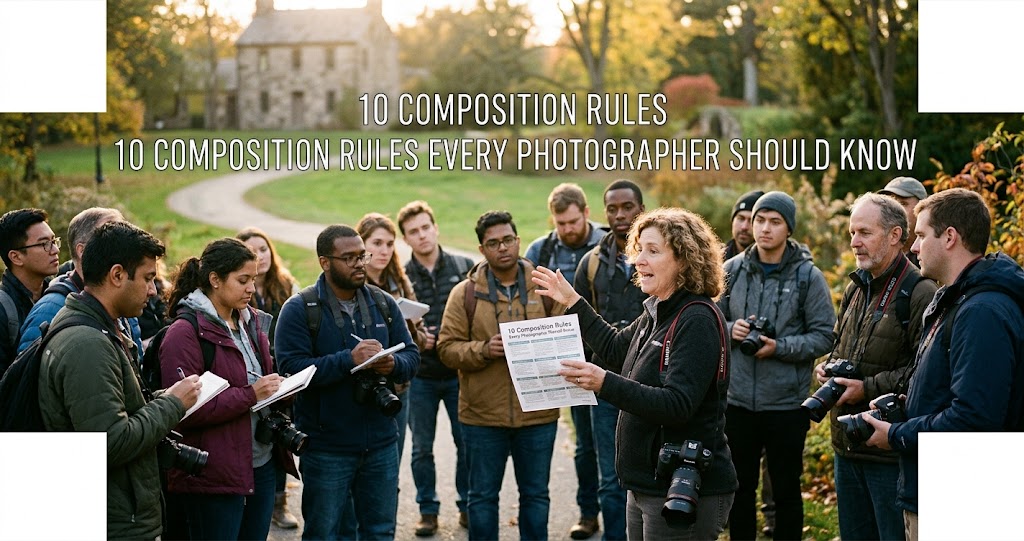
Composition is the strongest way of seeing. It's the placement or arrangement of visual elements in a photograph based upon why you are taking the shot, what your subject is, and how you want people to feel about the scene . If you can't compose an image, you can't take photos—that's the bottom line .
Many beginners feel overwhelmed by the so-called "rules" of composition. But as Ansel Adams once said, "There are no rules for good photographs, only good photographs" . Think of these rules as guidelines—a starting point that helps you create balanced, engaging images . With practice, these concepts become second nature, and eventually instinctual .
Here are the 10 composition rules every photographer should know, with practical tips you can apply immediately.
1 The Rule of Thirds
The rule of thirds is perhaps the most popular principle of photography composition . Imagine your frame divided into nine equal sections by two vertical and two horizontal lines—like a tic-tac-toe grid. The idea is to place your subject along these lines or at their intersections .
Why it works: The rule of thirds creates a sense of balance and harmony while allowing the viewer's eyes to move naturally across the photograph . Never place the horizon of a landscape image in the center—always put it on one of the horizontal two-thirds lines .
How to apply it: Enable the grid overlay on your camera or phone. Position key elements along the lines or at intersection points. For portraits, place the subject's eyes at one of the upper intersections .
2 Identify Your Subject Clearly
This is the non-negotiable of photography. Unless your subject is the focal point of the image, you don't have a photo . When looking at the image, a person should be able to clearly identify the subject .
Common mistake: Trying to include too much in an image often spoils it. An image that is cluttered causes the viewer's eye to dart around trying to make sense of it .
The fix: Give enough attention to the subject of your focus . If an element doesn't add value—whether visually or emotionally—leave it out .
3 Fill the Frame
This mantra, inspired by war photographer Robert Capa's famous words—"If your pictures aren't good enough, you're not close enough"—can transform your photography . Filling the frame means including only the elements that need to be there .
How to do it: Get in closer and exclude the parts that you don't want. Open space serves no purpose when the subject is too small or cannot be identified . Pay close attention to your subject, the foreground, the background, and the edges of your frame .
This isn't just about cropping tightly—it's about visual editing in real-time .
4 Use Leading Lines
Leading lines are powerful tools that guide the viewer's eye toward the subject, creating depth and perspective . They can be natural (rivers, roads, paths) or man-made (fences, railings, bridges) .
Why they work: Lines lead the eye to focal points. A river, road, fence, or path in a classic S-shape draws the eye along the route into your image . Diagonal lines add depth and a sense of direction .
Look for: Roads disappearing into the distance, railway tracks, shorelines, shadows, and architectural lines. Position yourself so these elements draw attention to your subject.
5 Frame Within a Frame
Framing involves using elements within your scene to create a "frame" around your subject . This technique helps isolate the subject and adds emphasis, giving a sense of depth and focus to the image .
Types of frames: Natural frames include openings in trees or rock formations. Man-made frames are doorways, windows, or arches . All of these help contain the subject or scene in a form that is pleasing to the eye .
Effective framing: Use a wide aperture (small f-stop number) to blur the frame slightly while keeping it visible, creating a sense of depth and intimacy .
6 Simplify and Eliminate Distractions
The best photo composition is often the simplest one. Eliminate anything in your photo that isn't truly necessary to tell the story that you want to share .
What to watch for: Make sure there is nothing in the background that detracts from your subject—things like chimneys growing out of heads and other subjects diverting the eye . Pay attention to the background, foreground, and edges of your frame .
Techniques to simplify: Move the camera, move the subject, wait for something to clear the background, or physically remove distracting items .
7 Use Negative Space
Negative space refers to the empty areas around your subject . When a photo gets too crowded, the viewer doesn't know where to look . Negative space allows the subject to breathe and command attention .
Balance is key: Too much negative space can make your subject too small to be noticed . Don't make your viewers hunt for the subject or guess what the photo is about .
How to use it: Look for open areas around your subject—a clear sky, an empty wall, or a plain background. Use negative space to enhance simplicity and create a more powerful image .
8 Balance and Symmetry
Balance ensures that no part of the photo feels heavier than another, creating harmony and stability . Symmetry, where elements are mirrored on either side of the image, can create a powerful visual impact .
When to center your subject: While the rule of thirds suggests placing subjects off-center, centering can give your subject a sense of power and command the space . Use reflections to achieve symmetry of your subject .
Balance with asymmetry: Asymmetry can also be used effectively, providing tension and interest . For example, if one side of the frame has a large tree, balance it with a smaller object on the opposite side .
9 Change Your Perspective
Shoot from high up or low down. Use your feet and move around the subject looking for an optimum angle . Don't be afraid to get down on your stomach or climb a tree .
Avoid A.E.L. Disease: Always Eye Level disease is a common pitfall . Don't take every photo from the same perspective. Experiment with high angles, low angles, and even tilting the camera .
Why it matters: Changing your perspective can significantly alter how a scene is perceived, transforming everyday scenes into visually compelling images .
Try this: Get low to the ground for a worm's-eye view, or climb to a higher vantage point for a bird's-eye view .
10 Look for Patterns, Shapes, and Textures
Patterns and shapes create visual interest and rhythm in the image . Look for interesting patterns, lines, and shapes in your environment .
Pattern interrupted: A pattern interrupted catches the eye. When you have a repeating pattern and something breaks it, the viewer immediately gets attracted to the thing that's different .
Diagonal lines and triangles: Diagonal lines add interest that most people ignore . They indicate travel and allow for division of elements using shapes like triangles, which can be visually powerful in a photo .
Beyond the Rules: The Philosophy of Composition
Edward Weston noted, "Rules of composition are deduced from the work of strong masters and used by weak imitators to produce nothing" . The science backs this up: rules can put creativity in a box, making it harder to think outside of it .
Here's a more practical approach: composition is the placement or arrangement of visual elements based upon why you are taking the shot, what your subject is, and how you want people to feel about the scene .
Know Your Why
Before you even pick up your camera, ask yourself: Why am I taking this shot? This purpose influences every decision—from composition to lighting and exposure .
Consider Emotion
How do you want the viewer to feel? The emotional impact of your image is crucial to its success .
Composition Do's and Don'ts
Do
- Identify your subject clearly
- Fill the frame with what matters
- Watch your background for distractions
- Look for lines, patterns, and shapes
- Work your shot—take multiple angles
Don't
- Don't amputate—cut off parts unintentionally
- Don't always shoot at eye level
- Don't include elements that don't add value
- Don't let the horizon split the frame in half
- Don't settle for your first idea
Turning Concepts into Habits
Composition is present in every photograph you take, whether or not you think about it . The key is to make the process of thinking about composition a habit. With practice, these guidelines will become second nature and eventually instinctual .
Create a mental checklist: Think before you press the shutter button and consider all of these points. Create a mental checklist to help you add these elements and create that great composition .
"Your BEST shot is your NEXT shot!"
— Joe EdelmanPractice Exercises to Build Your Eye
- One spot, 24 frames: Stand in one place and make 24 unique frames without moving your feet. You must recompose by zoom, angle, or subject focus .
- Symmetry vs. asymmetry: Shoot a symmetrical scene, then intentionally break the symmetry by shifting your subject off-center .
- Quality over quantity: Limit yourself to only 6-10 frames in a session. This forces careful planning .
- Pattern interrupted: Photograph a repeating pattern, then capture it with something that breaks the pattern .
Final Thoughts
Great photography isn't about following rules; it's about mastering tools and techniques that allow you to express your creative vision . These practical concepts will help you move beyond the constraints of traditional rules and create photographs that are uniquely yours .
Remember: composition is the strongest way of seeing. It's about telling a story, evoking emotion, and guiding the viewer's eye through your image. Practice these rules until they become second nature—then feel free to break them intentionally.