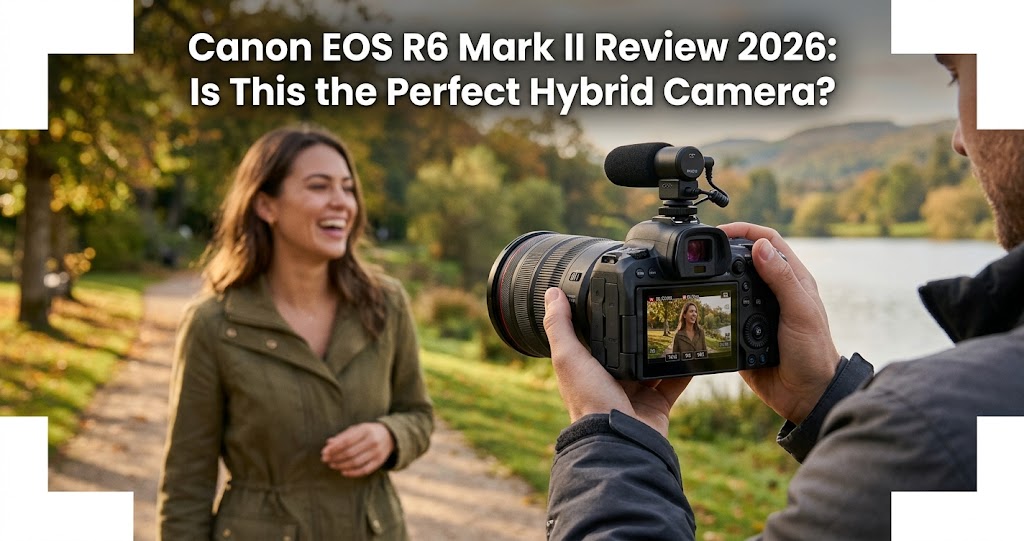
The Canon EOS R6 Mark II is still the perfect hybrid camera for most photographers in 2026 — especially at current used prices. With a 24.2MP sensor, 40fps electronic burst, 6K oversampled 4K 60p video, and class-leading Dual Pixel AF II, it remains a formidable all-rounder . At used prices of $1,600-1,800 USD (¥218,100-¥224,400 in Japan), it offers exceptional value compared to the newer R6 Mark III .
Why the R6 Mark II Still Matters in 2026
Announced in November 2022 as the successor to the original R6, the R6 Mark II was a substantial upgrade that addressed nearly every criticism of its predecessor . Three years later, with the R6 Mark III now available, the Mark II has become one of the best values in the full-frame mirrorless market .
The camera market has shifted dramatically — the R6 Mark III launched at $2,999-3,200 USD, while used R6 Mark II bodies can be found for $1,600-1,800 . For photographers who prioritize value over having the absolute latest features, this is a compelling equation. As one reviewer put it: "You can literally buy two Mark II bodies for the price of one Mark III" .
1 Canon EOS R6 Mark II — Core Specs (2026)
Image Quality: The Goldilocks Resolution
The 24.2MP sensor hits a sweet spot. It's high enough for large prints and cropping, yet low enough to keep file sizes manageable and high-ISO noise under control .
Dynamic range is excellent. The R6 Mark II captures approximately 13.5 stops of dynamic range at base ISO. Highlights can be recovered in post, and shadow lifting is clean up to about 3 stops. For hybrid shooters working in mixed lighting, this flexibility is invaluable .
Low-light performance is a standout feature. The native ISO range extends to 102,400 (expandable to 204,800) . In real-world testing, images are clean up to ISO 6400 and very usable at ISO 12800. For event photographers, wedding shooters, and documentary filmmakers working in uncontrolled lighting, this low-light capability is genuinely excellent .
Autofocus: Class-Leading Dual Pixel AF II
The R6 Mark II's Dual Pixel CMOS AF II system remains one of the best in the industry, even against newer competition . With 1,053 AF zones covering virtually the entire frame, subject detection is fast, consistent, and works seamlessly across photo and video modes .
Subject recognition has been expanded significantly from the original R6. In addition to body, eye, face, head, and animal recognition (now including horses and zebras — yes, you read that right), the R6 II can recognize cars, motorcycles, aircraft, and trains too .
What still works great: Eye AF for humans and animals is fast and sticky. The camera reliably locks onto eyes and tracks them through movement. Real-time Tracking for general subjects works well. Focus acquisition is nearly instant in good light.
Touch-to-focus during video is a feature Sony still hasn't fully matched. Tapping the rear touchscreen instantly shifts focus to a new subject — a game-changer for solo operators .
Burst Shooting and Pre-Capture: Never Miss the Moment
The R6 Mark II offers impressive burst rates: 40 fps with the electronic shutter (JPEG/HEIF) and 30 fps with RAW capture . The mechanical shutter delivers a reliable 12 fps.
RAW Burst Mode with 0.5 second pre-shooting buffer is a genuine advantage. The camera continuously buffers images as soon as you half-press the shutter. When you fully press, the previous 0.5 seconds of frames are saved. For wildlife, sports, and unpredictable moments, this is invaluable .
Buffer depth: The R6 Mark II can capture approximately 1,000+ JPEG frames in a single burst before slowing. For RAW shooters, the buffer handles around 100 frames — more than sufficient for most action sequences.
Video Capabilities: The Main Event
The R6 Mark II records 4K 60p video using the full width of the sensor with 6K oversampling . There is a minor 1.07x crop in 4K 60p mode, but the results are sharp, detailed, and free of moiré.
4K 120p slow motion is available with a 1.6x crop. This allows for dramatic 5x slow-motion effects, though the crop limits wide-angle options.
10-bit 4:2:2 internal recording is supported in XF-AVC S and MP4 formats. C-Log3 is included for maximum dynamic range, and Canon's C-Log3 is widely praised for natural skin tone reproduction and ease of use in post-production .
Unlimited recording time is a major advantage over the A7IV. The R6 Mark II has no official recording limit, making it suitable for interviews, events, and long-form content .
Heat management: The R6 Mark II handles extended recording well, though 4K 120p in hot conditions may trigger thermal warnings. Canon's official guidance suggests enabling "Temperature Rise Mitigation" in video settings for extended shoots .
Image Stabilization: 8 Stops of Handheld Magic
The R6 Mark II's 5-axis in-body image stabilization is rated at 8 stops when paired with compatible RF lenses with optical IS . This is a significant advantage over Sony's 5.5-stop IBIS .
In practice, I've shot handheld at 1/4 second with a 35mm lens and achieved consistently sharp results. For low-light event photography and handheld video, this is a game-changer.
Coordinated IS control when using RF lenses with optical stabilization combines both systems for maximum effectiveness. The system works particularly well with lenses like the RF 24-105mm f/4L IS USM, delivering buttery-smooth walk-and-talk shots .
Firmware Updates: Continuous Improvement
📢 Key Firmware Updates (2025-2026)
- Autofocus improvements: Enhanced subject tracking stability, particularly for video
- Temperature management refinements: Better heat dissipation algorithms for extended 4K recording
- Improved RF lens compatibility: Optimized IS performance with newer RF glass
- Bug fixes: Addresses minor menu and connectivity issues
Canon has been consistently updating the R6 Mark II, addressing early concerns and improving stability. The camera has reached a mature firmware state, with most updates now focusing on minor refinements rather than major feature additions.
R6 Mark II vs R6 Mark III (2026 Comparison)
Canon EOS R6 Mark II vs R6 Mark III — Key Differences
The R6 Mark III is objectively a more capable camera — 32.5MP, 7K RAW internal recording, open gate video, and CFexpress support . But at roughly 1.5-2x the used price, the R6 Mark II offers exceptional value for photographers who don't need the latest video specs or higher resolution .
R6 Mark II vs Sony A7IV: The Hybrid Showdown
Sony A7IV vs Canon R6 Mark II — Which Is Better for Hybrid Shooters?
The A7IV offers higher resolution and no-crop 4K 60p. The R6 Mark II offers superior low-light performance, unlimited recording, better IBIS, and more intuitive touch-focus. As one hybrid shooter concluded: "The R6 Mark II is my run-and-gun hero. The A7IV is my precision instrument" .
Used Market Guide: What to Pay in 2026
2 Current Used Prices (April 2026)
Best value point: Look for a well-maintained used unit in the $1,600-1,700 range. At this price, the R6 Mark II offers exceptional value — you can buy two Mark II bodies for the price of one Mark III .
Who Should Buy the R6 Mark II in 2026?
✅ Buy the R6 Mark II if:
- You're a hybrid shooter who needs both excellent stills and 4K video
- You shoot events, weddings, or low-light scenarios — the high-ISO performance is excellent
- You need unlimited 4K recording for interviews or long-form content
- You value class-leading IBIS (8 stops) for handheld shooting
- You prefer Canon's color science and C-Log3 for efficient grading
- You're on a budget of $1,600-1,800 and want the best value full-frame hybrid
- You want dual UHS-II SD card slots for redundancy
❌ Skip the R6 Mark II and buy the R6 Mark III if:
- You need 7K RAW internal recording or 4K 120p without crop
- You need 32.5MP resolution for large prints or heavy cropping
- You need open gate recording for multi-format delivery
- You need CFexpress card speeds for high-volume RAW bursts
- You have the budget ($2,400-2,700 used) for the newer model
❌ Consider the Sony A7IV if:
- You need 33MP resolution for print or heavy cropping
- You need no-crop 4K 60p for wide-angle work
- You prefer Sony's third-party lens ecosystem (Sigma, Tamron)
- You value S-Log3's extended dynamic range for heavy grading
Final Verdict (2026)
The Canon EOS R6 Mark II is the perfect hybrid camera for most photographers and videographers in 2026 — especially at current used prices. Its 24.2MP sensor, 40fps burst, 6K oversampled 4K 60p video, and class-leading Dual Pixel AF II deliver professional results across virtually every shooting scenario .
The compromises are real — the 1.07x crop in 4K 60p mode, the lack of 7K RAW internal recording, and the modest 24MP resolution compared to the A7IV . For the vast majority of hybrid shooters, these are acceptable trade-offs given the price advantage.
At used prices of $1,600-1,800, the R6 Mark II offers exceptional value — you can literally buy two Mark II bodies for the price of one Mark III . For photographers and videographers who need a reliable, versatile, and affordable full-frame hybrid system, the R6 Mark II is the smartest purchase you can make in 2026.
As one reviewer concluded: "The EOS R6 Mark II is an excellent option for anyone looking to upgrade from the now-aging EOS RP and EOS R or for someone wanting to get their hands on one of the best hybrid mirrorless cameras on the market today" . Three years after its release, that statement remains true.
Recommended Lenses for the R6 Mark II in 2026
The RF mount ecosystem has matured significantly. Here are my top lens recommendations for 2026:
- Canon RF 24-105mm F4L IS USM: The perfect all-around zoom for hybrid shooters. Sharp, versatile, and features excellent IS that pairs perfectly with the R6 II's IBIS .
- Canon RF 35mm F1.8 Macro IS STM: A compact, affordable prime for low-light work and environmental portraits. Includes macro capability.
- Canon RF 50mm F1.8 STM: The "nifty fifty" — essential for portrait photographers on a budget. Sharp and lightweight.
- Canon RF 85mm F2 Macro IS STM: A portrait prime with image stabilization and macro capability. Excellent value for the price.
- Sigma 24-70mm F2.8 DG DN Art (RF-mount): A professional-grade standard zoom with constant f/2.8 aperture. Sharper than the RF 24-105mm f/4L in the center.
- Tamron 28-75mm F2.8 Di III VXD G2 (RF-mount): A lighter, more affordable alternative to the Sigma. Excellent value for hybrid shooters.