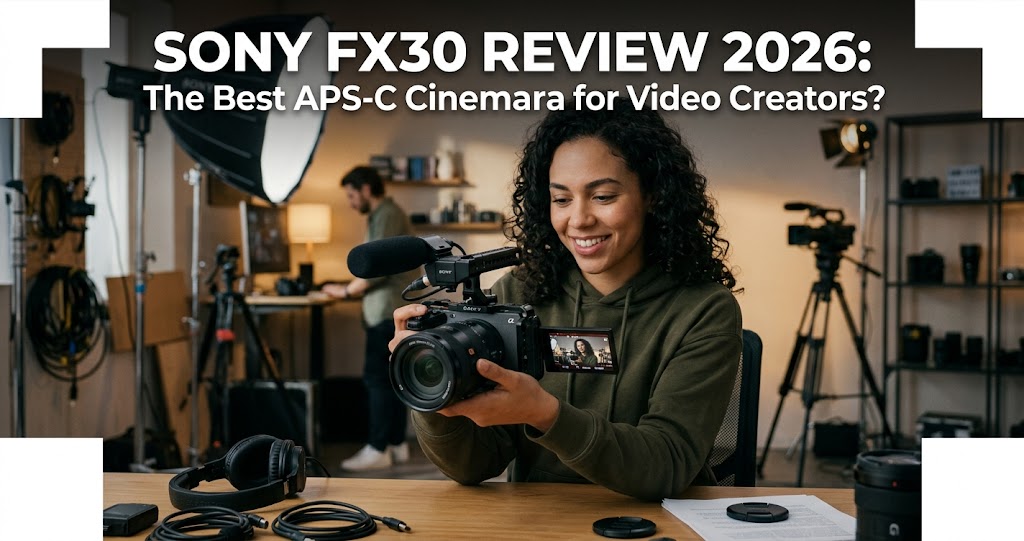
The Sony FX30 is the best APS-C cinema camera for video creators who need professional reliability without the full-frame price tag. With a 26MP sensor, 4K 120p 10-bit recording, dual native ISO (800/2500), 14+ stops of dynamic range, and a built-in cooling fan, the FX30 is a genuine cinema tool at $1,800 . As one creator put it: "You can buy two FX30 bodies for the price of one XDCAM, and I plan to use mine for the next decade" .
Why the FX30 Matters for Video Creators in 2026
When Sony launched the FX30 in late 2022, it made headlines for offering cinema-grade features in a sub-$2,000 body . Three years later, with active firmware support and a mature ecosystem, the FX30 has proven itself as a reliable workhorse for independent filmmakers, content creators, and small production houses .
The camera shares the same body design as the full-frame FX3, meaning you can use identical cages, rigs, and accessories across both systems . This makes the FX30 an excellent B-cam for FX3/FX6 owners, or a complete dual-camera setup for the price of one higher-end cinema camera .
As Sony Taiwan's official store notes: "對於初次嶄露頭角的創作者而言,輕巧的 FX30 讓影片製作領域比從前更加親民了" — For emerging creators, the lightweight FX30 makes filmmaking more accessible than ever .
1 Sony FX30 — Core Specs (2026)
Video Quality: 4K 120p and 6K Oversampling
The FX30 records 4K video at up to 120fps, with 4K 60p derived from 6K oversampling . This oversampling captures massive amounts of detail, resulting in footage that is exceptionally sharp, with minimal moiré and aliasing.
6K oversampling to 4K 60p is the FX30's sweet spot. As one creator noted: "4K mode: 6K oversampling → 4K output. FHD mode: pixel skipping → softer, lower-resolution image. So even if the final delivery is 1920×1080 60P, you should still record in 4K60P to maintain clarity" .
4K 120p recording provides dramatic slow-motion capabilities. At 120fps, footage plays back at 5x slow motion when interpreted to 24fps. This is ideal for capturing fleeting moments — splashing water, flying hair, emotional gestures.
Dual Native ISO and Dynamic Range
The FX30's dual native ISO system operates at ISO 800 and ISO 2500 in Cine EI mode . This means you can shoot at ISO 2500 with the same noise level as ISO 800 — a massive advantage for low-light shooting.
14+ stops of dynamic range provide exceptional latitude for color grading. S-Log3 captures detail in both shadows and highlights, giving you flexibility to adjust exposure in post without quality loss . For run-and-gun documentary work where lighting is uncontrolled, this is invaluable.
Cine EI, Cine EI Quick, and Flexible ISO modes offer three ways to manage exposure. Cine EI prioritizes maximum dynamic range; Cine EI Quick automatically switches between base ISOs; Flexible ISO works like a traditional camera for maximum convenience .
Built-In Cooling: No Overheating, Unlimited Recording
The FX30 features an active cooling fan that vents heat away from the sensor and processor. This is the single biggest advantage over hybrid cameras like the A6700 or A7 IV .
The FX30 does not overheat. In real-world testing, the camera records 4K 60p continuously for hours without interruption. For interviews, event coverage, documentary work, and any situation where reliability matters, this is a decisive advantage.
The fan can be set to Auto (runs only when needed) or always-on for maximum cooling. The fan noise is minimal — not audible when using an external microphone or on-camera shotgun mic at normal distances .
Firmware 6.01: 2026 Updates
📢 Firmware Version 6.01 — March 2026 Update
- Optimized user LUT processing — smoother on‑set monitoring
- Improved overall performance and stability — fewer bugs, more reliable
- Important update path: If your camera is running Ver. 1.02 or earlier, you must first update to Ver. 1.05 before installing Ver. 6.01
The March 2026 firmware update (Ver. 6.01) focuses on stability and LUT processing improvements . Previous updates added DCI 4K 24p recording and anamorphic lens support (1.3x and 2.0x desqueeze preview), making the FX30 even more versatile for narrative filmmaking .
Body and Handling: Built for Production
The FX30's magnesium alloy body is weather-sealed and designed for professional use. At 646g (body only) and 951g with the XLR handle unit, it's light enough for gimbal work but substantial enough to feel solid .
The tally lamp is a production essential. As one creator explained: "The tally lamp is not primarily for the camera operator — it's for everyone around you: directors, audio engineers, still photographers, event staff. They can instantly see whether the camera is recording. The FX30's tally lamp is extremely clear, and it significantly reduces the risk of accidental non‑recording" .
Multiple record button locations include the top plate, the shutter button, and a side button near the grip. As one user noted: "Depending on shooting posture, I can trigger recording with right index finger, right thumb, or left middle finger. The flexibility is excellent" .
Focus magnifier (Focus Mag) is a feature borrowed from broadcast cameras. It's essential when using manual focus lenses or shooting in challenging conditions where autofocus may struggle .
The XLR handle unit includes two XLR/TRS combo inputs with phantom power, plus a built-in shotgun microphone. This turns the FX30 into a complete, ready-to-shoot production camera with professional audio capabilities .
Stills Photography: Capable but Compromised
The FX30 can shoot 26MP stills, but there are significant limitations compared to a hybrid camera like the A6700 .
Limitations: No mechanical shutter (electronic only), no viewfinder (rear screen only), no strobe/flash support, and noticeable rolling shutter for fast-moving subjects .
Usable for: Interval shooting, fisheye shots, environmental/event wide shots, and situations where full-frame is unnecessary .
As one reviewer concluded: "Given that it's a Cinema Line camera, the fact that it can shoot stills at all is already a bonus" .
Sony FX30 vs A6700 — Which One for Video Creators?
As one creator who switched from A6700 to dual FX30 bodies concluded: "If you want a true hybrid camera, the α6700 will make you happier. But if your work requires 4K60P long‑form recording and reliable thermal performance, the FX30 is a fantastic choice" .
Used Market Guide: What to Pay in 2026
2 Current Used Prices (April 2026)
Used prices have dropped as the camera matures in the market. At $1,300-1,800, the FX30 offers exceptional value compared to the FX3 ($4,000+) or full-frame cinema cameras .
Who Should Buy the FX30 in 2026?
✅ Buy the FX30 if:
- You're a video-first creator who needs reliable, long-form 4K recording
- You need active cooling for interviews, events, or documentary work
- You want professional audio inputs (XLR) without external recorders
- You're building a multi-camera cinema setup on a budget
- You need 4K 120p slow-motion and 10-bit color
- You want to use APS-C/Super 35 lenses — smaller, lighter, more affordable
- You're a documentary or event filmmaker who can't risk overheating
❌ Skip the FX30 and buy the A6700 if:
- You're a hybrid shooter who needs excellent stills and video in one camera
- You need a viewfinder for bright outdoor shooting
- You need a mechanical shutter for strobe lighting or fast action
- You rarely shoot longer than 30 minutes continuously
❌ Spend more for the FX3 (full-frame) if:
- You need full-frame shallow depth of field for your creative vision
- You need even better low-light performance (FX3's dual ISO at 12800)
- You have the budget ($3,500+ used) and need the absolute best
Final Verdict (2026)
The Sony FX30 is the best APS-C cinema camera for video creators who prioritize reliability, professional features, and value. Its combination of 4K 120p, 6K oversampling, dual native ISO, active cooling, and XLR audio inputs makes it a genuine cinema tool at an accessible price point .
The compromises are real — no viewfinder, no mechanical shutter, and stills capabilities are limited. For hybrid shooters, the A6700 is a better choice. But for dedicated video creators who need long-form recording without overheating, the FX30 is unmatched in its price class .
"The FX30 may be at the entry level of Sony's Cinema Line offerings, but it's without doubt the brand's best value option for video content creators. It's perfectly suited to 'run and gun' videographers or those working on their own" . Three years after its release, that statement remains true.
Recommended Lenses for the FX30 in 2026
The E-mount system offers exceptional glass for APS-C/Super 35 shooting. Here are my top recommendations for 2026:
- Sony E PZ 18-105mm F4 G OSS: The classic video zoom. Power zoom, constant f/4 aperture, and optical stabilization. Perfect for run-and-gun documentary work.
- Sigma 18-50mm F2.8 DC DN | Contemporary: A compact standard zoom with constant f/2.8. Ideal for gimbal work and lightweight rigs.
- Tamron 17-70mm F2.8 Di III-A VC RXD: Versatile zoom with image stabilization (VC) that complements the FX30's IBIS. Great for handheld shooting.
- Sigma 16mm F1.4 DC DN | Contemporary: A wide-angle prime for establishing shots, interiors, and low-light work. The f/1.4 aperture is invaluable in dim conditions.
- Sigma 56mm F1.4 DC DN | Contemporary: An 85mm equivalent portrait lens for interviews and close-ups. Beautiful bokeh and exceptional sharpness.
- Sony E 11mm F1.8: An ultra-wide prime for vlogging and establishing shots. Extremely lightweight — perfect for gimbal work.