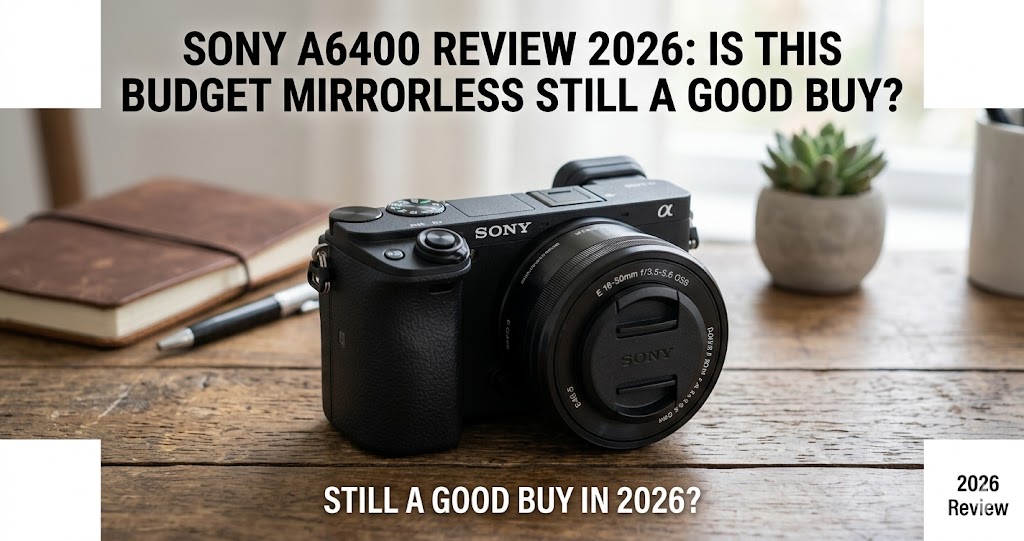
The Sony A6400 in 2026 is arguably the best budget APS-C mirrorless camera for photographers who prioritize stills quality and autofocus speed over IBIS and modern video features. At used prices of $500-650 USD (€479-580, SEK 9,490, NT$26,980), the A6400 offers 24MP resolution, lightning-fast 4D autofocus with Real-time Eye AF, and 4K video with full-sensor readout . It's a "mitnehmen-statt-stehenlassen" (take-with-you-instead-of-leave-behind) camera that punches well above its weight class .
Seven Years Later: Why the A6400 Still Matters in 2026
Announced in January 2019, the Sony A6400 was positioned as a mid-range APS-C mirrorless camera between the entry-level A6100 and the flagship A6600. Seven years later, with used prices having dropped significantly, it has become an exceptional value proposition .
The camera market has shifted dramatically — new APS-C bodies now cost $1,400-1,700, while the A6400 can be found used for roughly a third of that . For photographers who prioritize value over having the absolute latest features, this is a compelling equation. As one reviewer put it: "Die Sony Alpha 6400 ist so eine Kamera, die du ständig empfohlen bekommst – und das hat Gründe: kompakt, schnell, top Autofokus, starke Bildqualität" .
1 Sony A6400 — Core Specs (2026)
Image Quality: Still Excellent for 24MP
The 24.2MP APS-C Exmor CMOS sensor combined with the BIONZ X processor remains highly capable. While newer sensors offer 26MP (A6700) or 33MP (full-frame), the difference is marginal in real-world shooting. The A6400's 24MP resolution is still more than enough for large prints, social media, and professional work .
Dynamic range is very good. At base ISO, the A6400 captures approximately 13.5 stops of dynamic range. Highlights can be recovered in post, and shadow lifting is clean up to about 3 stops. This makes the camera versatile for landscape and outdoor work .
Low-light performance: Native ISO ranges from 100 to 32,000, expandable to an incredible ISO 102,400 for extreme low-light situations . However, as multiple reviews note, noise becomes noticeable above ISO 3200. As one ShopSavvy reviewer put it: "Noticeable noise creeps in above ISO 1200, limiting low-light capabilities" . For well-lit scenes, however, the image quality is exceptional.
Autofocus: The 4D FOCUS System That Still Impresses
The A6400's 4D FOCUS system remains one of its strongest selling points in 2026. Inheriting technology from the flagship A9, the hybrid autofocus combines 425 phase-detection points with 425 contrast-detection areas, covering approximately 84% of the sensor. Focus acquisition takes as little as 0.02 seconds .
Real-time Eye AF and Real-time Tracking are the headline features. The camera automatically detects and locks onto human or animal eyes in both stills and video . As one Indonesian reviewer noted: "Real-Time Eye Autofocus mampu mengunci fokus ke mata manusia maupun hewan secara instan. Hasilnya: foto portrait lebih tajam dan konsisten, minim retake, aman untuk foto anak-anak, hewan, atau candid moment" .
What still works great: Eye AF for humans and animals is fast and sticky. The camera reliably locks onto eyes and tracks them through movement. Real-time Tracking for general subjects (cars, people walking, etc.) works well. Focus acquisition is nearly instant in good light .
Practical start setting: As Alpha-Magic recommends, activate AF-C, enable face/eye priority, and only increase burst mode when movement is really a factor .
Video Capabilities: The Main Compromise in 2026
The A6400 shoots 4K 30p with full pixel readout and 6K oversampling — producing sharp, detailed footage without pixel binning . This reduces moiré and aliasing, ensuring clean results for travel videos, tutorials, or short films .
What you get: 4K 30p with excellent detail, S-Log2 and S-Log3 profiles, HLG (Hybrid Log-Gamma), 1080p up to 120fps, microphone input, and clean HDMI output .
What's missing: No 4K 60p — a significant limitation for slow-motion enthusiasts. 8-bit internal recording only (no 10-bit). Noticeable rolling shutter in 4K mode. No IBIS (in-body image stabilization), which makes handheld walking shots challenging .
For vloggers, the 180° flip-up screen is practical, but be aware that a microphone mounted on the hot shoe can partially block the display. Solution: mount the mic sideways or keep it very compact .
Build and Handling: Compact, Lightweight, Durable
The A6400's magnesium alloy body provides durability while keeping the weight to just 359 grams without a battery . Its compact size makes it a "mitnehmen-statt-stehenlassen" camera — one you'll actually carry rather than leave at home .
The 3-inch 180° tilting LCD touchscreen features WhiteMagic technology for enhanced brightness in daylight . The screen flips up for selfies and vlogging, but takes time to adjust to the workflow compared to side-flip designs .
The Tru-Finder OLED viewfinder offers 2.36 million dots, providing a bright and detailed display for framing in bright sunlight — a feature uncommon at this compact size and price point .
Ergonomics: The camera is compact and grippy enough, but with large hands, it's not a luxury feeling. As one reviewer noted: "Mit großen Händen ist das nicht Luxus-Feeling, aber absolut okay" .
Battery Life and Connectivity: The Weak Spots
The NP-FW50 battery provides approximately 360 shots using the viewfinder or 410 shots with the LCD screen . This is notably weak by 2026 standards, and multiple reviewers call this out as a significant drawback .
What you can do: USB charging enables connection to a computer or portable battery, keeping the camera ready for extended shoots . Plan on carrying spare batteries for anything beyond a few hours of shooting .
Connectivity options: Built-in Wi-Fi, NFC, and Bluetooth 4.1 allow instant transfer of images to smartphones or tablets. However, the Imaging Edge Mobile app is essentially non-functional (1.8 app store rating) and the camera menu still references it . Wireless photo transfer is neither intuitive nor easy to configure.
Sony A6400 vs Alternatives (2026)
Sony A6400 vs A6100 vs A6600 vs A6700 vs ZV-E10 II (2026)
The A6400 sits in the middle: It's more feature-rich than the A6100 (better EVF, weather sealing, better AF), but lacks the IBIS and battery life of the A6600. It's significantly cheaper than the A6700 but lacks 10-bit video and AI autofocus .
⚠️ Used Buying Checklist (2026)
- Shutter count: The A6400 is rated for 200,000 actuations. Aim for under 50,000 for best value
- Sensor condition: Test at f/16 against a white wall to check for dust or scratches
- Flip screen hinge: The 180° up-flip mechanism can wear over time — test thoroughly
- Ports: Check the micro-USB port (this is a known wear point)
- Battery health: NP-FW50 batteries degrade noticeably — plan to buy a spare
- Hot shoe: Test with an external flash or microphone
- Firmware version: Check for latest updates (Sony released security updates as recently as February 2026)
Who Should Buy the A6400 in 2026?
✅ Buy the A6400 if:
- You're a still photographer who prioritizes photo quality and autofocus speed over video features
- You're on a tight budget ($500-650) and want the best value APS-C camera
- You need lightning-fast autofocus with Real-time Eye AF for portraits, street, or family photography
- You want a compact, travel-friendly camera that you'll actually carry
- You're upgrading from a smartphone or older camera and want to learn on quality gear
- You want access to Sony's massive E-mount lens ecosystem without breaking the bank
❌ Skip the A6400 and buy alternatives if:
- You need IBIS (in-body stabilization) for handheld video — consider A6600 (used) or A6700
- You're a video-first creator who needs 4K 60p or 10-bit color — consider ZV-E10 II or A6700
- You need excellent battery life for all-day shooting — consider A6600 or A6700
- You want the absolute cheapest entry into Sony APS-C — consider A6100 (used)
- You need modern AI-powered autofocus for birds, insects, or vehicles — consider A6700
Final Verdict (2026)
The Sony A6400 in 2026 is the best budget APS-C mirrorless camera for still photographers who prioritize autofocus speed and compact size over IBIS and modern video features. Its combination of 24MP resolution, 4D FOCUS with Real-time Eye AF, 11 fps burst, and 4K video remains highly capable .
The compromises are real — no IBIS, weak battery life, 8-bit video only, micro-USB instead of USB-C, and a dated menu system . For video-focused creators or those who need stabilization, the A6600 (used) or A6700 are worth the extra cost .
But for photographers who prioritize stills quality, portability, and value, the A6400 is arguably the smartest used camera purchase you can make in 2026. At $500-650, it's a "no-brainer for beginners" .
"The Sony A6400 is a camera that takes excellent photos and won't weigh you down for travel, but you're essentially buying exactly what you see right now with no improvements coming from the manufacturer" . If that works for you, it's still an outstanding choice.
Recommended Lenses for the A6400 in 2026
The A6400's E-mount is one of its greatest strengths. Here are my top lens recommendations for 2026 :
- Sigma 18-50mm F2.8 DC DN | Contemporary: The perfect compact standard zoom. Sharp, fast, and lightweight — ideal for travel and everyday use. "Klein, lichtstark, super flexibel – genau das, was die A6400 als Reise-Setup stark macht" .
- Tamron 17-70mm F2.8 Di III-A VC RXD: A versatile zoom with image stabilization (VC) that compensates for the A6400's lack of IBIS. Great for video and run-and-gun shooting .
- Sigma 56mm F1.4 DC DN | Contemporary: An 85mm equivalent portrait lens with beautiful bokeh and sharpness. "Diese Linse macht APS-C richtig sexy" .
- Sigma 16mm F1.4 DC DN | Contemporary: A 24mm equivalent wide-angle for landscapes, astrophotography, and vlogging.
- Sony E 70-350mm F4.5-6.3 G OSS: For wildlife and sports, this lens provides exceptional reach in a compact package. "Für Tiere, Sport, Reichweite" .