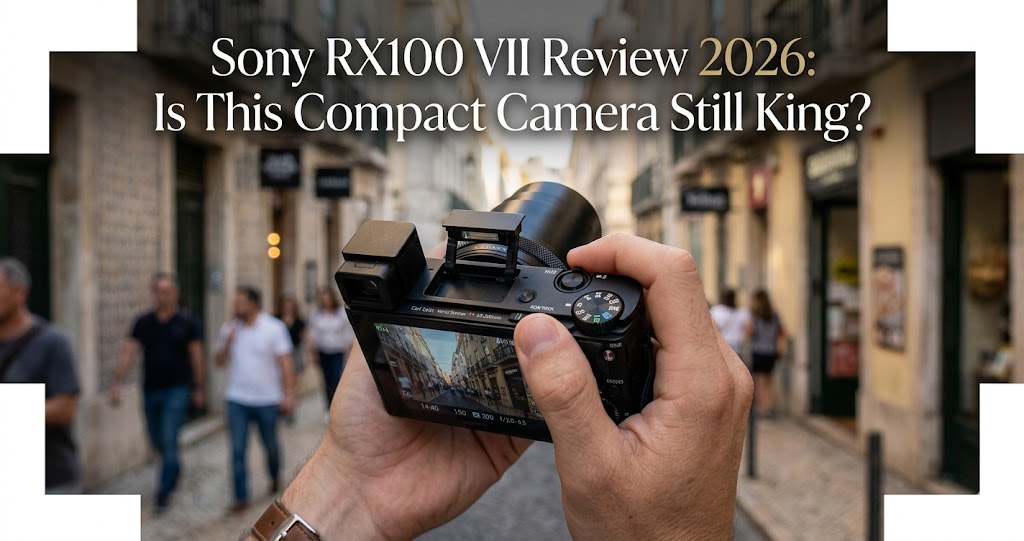
The Sony RX100 VII is still the king of premium compact cameras in 2026 — but the crown fits a narrower head than it used to. With its 24-200mm f/2.8-4.5 Zeiss zoom, 20fps blackout-free shooting, real-time Eye AF, and pocketable size, it remains unmatched for travelers and street photographers who want pro-level versatility without a backpack full of gear . At $1,000-1,300 new or $800-1,000 used, it's not cheap, but for the right user, it's still a brilliant buy .
Seven Years Later: Why the RX100 VII Still Matters
Announced in July 2019, the RX100 VII was the seventh generation of Sony's flagship compact camera series. Seven years later, Sony has not released an RX100 VIII — the series appears to be on hiatus as the company focuses on the ZV vlogging line . Yet the RX100 VII remains in production, continues to receive firmware updates, and is still widely available on the used market .
What explains this longevity? Simple: no other camera offers the RX100 VII's combination of features in such a small package. The 24-200mm equivalent zoom lens covers everything from wide landscapes to telephoto portraits. The autofocus system, borrowed from the flagship A9, is still class-leading. And the entire package fits in a jeans pocket .
As one reviewer put it: "The RX100 VII is the camera you'll often see in a professional's pocket" — and that observation still holds true in 2026 .
1 Sony RX100 VII — Core Specs (2026)
The 24-200mm Zeiss Zoom: Unmatched Versatility
The RX100 VII's defining feature is its 24-200mm equivalent f/2.8-4.5 Zeiss Vario-Sonnar T* lens. This 8.3x optical zoom covers everything from wide-angle landscapes to telephoto portraits — all without changing lenses or carrying additional weight .
What this means in practice: You can shoot a wide establishing shot of a cathedral, then zoom to 200mm to capture a street performer's expression without moving an inch. You can photograph your family at dinner, then zoom in on a distant landmark. The versatility is genuinely liberating .
The trade-off: The lens is relatively slow at the telephoto end (f/4.5), and the 1-inch sensor means low-light performance lags behind larger APS-C or full-frame cameras. For daytime travel and street photography, this is rarely an issue. For evening shooting, you'll need to raise ISO or use a tripod .
Autofocus: Still Class-Leading
The RX100 VII inherited its autofocus system from Sony's flagship A9 — a 2017 pro sports camera — and it remains remarkably capable in 2026 . With 357 phase-detection points covering 70% of the sensor and 425 contrast-detection points, the camera locks onto subjects instantly.
Real-time Eye AF for humans and animals works reliably in both stills and video. As one user noted: "The autofocus tracks a subject and holds focus with uncanny tenacity, even while recording 4K video" .
20 fps blackout-free shooting with full AF/AE tracking means you can capture fast-moving subjects — children playing, street performers dancing, birds taking flight — without missing the decisive moment. The Single Burst mode shoots 90 fps for blink-and-you'll-miss-it action .
In real-world testing, the RX100 VII achieved sharp focus on 9 out of 10 frames of a cyclist passing at 25km/h — a keeper rate that rivals much larger, more expensive cameras .
Video Capabilities: Pro Features, Some Limitations
The RX100 VII shoots 4K 30p video with full pixel readout and 6K oversampling, resulting in sharp, detailed footage with minimal moiré and aliasing . The camera also includes S-Log3, HLG, and S-Cinetone profiles for flexible color grading .
What's missing in 2026: No 4K 60p, which is a significant limitation for slow-motion enthusiasts. The camera also exhibits noticeable rolling shutter during fast pans — a common issue with 1-inch stacked sensors .
Audio is a strength: The 3.5mm microphone jack (a rarity in compact cameras) allows you to use external mics for better audio quality. The built-in stereo mics are adequate for casual use .
Slow-motion capabilities: The RX100 VII can shoot 1080p at up to 120fps, and its HFR (High Frame Rate) mode captures up to 960fps for extreme slow-motion effects .
Build, Handling, and the EVF
The RX100 VII is exceptionally well-built for its size. The magnesium alloy body feels solid in hand, and the lens mechanism extends and retracts smoothly. At 302g, it's light enough to carry anywhere .
The pop-up electronic viewfinder (EVF) is a standout feature. With 2.36 million dots, it's sharp enough for critical focusing, and it's invaluable when shooting in bright sunlight where rear screens become unreadable. The EVF also includes a tilt indicator to help keep horizons level — a thoughtful touch for architectural photography .
The tilting touchscreen flips up 180 degrees for selfies and low-angle shooting. It's responsive, though the menu system is dense — as one reviewer noted, the RX100 VII "feels more like an electrical appliance than a 'photographer's camera'" .
Control layout: The camera has two control dials, a customizable lens ring, and multiple function buttons. However, the small body means buttons are tiny and can be fiddly — especially with gloves or larger hands .
Image Quality: 1-Inch Excellence
The 20.1MP 1-inch stacked CMOS sensor produces excellent image quality in good light. Colors are accurate, dynamic range is good (approximately 12 stops at base ISO), and detail is sharp .
RAW file flexibility: The RX100 VII's RAW files respond well to editing in Lightroom or Capture One. You can recover shadows and highlights, adjust white balance, and fine-tune colors without significant quality loss .
Low-light performance: This is the camera's biggest compromise. At ISO 800, noise is minimal. At ISO 1600, it's noticeable but acceptable. At ISO 3200, detail starts to soften. For nighttime street photography or dim interiors, you'll need to use slower shutter speeds (with IBIS support) or accept some noise .
As one user noted: "Beaucoup de bruit. Déçu en intérieur ou en photo de nuit" — much noise, disappointed indoors or at night .
Battery Life: The Weakest Link
The NP-BX1 battery is rated for 260 shots per charge (CIPA) — significantly less than modern mirrorless cameras . In real-world use with a mix of stills, video, and Wi-Fi transfer, you'll be lucky to get 200 shots.
The fix: Carry spare batteries. The battery is small and easy to swap, and third-party options are affordable. USB charging is supported, but the micro-USB port (not USB-C) is dated and slow .
Sony RX100 VII vs Smartphones (2026) — Documentary Travel Test
Used Market Guide: What to Pay in 2026
2 Current Used Prices (April 2026)
Best value point: Look for a well-maintained used unit in the $800-900 range. At this price, the RX100 VII offers exceptional value compared to any new compact camera .
Who Should Buy the RX100 VII in 2026?
✅ Buy the RX100 VII if:
- You're a travel photographer who wants pro-level versatility without a heavy kit
- You need a pocketable 24-200mm zoom for capturing everything from landscapes to portraits
- You shoot street, documentary, or family moments where fast autofocus and silent shooting matter
- You're a hybrid creator who wants 4K video with S-Log and a mic input in a tiny package
- You want a professional backup camera that fits in your pocket
- You value pocketability over low-light performance
❌ Skip the RX100 VII and consider alternatives if:
- You primarily shoot in low light — an APS-C or full-frame camera with a fast prime will perform much better
- You need 4K 60p video or 10-bit color — newer hybrid cameras offer these features
- You want USB-C charging and modern connectivity — the RX100 VII uses micro-USB
- You're on a tight budget under $600 — consider an RX100 VI or a smartphone upgrade
- You need weather sealing for challenging conditions — the RX100 VII is not sealed
Final Verdict (2026)
The Sony RX100 VII is still the king of premium compact cameras — but the crown fits a narrower head than it used to. Its combination of a 24-200mm Zeiss zoom, class-leading autofocus, 20fps burst, and pocketable size remains unmatched . For travelers, street photographers, and documentary shooters who prioritize versatility and discretion, it's still a brilliant buy.
The compromises are real — limited low-light performance, modest battery life, micro-USB charging, and no 4K 60p video. For those who shoot primarily in good light and value pocketability above all else, these are acceptable trade-offs .
At used prices of $800-1,000, the RX100 VII offers exceptional value for the right user. As one reviewer concluded: "If you crave big-camera flexibility in a front-pocket body, the RX100 VII remains a standout" . Seven years after its release, that statement still holds true.
Recommended Accessories for the RX100 VII in 2026
- Spare NP-BX1 batteries: Essential for all-day shooting. Third-party options from Wasabi or RavPower offer good value.
- Small grip attachment: The Sony AG-R2 or a third-party grip improves handling significantly .
- Screen protector: The tilting screen is vulnerable to scratches; a tempered glass protector is cheap insurance.
- Small carrying case: A low-profile case like the Sony LCS-CSJ protects the camera in your bag .
- External microphone: The 3.5mm jack works with compact mics like the Rode VideoMicro for better audio .