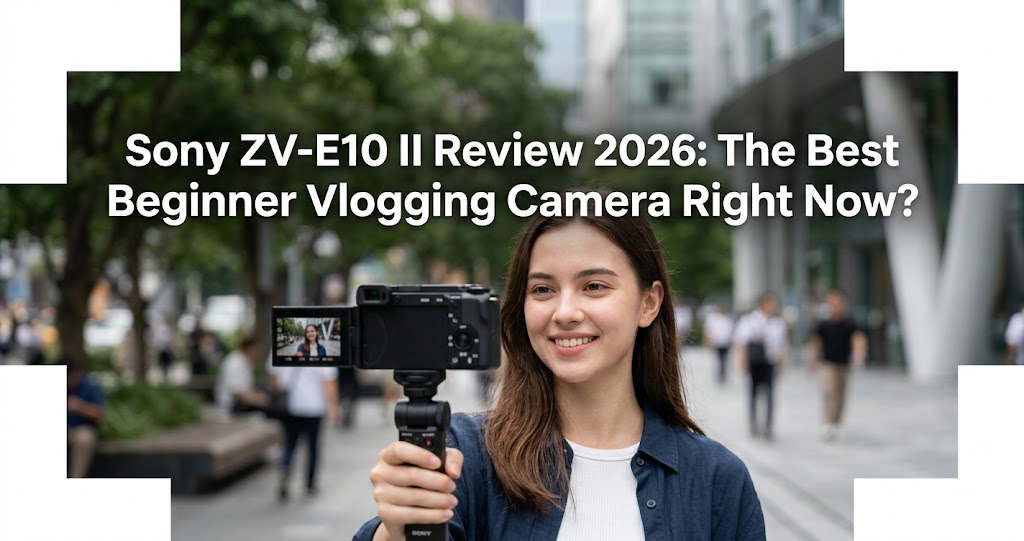
The Sony ZV-E10 II is the best beginner vlogging camera you can buy in 2026. With a 26MP APS-C sensor borrowed from the FX30 cinema line, 4K 60p 10-bit video, 759-point autofocus, and the massive NP-FZ100 battery, it's a massive upgrade over the original ZV-E10 . At around €1,055 / $1,100 / £950 with the kit lens, it's the perfect bridge between smartphone convenience and professional-quality content creation .
Why the ZV-E10 II Matters for Beginner Creators
The original ZV-E10 was a hit because it understood something crucial: most vloggers and content creators don't want to learn complex camera menus. They want great-looking video, reliable autofocus, and simple controls . The ZV-E10 II takes that formula and adds professional-grade internals .
The camera shares its 26MP BSI Exmor R CMOS sensor and BIONZ XR processor with the cinema-focused FX30 . That means you're getting professional color science, 10-bit 4:2:2 recording, and 4K 60p — features that were previously reserved for cameras costing twice as much .
For creators ready to move beyond their smartphone, the ZV-E10 II offers the perfect balance: approachable controls, excellent image quality, and a clear upgrade path through Sony's vast E-mount lens ecosystem .
1 Sony ZV-E10 II — Core Specs (2026)
Video Capabilities: The Creator's Dream
The ZV-E10 II's video specs are what set it apart from every other beginner camera. The camera records 4K 60p video using 5.6K oversampling, resulting in exceptionally sharp and detailed footage .
10-bit 4:2:2 internal recording is available in XAVC HS (HEVC) and XAVC S-I (All-Intra) codecs . For color grading, this is a game-changer — you get smoother gradients, less banding, and more flexibility in post-production. S-Log3, HLG, and S-Cinetone profiles are all included .
LUT import support is a standout feature for this price point. You can load custom LUTs (Look-Up Tables) directly into the camera and record with baked-in color grades . For creators who want to upload straight to YouTube without editing, this is invaluable.
Active Stabilization mode uses electronic image stabilization to smooth out handheld walking shots. It crops the frame by approximately 1.5x, but the results are remarkably stable — perfect for run-and-gun vlogging .
Autofocus: Sony's Secret Weapon
The ZV-E10 II inherits Sony's class-leading autofocus system, with 759 phase-detection points covering 94% of the sensor area . Real-time Eye AF for humans, animals, and birds works flawlessly in both stills and video .
What's missing: The camera does not include Sony's dedicated AI processing unit, so it lacks advanced subject recognition for insects, vehicles, or body pose estimation. For human-centric vlogging, however, this is rarely an issue .
Product Showcase Mode is a creator's best friend. When activated, the camera instantly shifts focus from your face to any object held up to the lens — perfect for unboxings, reviews, and demonstration videos .
One-click Background Defocus lets you instantly switch between shallow depth of field (blurry background) and deep focus without diving into menus. It's a simple button on the top plate, and it works beautifully .
Audio: Built-in Excellence
The ZV-E10 II features a 3-capsule directional microphone built into the top plate. It can switch between front, rear, and omnidirectional pickup patterns automatically or manually . The included windshield (deadcat) effectively reduces wind noise outdoors .
Audio connectivity options: 3.5mm microphone input, 3.5mm headphone jack for monitoring, and Multi Interface Shoe (MI Shoe) with digital audio interface for compatible Sony microphones like the ECM-B1M .
Battery Life and Handling
The move to the NP-FZ100 battery is one of the most significant upgrades from the original ZV-E10 . Rated at 610 shots (CIPA) and 130 minutes of continuous video recording, you can vlog all day on a single charge .
The larger battery necessitated a redesigned, deeper handgrip. As multiple users note, the grip is significantly more comfortable than the original ZV-E10, especially when using larger lenses .
USB-C connectivity supports fast data transfer (USB 3.2, 5Gbps), charging, and 4K webcam functionality simultaneously .
Stills Photography: Surprisingly Capable
While the ZV-E10 II is video-focused, its 26MP sensor captures excellent stills. The camera shoots at 11 fps with continuous AF/AE tracking, making it capable for action and everyday photography .
Creative Look presets offer 10 built-in color profiles (ST, PT, NT, VV, VV2, FL, IN, SH, BW, SE), each adjustable via 8 parameters . These are perfect for creators who want great out-of-camera JPEGs without editing.
One limitation: The camera has no mechanical shutter — only an electronic shutter. For most users, this won't matter, but you may notice rolling shutter artifacts with very fast-moving subjects or under certain artificial lighting .
Sony ZV-E10 II vs Original ZV-E10 — Key Differences
What's Missing: The Compromises
Sony made intentional compromises to hit the ZV-E10 II's price point. Understanding them is key to deciding if this camera is right for you .
- No IBIS (In-Body Image Stabilization): There's no mechanical stabilization in the body. You rely on lens-based OSS or electronic Active Stabilization (which crops the frame) .
- No mechanical shutter: Electronic shutter only. For most video creators, this is fine. For photographers shooting fast action, it's a limitation .
- No viewfinder: Like the original, there's no EVF. You compose exclusively on the rear screen. Most vloggers won't miss it, but photographers might .
- No AI autofocus chip: Subject recognition is excellent for humans/animals/birds, but lacks the advanced AI processing of the A6700 or A7 V .
- No Auto Framing: The camera lacks the AI-powered Auto Framing feature found on higher-end Sony cameras .
- Plastic body: The build quality is good, but the camera feels less robust than the A6700's magnesium alloy chassis .
Who Should Buy the ZV-E10 II in 2026?
✅ Buy the ZV-E10 II if:
- You're a beginning vlogger or YouTuber ready to upgrade from your smartphone
- You want professional 4K 60p video and 10-bit color without spending $2,000+
- You need reliable, fast autofocus with eye tracking for talking-head videos
- You value simple, creator-focused controls like Product Showcase and Background Defocus
- You want access to Sony's massive E-mount lens ecosystem as your skills grow
- You need all-day battery life for shooting on the go
- You're live streaming and want 4K webcam quality via USB-C
❌ Skip the ZV-E10 II and buy the A6700 if:
- You need IBIS (in-body stabilization) for handheld walking shots
- You want AI-powered subject recognition for birds, insects, or vehicles
- You need a mechanical shutter for photography in artificial lighting
- You want weather sealing for outdoor shooting in challenging conditions
- You have the budget ($1,400+) and want the best APS-C hybrid camera
❌ Save money and buy the original ZV-E10 (used) if:
- You're on a very tight budget ($500-700)
- You don't need 4K 60p or 10-bit video
- You're okay with shorter battery life and micro-USB charging
Final Verdict (2026)
The Sony ZV-E10 II is the best beginner vlogging camera you can buy in 2026. It takes everything that made the original great — simple controls, excellent autofocus, creator-friendly features — and adds professional-grade video specs, class-leading battery life, and Sony's latest processor .
The compromises are real — no IBIS, no mechanical shutter, no viewfinder. For dedicated vloggers, these are acceptable trade-offs. For photographers or hybrid shooters who need stabilization, the A6700 is worth the extra cost .
At $1,100 with the 16-50mm kit lens, the ZV-E10 II offers exceptional value for creators ready to take their content seriously. As one user put it: "Die ZV-E10 II ist eigentlich eine 6700er, nur deutlich leichter und günstiger" . It's the perfect gateway into professional content creation.
Recommended Lenses for the ZV-E10 II in 2026
The E-mount system is one of the ZV-E10 II's greatest strengths. Here are my top lens recommendations for vlogging :
- Sony E PZ 16-50mm F3.5-5.6 OSS II (kit lens): The updated kit lens is compact, features power zoom for smooth video transitions, and includes optical stabilization. Perfect for beginners .
- Sony E 11mm F1.8: An ultra-wide prime ideal for selfie vlogging. The wide field of view keeps you in frame even with the camera at arm's length, and the fast aperture helps in low light .
- Sigma 16mm F1.4 DC DN | Contemporary: A 24mm equivalent prime with excellent low-light performance and beautiful background blur. Sharper than the Sony 11mm, but slightly heavier .
- Tamron 17-70mm F2.8 Di III-A VC RXD: A versatile zoom with image stabilization (VC) that compensates for the camera's lack of IBIS. Great for run-and-gun shooting .
- Sigma 18-50mm F2.8 DC DN | Contemporary: A compact standard zoom with constant f/2.8 aperture. Much smaller and lighter than the Tamron, making it ideal for travel .