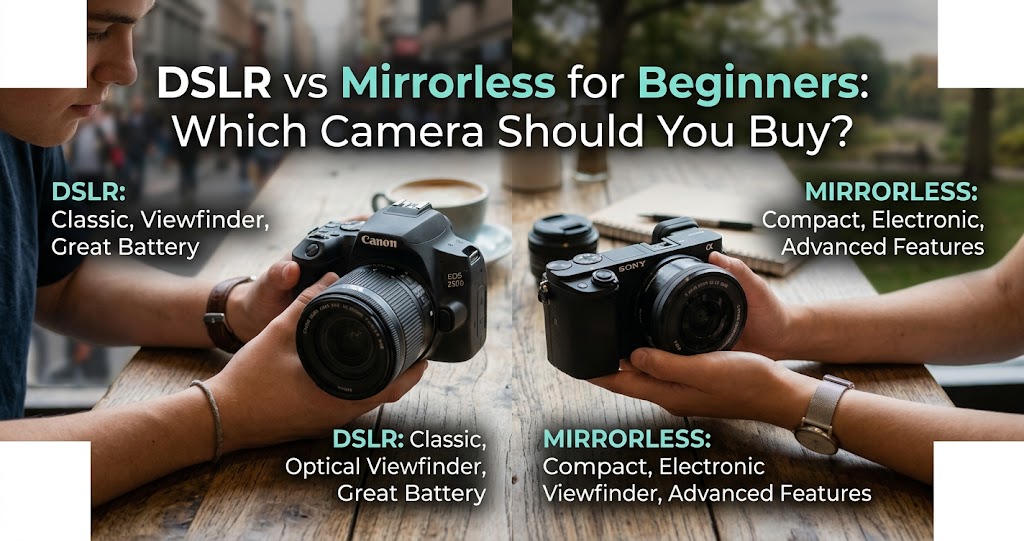
Choosing your first "real" camera is one of the most exciting steps in photography, and it can be one of the most confusing. For beginners in 2026, the debate usually comes down to two options: DSLR cameras or mirrorless systems .
Both can produce stunning images. Both are used by professionals. And both have strengths that make them appealing to first-time photographers. The key difference isn't which is better overall — it's which is better for how you plan to shoot .
This guide compares entry-level DSLR cameras and mirrorless systems so you can choose the right gear with clarity and confidence .
Quick Picks: Best Cameras for Beginners 2026
How DSLR and Mirrorless Cameras Work
The fundamental difference lies in their internal design. A DSLR (Digital Single-Lens Reflex) camera uses a mirror mechanism that reflects light from the lens up into an optical viewfinder. When you press the shutter, the mirror flips up, allowing light to hit the image sensor .
Mirrorless cameras, as the name suggests, eliminate the mirror entirely. Light passes directly from the lens to the image sensor, which feeds a live preview to an electronic viewfinder (EVF) or the rear LCD screen .
This structural shift affects size, weight, speed, and functionality .
DSLR vs Mirrorless: Quick Comparison
| Feature | DSLR | Mirrorless |
|---|---|---|
| Size & Weight | Larger, heavier | Smaller, lighter, more portable |
| Battery Life | Longer (600–1000+ shots) | Shorter (300–500 shots) |
| Viewfinder | Optical (real scene, no lag) | Electronic (live preview with settings) |
| Autofocus Performance | Good for static subjects; slower tracking | Fast, full-frame coverage; excellent tracking |
| Video Capabilities | Limited (often 1080p, basic AF) | 4K+, log profiles, advanced AF |
| Lens Selection | Extensive legacy glass available | Growing rapidly; adapters expand options |
| Future Development | Largely discontinued | Actively evolving |
| Price (Entry-Level) | Generally cheaper used; great deals | Slightly higher entry cost; better long-term value |
DSLR Cameras: Pros and Cons for Beginners
DSLR Strengths
- Excellent value (especially used): With many photographers transitioning to mirrorless, the used camera market is full of high-quality entry-level DSLR bodies and lenses at very accessible prices .
- Large lens ecosystem: DSLR systems from Canon and Nikon have decades of compatible lenses available .
- Optical viewfinder experience: Many beginners prefer a clear, lag-free view of the scene that performs well in bright outdoor conditions .
- Long battery life: DSLRs generally outperform mirrorless cameras in battery life, making them ideal for long shoots and travel .
- Durability: Many entry-level DSLRs feature robust construction and weather-sealed bodies .
DSLR Weaknesses
- Larger and heavier bodies: DSLRs are bulkier, which can be noticeable when travelling or carrying gear for long periods .
- Video autofocus limitations: While modern DSLRs shoot excellent video, continuous autofocus and subject tracking typically lag behind mirrorless systems .
- Slower innovation: DSLR technology has matured. Most future development is focused on mirrorless platforms .
- No real-time exposure preview: Through the optical viewfinder, you can't see how settings will affect the final image .
Best DSLR Picks for Beginners
- Nikon D3500: 24MP APS-C, Guide Mode teaches photography basics, excellent battery life, amazing value used . "The D3500 is perfect for first-time shooters who are short on cash" .
- Nikon D610: Full-frame DSLR, outstanding ISO performance and image quality for the price, fantastic dynamic range, robust build . "Represents outstanding value" .
- Canon EOS Rebel T7: Guide mode, 9-point AF, Wi-Fi, very affordable used .
Mirrorless Cameras: Pros and Cons for Beginners
Mirrorless Strengths
- Compact and lightweight: Easier to carry, making them appealing for everyday shooting and travel .
- Live exposure preview: Electronic viewfinders show exactly how your image will look before you take the shot, helping beginners learn exposure faster .
- Advanced autofocus: Face detection, eye autofocus, and subject tracking are strong advantages, especially for portraits and video .
- Future-focused systems: Mirrorless platforms continue to receive the newest lenses, firmware updates, and performance improvements .
- Superior video performance: Most mirrorless models support 4K video, log profiles, and external microphone inputs .
- In-body image stabilization (IBIS): Many mirrorless brands include IBIS, reducing blur from shaky hands .
Mirrorless Weaknesses
- Higher entry cost: Mirrorless systems often cost more upfront, particularly once lenses are added .
- Shorter battery life: Constant electronic display use means batteries drain faster than on DSLRs .
- Smaller used market: While growing quickly, the used mirrorless market is still smaller than the DSLR market .
- Electronic viewfinder lag (older models): Some users prefer optical clarity, though modern EVFs have improved dramatically .
Best Mirrorless Picks for Beginners
- Canon EOS R50: Beginner-friendly menus, reliable autofocus, 4K 60p video, lightweight, compact . "The R10 makes shooting fun for novices, offering a straightforward approach to photography" .
- Sony ZV-E10: Vlogger-focused, flip screen, AI tracking, excellent autofocus, 4K video .
- Sony A6400: Exceptional autofocus, fast and responsive, compact, 4K 30p video, great value used .
- Fujifilm X-S10: In-body image stabilization, film simulation modes, excellent lens array .
The Big Question: Is the DSLR Dead in 2026?
"Dead" doesn't mean "useless." Millions of working DSLRs remain in circulation, supported by vast libraries of lenses, accessories, and repair networks .
However, major manufacturers have largely pivoted to mirrorless. Canon and Nikon, once DSLR powerhouses, now focus most of their R&D on mirrorless lines like the Canon EOS R series and Nikon Z series . Even Pentax, one of the last holdouts, has only released minor DSLR updates since 2016 . CIPA data shows mirrorless units now account for over 70% of interchangeable-lens camera purchases globally .
Think of DSLRs like combustion-engine cars: still functional, widely supported, and beloved by enthusiasts, but no longer the direction of progress . Innovation, marketing, and ecosystem development are centered firmly on mirrorless platforms .
Real-World Case Studies
Sarah, a college student interested in documenting campus life and creating Instagram content, had a budget of $800 and wanted something easy to carry but capable of good photos and videos. Initially drawn to the Canon EOS Rebel SL3 for its affordability, she hesitated after watching several YouTube comparisons showing the Canon EOS R50 — a mirrorless model — offering better autofocus, flip-out screens, and 4K video .
She visited a local camera store and held both models. The DSLR felt sturdier, but the mirrorless was noticeably lighter. When she looked through the EVF of the R50, she could see how changing her ISO would affect the image in real time — a feature the salesperson said helped him teach beginners faster .
Sarah ultimately chose the EOS R50. Within weeks, she was filming short reels with smooth autofocus transitions and taking sharper portraits thanks to eye-tracking. Six months later, she upgraded to a second lens via Canon's growing RF lineup .
Tom, a high school sports photographer volunteering for his local paper, needed reliability and long battery life during weekend tournaments. He bought a refurbished Canon 90D DSLR. Its deep grip suited extended shooting, optical viewfinder eliminated lag during fast plays, and he could shoot all day on two batteries. While bulkier, it met his functional needs without requiring frequent charging .
Neither choice was wrong. Each aligned with the user's environment, goals, and workflow .
Step-by-Step Guide: How to Choose Your First Camera
- Define your primary use: Are you shooting stills, video, or both? Video-heavy work leans heavily toward mirrorless .
- Set a realistic budget: Include not just the body, but also lenses, memory cards, and accessories. Entry-level mirrorless kits start around $600; DSLRs can be found for $400 used .
- Test ergonomics: Visit a store and hold both types. A camera that fits your hand encourages regular use .
- Check lens availability: Research whether the brand offers affordable primes, zooms, and macro options you might want later .
- Try the viewfinder: Spend time looking through both OVF and EVF. Some users adapt quickly; others dislike electronic rendering .
- Consider future-proofing: Mirrorless systems are where innovation is happening. New features will appear there first .
- Check battery performance: If you plan long outings, DSLRs offer longer runtime. Mirrorless users should carry spares .
Decision Checklist
Frequently Asked Questions
Can I use my old DSLR lenses on a mirrorless camera?
Yes, in most cases. Manufacturers offer official adapters (e.g., Canon EF-EOS R, Nikon FTZ), and third-party options exist. Autofocus performance may vary, but many combinations work very well .
Is it worth buying a DSLR in 2026?
Only under specific conditions: if you find a great deal on a used body, prefer optical viewfinders, need extreme battery endurance, or are inheriting a collection of DSLR lenses. For most beginners starting fresh, mirrorless offers better long-term value and support .
Do professional photographers still use DSLRs?
A few do, particularly in sports or photojournalism where ruggedness and battery life are critical. However, the majority have transitioned. Major events like the Olympics now show mirrorless cameras dominating sidelines .
Are mirrorless cameras less durable than DSLRs?
Not necessarily. While DSLRs have a proven track record of ruggedness, modern mirrorless cameras are built to similar standards. Many mid-range and pro models feature weather-sealed magnesium alloy bodies. The lack of a mirror actually reduces moving parts, potentially increasing long-term reliability .
Final Verdict: Which Should Beginners Choose in 2026?
Entry-level DSLR cameras are ideal if: you want strong value, long battery life, access to a huge used market, and a traditional shooting experience. They remain an excellent choice for beginners focused on still photography and learning the fundamentals .
Mirrorless cameras are better suited if: you value portability, plan to shoot video, or want modern autofocus and real-time exposure feedback. They're compact, powerful, and designed with the future in mind .
For a beginner, choosing a DSLR today is a deliberate step backward in terms of technology access. You'll miss out on real-time feedback, advanced autofocus, and seamless video integration — all of which accelerate learning. While a DSLR won't ruin your journey, a mirrorless camera will likely enhance it .
That said, the best camera is still the one you'll use consistently. If budget constraints lead you to a used Nikon D3500 or Canon 80D, go for it. Learn the fundamentals. Then, when you're ready, transition into a mirrorless system with confidence .
Final Thoughts
Technology evolves faster than ever, but photography endures. Whether you choose mirrorless or DSLR, what matters most is picking up the camera, understanding its strengths, and using it to capture moments that matter .
The best camera is the one you enjoy using — one that encourages you to keep learning, experimenting, and creating .