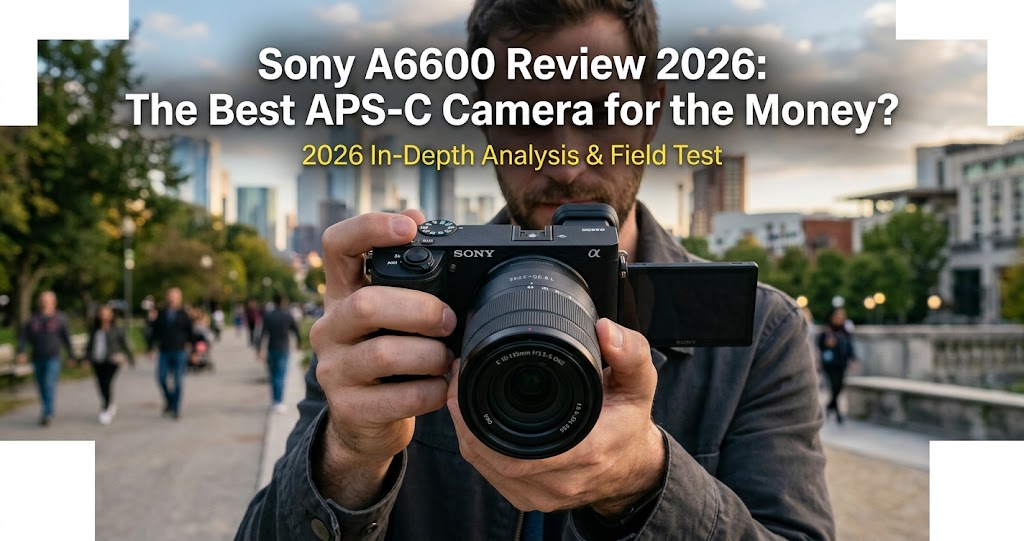
The Sony A6600 in 2026 is arguably the best value APS-C camera you can buy — if you're willing to go used. With used prices now hovering around $700-900 USD (¥89,000-138,000 in Japan, ₹89,990 in India), the A6600 offers IBIS, real-time Eye AF, class-leading battery life, and access to Sony's massive E-mount ecosystem at a fraction of the cost of newer alternatives .
Why the A6600 Still Matters in 2026
Announced in August 2019, the Sony A6600 was the flagship of Sony's APS-C lineup for years before the A6700 arrived in 2023 . Six years later, with used prices having dropped significantly, it has become an exceptional value proposition .
The camera market has shifted dramatically — new APS-C bodies now cost $1,400-1,700, while the A6600 can be found used for roughly half that . For photographers who prioritize value over having the absolute latest features, this is a compelling equation.
As one user on Reddit put it: "A6600 is probably one of the best value cameras you can get used out there. Ticks every core box" .
1 Sony A6600 — Core Specs (2026)
Image Quality: Still Excellent for 24MP
The 24.2MP APS-C Exmor CMOS sensor remains highly capable. While the A6700 offers 26MP, the difference is marginal in real-world shooting. The A6600's 24MP resolution is still more than enough for large prints, social media, and professional work .
Dynamic range is very good. At base ISO, the A6600 captures approximately 13.5 stops of dynamic range. Highlights can be recovered in post, and shadow lifting is clean up to about 3 stops. This makes the camera versatile for landscape and outdoor work .
Color science in 2026: Sony's color science has improved over the years, but the A6600 retains the older, slightly cooler rendering. Skin tones are accurate but not as warm as Canon or Fujifilm. However, RAW shooters can easily adjust this in post, and many photographers prefer the neutral starting point .
Autofocus: Real-Time Tracking That Still Impresses
The A6600 introduced Sony's Real-time Tracking and Real-time Eye AF to the APS-C lineup. In 2026, this system remains highly effective .
What still works great: Eye AF for humans and animals is fast and sticky. The camera reliably locks onto eyes and tracks them through movement. Real-time Tracking for general subjects (cars, people walking, etc.) works well. Focus acquisition is nearly instant in good light .
Where it shows its age: Low-light AF is less reliable than the A6700 or A7 IV. The A6600 uses the older BIONZ X processor, which is slower at processing AF data. For very fast action (sports, birds in flight), the newer models have an edge .
As user u/nimbleVaguerant noted: "The A6600 is still a beast of a camera. Excellent battery life, IBIS, great ergonomics and tons of buttons" .
Video Capabilities: The Main Compromise
The A6600 shoots 4K 30p with full pixel readout (no crop) and 6K oversampling — producing sharp, detailed footage. However, several limitations become apparent in 2026 .
What you get: 4K 30p with excellent detail, S-Log2 and S-Log3 profiles, 1080p up to 120fps, microphone and headphone jacks, and 5-axis IBIS for handheld video .
What's missing: No 4K 60p — a significant limitation for slow-motion enthusiasts. 8-bit internal recording only (no 10-bit). Noticeable rolling shutter in 4K mode. 1080p 60fps quality is notably soft .
As one user complained: "The 60fps 1080p is absolutely unusable except when viewing the footage on a smartphone" .
Firmware v2.00: The Last Major Update
📢 Firmware Version 2.00 — Key Improvements
- Improved Real-time AF: Better eye and face detection, even in low light
- Increased stability: During extended 4K video recording
- Bug fixes: For third-party lenses (Sigma, Tamron)
- LA-EA5 adapter support: Full AF compatibility with A-mount lenses
Sony released Firmware v2.00 as the last major update for the A6600. The LA-EA5 adapter support was particularly significant — it enables full focal-plane phase-detect AF with all A-mount lenses, making the vast legacy of Sony/Minolta glass accessible with modern autofocus performance .
However, as the A6600 reached end-of-life in 2023, no further feature updates are expected. The camera has reached its software maturity .
Image Stabilization: 5-Axis IBIS That Works
The 5-axis in-body image stabilization provides up to 5 stops of compensation . For handheld shooting, this is a significant advantage over the A6400 and A6100, which lack IBIS entirely.
In practice, I've shot handheld at 1/10 second with a 35mm prime and achieved sharp results. For video, the IBIS reduces micro-jitters, though walking shots still benefit from a gimbal or post-stabilization .
Battery Life: Still Class-Leading
The NP-FZ100 battery is one of the A6600's strongest features. Rated at 810 shots per charge (CIPA), real-world use often exceeds 1,000 shots on a single charge . This is significantly better than most APS-C competitors and rivals full-frame cameras.
For event photographers, travel shooters, and anyone who spends long days in the field, the battery life is a genuine advantage. You can shoot an entire wedding day on one battery — a rare claim for mirrorless cameras .
⚠️ Used Buying Checklist (2026)
- Shutter count: The A6600 is rated for 200,000 actuations. Aim for under 50,000 for best value
- Sensor condition: Test at f/16 against a white wall to check for dust or scratches
- IBIS function: Test with a stabilized lens to ensure the system is working
- Ports: Check the micro-USB port (this is a known wear point)
- Battery health: Ensure the original NP-FZ100 holds a charge
- Screen condition: The tilt screen hinge can wear over time — check for looseness
- Firmware version: Confirm it's updated to v2.00
Used Market Guide: What to Pay in 2026
2 Current Used Prices (April 2026)
Best value point: Look for a body with 10,000-30,000 shutter actuations in good cosmetic condition. At $700-800, the A6600 offers exceptional value compared to the A6700 at $1,400+ .
Sony A6600 vs A6700 — Key Differences (2026)
The A6700 is objectively the better camera — faster processor, better AF, 10-bit video, and USB-C. But at roughly double the used price, the A6600 offers compelling value for photographers who don't need the latest video specs or AI autofocus .
Who Should Buy the A6600 in 2026?
✅ Buy the A6600 if:
- You're a still photographer who doesn't need 4K 60p or 10-bit video
- You're on a tight budget ($700-900) and want the best APS-C value
- You need IBIS and excellent battery life
- You're upgrading from a smartphone or older camera and want to learn on quality gear
- You want access to Sony's massive E-mount lens ecosystem without breaking the bank
- You're looking for a travel or second camera that won't stress your budget
❌ Skip the A6600 and buy the A6700 if:
- You need 4K 60p or 10-bit video for professional video work
- You require AI-powered autofocus for birds, insects, or vehicles
- You need dual card slots or USB-C connectivity
- You have the budget ($1,400+) for the newer model
- You plan to use the camera for professional video production
❌ Consider Fujifilm alternatives if:
- You prefer out-of-camera JPEG colors (Fujifilm's Film Simulations are excellent)
- You want tactile, analog controls (X-T30 II, X-S10)
- You don't need Sony's third-party lens ecosystem
Final Verdict (2026)
The Sony A6600 in 2026 is the best value APS-C camera for still photographers on a budget. Its combination of 24MP resolution, 5-axis IBIS, real-time Eye AF, and class-leading battery life remains highly capable. At used prices of $700-900, it offers exceptional value compared to newer alternatives .
The compromises are real — no 4K 60p, 8-bit video only, microUSB instead of USB-C, and older AF processor. For video-focused creators, the A6700 is worth the extra cost. But for photographers who prioritize stills quality, portability, and value, the A6600 is arguably the smartest used camera purchase you can make in 2026 .
"If you're just starting out with mirrorless cameras, I'd suggest saving your money and go with an A6600" . Six years after its release, that advice still holds true.
Recommended Lenses for the A6600 in 2026
The A6600's E-mount is one of its greatest strengths. Here are my top lens recommendations for 2026:
- Sigma 18-50mm F2.8 DC DN | Contemporary: The perfect compact standard zoom. Sharp, fast, and lightweight — ideal for travel and everyday use.
- Tamron 17-70mm F2.8 Di III-A VC RXD: A versatile zoom with image stabilization (VC) that complements the A6600's IBIS. Great for video and run-and-gun shooting.
- Sigma 56mm F1.4 DC DN | Contemporary: An 85mm equivalent portrait lens with beautiful bokeh and sharpness. One of the best APS-C primes ever made.
- Sigma 16mm F1.4 DC DN | Contemporary: A 24mm equivalent wide-angle for landscapes, astrophotography, and vlogging.
- Sony E 70-350mm F4.5-6.3 G OSS: For wildlife and sports, this lens provides exceptional reach in a compact package.