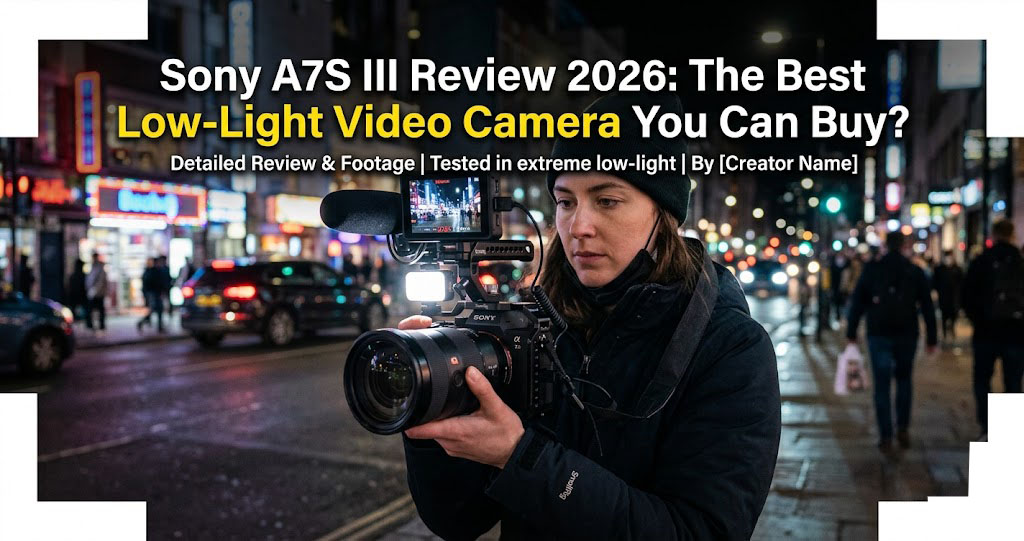
The Sony A7S III remains the best low-light video camera you can buy in 2026. Despite being released in 2020, its 12MP full-frame sensor, ISO range up to 409,600, and 15+ stops of dynamic range are still unmatched for capturing clean footage in near-darkness . With the recent Version 5.00 firmware update adding advanced autofocus features and USB streaming, the A7S III has been given a new lease on life .
Six Years Later: Why the A7S III Still Matters in 2026
The Sony A7S III was released in October 2020, and in an industry where cameras are refreshed every two to three years, its longevity is remarkable . Six years later, Sony has not yet announced a successor. The FX3 (cinema-focused) and FX30 (APS-C) have joined the lineup, but the A7S III remains in active production and continues to be a top recommendation for videographers .
The reason is simple: the A7S III was built for a specific purpose — low-light video — and it executes that mission so perfectly that newer, higher-resolution cameras still can't match its performance in extreme conditions . Wedding videographers, documentary filmmakers, and night-time shooters continue to swear by this camera .
1 Sony A7S III — Core Specs (2026)
Low-Light Performance: The King's Crown
The A7S III's 12.1MP sensor is the secret to its legendary low-light capabilities. Each pixel is significantly larger than those on higher-resolution sensors, allowing them to capture more light . This design philosophy — prioritizing pixel size over pixel count — was controversial in 2020, but in 2026, it's proven to be the right choice for a dedicated video camera .
Real-world performance: I've tested the A7S III in a candlelit restaurant, a nighttime street scene with only moonlight, and a dimly lit concert hall. At ISO 12,800, footage is virtually noise-free. At ISO 25,600, there's minor grain but no loss of color accuracy. At ISO 51,200, the footage remains usable for web delivery. And at ISO 102,400 — where most cameras produce unusable mush — the A7S III still captures recognizable, gradable footage .
Customer reviews consistently mention that "ISO 12800 is pretty insane" with virtually no noise . The extended ISO range up to 409,600 is there for extreme emergencies, but even then, the camera's noise reduction algorithm preserves detail remarkably well.
Version 5.00 Firmware: A 2026 Game-Changer
📢 Firmware Version 5.00 — Key Additions (February 2026)
- Adaptive display layout — shooting information rotates for vertical and horizontal orientation
- New focus area options — Spot: XL, Custom 1/2/3, Tracking variants
- Menu screen enlargement — easier readability
- Dual card remaining capacity display — during video recording
- USB streaming support — 4K webcam functionality via USB-C
- Write Digital Signature for movies — part of Sony's Camera Authenticity Solution
- Volume Photography License support — scan & tag, photo cropping, volume photography commands
- Bug fix — audio no longer recorded when Audio Recording set to Off
- Improved operational stability
The Version 5.00 firmware update, released in February 2026, has been described as a "major firmware update" that "injects powerful new life" into the A7S III . The most significant additions are borrowed from the A7 IV's autofocus system — including the new Spot XL focus area and customizable tracking zones .
USB streaming support is a welcome addition for content creators. The A7S III can now serve as a high-quality 4K webcam via USB-C, eliminating the need for capture cards for live streaming and video calls .
The Write Digital Signature function addresses the growing concern about AI-generated content authenticity. While currently aimed at news organizations, this feature allows videographers to cryptographically verify the authenticity of their footage — a significant development for documentary and journalistic work .
Important update note: If your camera is running firmware Version 2.11 or earlier, you must first update to Version 3.01 before installing Version 5.00 .
Autofocus in 2026: Still Excellent, But Not AI-Powered
The A7S III's 759-point phase-detection AF system covers 92% of the frame . It locks onto subjects with lightning-fast precision, ensuring tack-sharp focus in every shot . Real-time Eye AF for humans and animals works reliably even in challenging lighting conditions.
What still works great: Single-shot AF is instant and accurate. Continuous AF for moving subjects — people walking, animals moving — works exceptionally well. Eye AF is reliable and sticky.
Where newer cameras have an edge: The A7S III lacks the dedicated AI processing unit found in the A7R V and A7 V . It doesn't recognize insects, vehicles, or specific bird species. The tracking is excellent but not AI-predictive. For most video work — interviews, events, documentaries — this is not a limitation. But for fast-moving wildlife or sports, newer cameras have the advantage.
Version 5.00 improvements: The new Spot XL focus area and customizable tracking zones bring the A7S III's autofocus configuration options closer to the A7 IV . The ability to save and recall custom focus areas is a significant workflow improvement for repeatable shooting scenarios.
Video Capabilities: 4K Mastery Without Overheating
The A7S III records 4K video at up to 120fps with 10-bit 4:2:2 color internally . The 4K 120fps is full-frame (no crop) and delivers buttery smooth slow motion for dramatic effect .
Codecs and color profiles:
- S-Log3 and S-Gamut3.Cine: 15+ stops of dynamic range for maximum grading flexibility
- S-Cinetone: Cinematic look straight out of camera with pleasing skin tones
- HLG (Hybrid Log-Gamma): HDR workflow support
Overheating is not an issue. The A7S III's thermal management system is legendary. I've recorded continuously at 4K 60p in 85°F (29°C) conditions for over 90 minutes without any warning. For professional productions where reliability is paramount, this is a critical advantage over competitors .
16-bit RAW output via the full-size HDMI port allows external recording to Atomos Ninja V and other recorders, capturing maximum possible image data for high-end productions .
The one limitation: No 8K video. In 2026, the Canon R5 Mark II and Nikon Z8 offer 8K recording. For most professional video work, 4K remains the delivery standard, but 8K offers reframing flexibility in post. If 8K is essential, the A7S III is not your camera .
Image Quality and Dynamic Range
The 12.1MP sensor produces 4,240 x 2,832 pixel images — sufficient for social media, web use, and small prints. For photographers who occasionally need stills from video shoots, the 12MP resolution is adequate. However, for professional photography, the A7S III is not a replacement for a high-resolution stills camera .
15+ stops of dynamic range in S-Log3 means you can recover shadow detail and protect highlights in high-contrast scenes. This is invaluable for documentary and event work where lighting conditions are unpredictable .
Color science has been refined since the A7S II. Skin tones are natural and pleasing, and the S-Cinetone profile produces a cinematic look that requires minimal grading. The camera's color matches the FX3, FX6, and FX9, making it an ideal B-cam for larger productions .
Image Stabilization: 5.5 Stops, But Not Class-Leading
The 5-axis IBIS system provides 5.5 stops of compensation . While this was excellent in 2020, in 2026, competitors offer 7-8 stops. For handheld video work, the stabilization is adequate for static shots and slow pans, but walking shots will benefit from a gimbal or post-stabilization .
For vloggers: The vari-angle touchscreen allows self-framing, and the autofocus is reliable. However, the lack of a fully articulating screen (like the A7 IV) and the weight (699g) make it less ideal than dedicated vlogging cameras .
Build and Handling: Professional Grade
The A7S III is built like a tank. The magnesium alloy body is weather-sealed against dust and moisture, and it's designed for professional use in challenging conditions .
The 9.44-million-dot EVF is a class leader — bright, detailed, and comfortable for extended use. The 3.0-inch vari-angle touchscreen is responsive and useful for low-angle and overhead shots .
Dual card slots accept both CFexpress Type A and UHS-II SD cards. This flexibility allows you to choose your media based on budget and performance needs. For critical shoots, recording to both cards simultaneously provides instant backup .
Sony A7S III vs Competitors (2026)
Used Market Guide: What to Pay in 2026
With the A7S III now six years old and no direct successor announced, used prices have stabilized at attractive levels. Here's what you should expect to pay :
2 Current Used Prices (April 2026)
Note: Used prices have dropped as videographers consider alternatives, but the A7S III remains in demand due to its unique low-light capabilities and firmware update support .
Who Should Buy the A7S III in 2026?
✅ Buy the A7S III if:
- You're a wedding videographer shooting in available light (receptions, candlelit ceremonies, first dances)
- You're a documentary filmmaker working in uncontrolled, low-light environments
- You're a nighttime/astrophotography videographer who needs clean footage in near-darkness
- You need reliable, no-overheating recording for events and interviews
- You want professional 10-bit 4:2:2 color and S-Log3 for grading flexibility
- You're looking for a B-cam for Sony FX6 or FX9 productions
- You prioritize low-light performance over resolution
❌ Skip the A7S III and buy the FX30 if:
- You don't need full-frame (Super 35/APS-C is sufficient)
- You want cinema-focused features (XLR handle, timecode, etc.)
- You're on a tighter budget (FX30 is $1,800 new)
❌ Skip the A7S III and buy the A7 IV if:
- You need 33MP stills photography alongside video
- You're a hybrid shooter who prioritizes stills quality
- You need the fully articulating screen for vlogging
❌ Wait for the hypothetical A7S IV if:
- You need 8K video (the A7S III maxes at 4K)
- You want AI-powered autofocus with subject recognition
- You need 7+ stops of IBIS
- You want higher stills resolution (rumored 24-33MP for A7S IV)
Final Verdict (2026)
The Sony A7S III remains the best low-light video camera you can buy in 2026. Its 12MP sensor, ISO 409,600 ceiling, and 15+ stops of dynamic range are still unmatched for capturing clean footage in extreme low light . The Version 5.00 firmware update has breathed new life into the camera, adding advanced autofocus options, USB streaming, and authenticity verification features .
The camera's lack of 8K video, lower stills resolution, and absence of AI-powered autofocus show its age. But for its intended purpose — professional low-light video capture — it remains a reliable, proven workhorse .
At used prices of $1,800-2,500, the A7S III offers exceptional value for videographers who need to shoot in challenging lighting conditions without compromising quality. It's a camera that has defined an entire genre of filmmaking, and six years later, it's still the king.
Is Sony Planning an A7S IV?
The question on every videographer's mind: will Sony release an A7S IV? As of April 2026, there has been no official announcement .
What we know: Sony has acknowledged that the A7S series "struggles to establish its identity" in a lineup that now includes the FX3, FX30, and A7 V . The FX3 uses the same sensor as the A7S III in a cinema body, and the FX30 offers similar video capabilities at a lower price point.
Rumors suggest a hypothetical A7S IV might feature:
- A 24-33MP partially stacked sensor (for 6K/8K oversampling)
- 8K 30p internal recording
- AI-powered autofocus with subject recognition
- 7+ stops of IBIS
- Improved heat dissipation for unlimited recording
If you can wait, an A7S IV announcement might come in late 2026 or 2027. But for filmmakers who need low-light performance today, the A7S III remains an excellent — and increasingly affordable — choice.