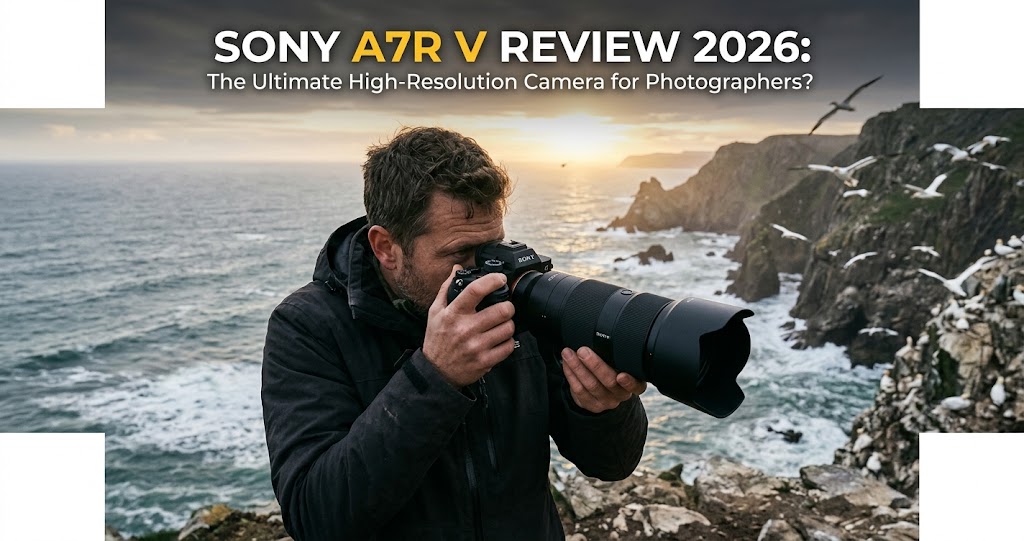
The Sony A7R V is the ultimate high-resolution camera for photographers who demand the absolute best in detail, color, and dynamic range. With its 61MP full-frame sensor, AI‑powered autofocus that recognizes seven subject types, 8‑stop IBIS, and 8K video, the A7R V sits at the pinnacle of Sony's R‑series lineage . It's not a camera for everyone — but for landscape, studio, architectural, and fine art photographers, it's arguably the finest tool ever made .
The Evolution of Resolution: Same Sensor, New Brains
The A7R V shares its 61MP back‑ilSHOTAVIXted Exmor R CMOS sensor with the A7R IV . But that's where the similarities end. Sony has paired this sensor with the BIONZ XR processor — the same engine found in the flagship A1 — which offers up to 8x greater processing performance than previous generations .
What this means in practice: The sensor's full potential is finally unleashed. Rolling shutter is dramatically reduced, burst shooting is snappier, and autofocus computations happen in real‑time without compromising image quality . The copper wiring layer in the sensor design improves data transmission speed, enabling consistent 14‑bit, 61MP stills .
The native ISO range is 100-32,000, expandable to 50-102,400. Dynamic range measures an impressive 15 stops at lower sensitivities, delivering smooth color transitions and subtle highlight/shadow gradation . For landscape and studio photographers, this is pure gold.
1 Sony A7R V — Core Specs (2026)
The AI Autofocus Revolution: 7 Subject Types
The headline feature of the A7R V is its dedicated AI Processing Unit, which dramatically improves subject recognition and tracking . This isn't just marketing hype — the AI processor uses deep learning to recognize not just faces, but entire body poses and head positions .
Real-time Recognition AF works with seven selectable target types :
- Human: Tracks body and head positions for accurate portraits. Real-time Eye AF performance has improved by 60% thanks to human pose estimation .
- Animal / Bird: 40% more accurate for dogs, cats, birds, and more — now recognizes heads and bodies, not just eyes .
- Insect: Finer performance that can detect the head or entire insect subject .
- Car/Train and Airplane: Detects front sections, noses, or entire fast-moving vehicles .
For wildlife photographers, the improved animal recognition is transformative. The camera can now distinguish between different animals and maintain focus on specific individuals in a group. For insect photographers, the dedicated insect mode locks onto tiny subjects with remarkable precision .
693 phase-detection AF points cover 79% of the full-frame image area — and 100% of the APS-C cropped area . Sensitivity extends down to -4 EV, meaning the A7R V focuses reliably in near‑darkness. Full‑time DMF (Direct Manual Focus) allows instant manual override without switching modes .
Image Quality: The 240.8MP Secret Weapon
The 61MP sensor captures images at 9,504 x 6,336 pixels . That's enough resolution for massive prints — think 40x60 inches at 240 DPI without interpolation. But Sony offers an even more staggering capability: Pixel Shift Multi Shooting .
This feature shifts the sensor while making 16 consecutive exposures, then combines them in post‑production using Sony's Imaging software. The result is a composite image with approximately 240.8MP of information and an image size of 19,008 x 12,672 pixels . Color accuracy and detail surpass what's possible with a single exposure, making this invaluable for archival work, fine art reproduction, and product photography.
Color science has also been refined. A new auto-exposure algorithm can detect skin areas in faces to balance portraits more accurately — approximately 20% more reliable, even in challenging backlit conditions . Deep learning technology, combined with visible light and IR sensors, contributes to more accurate color reproduction and auto white balance processing .
Image Stabilization: 8 Stops of Handheld Magic
The A7R V's 5‑axis in-body image stabilization has been revised to support up to 8 stops of compensation . This is a significant upgrade over the A7R IV and brings the R‑series into competition with the best stabilization systems on the market.
How Sony achieved 8 stops: A high‑performance gyro sensor combines with an optimized algorithm for more precise shake control. Communication between the camera body and lens has also been improved .
For video, Active IS mode adds even more precise stabilization methods for smoother handheld footage. This digital stabilization system has been updated with a new algorithm that offers the best performance when paired with select OSS‑enabled lenses .
In practice, I've shot handheld at 1/10 second with a 50mm lens and achieved consistently sharp results. For landscape photographers who often work in low light without a tripod, this is a game‑changer.
Video Capabilities: 8K for High‑Resolution Production
The A7R V is a stills‑first camera, but its video specs are impressive :
- 8K 24p/25p recording using the full width of the sensor with full pixel readout .
- 4K 60p using the full sensor width (not cropped) .
- 10‑bit 4:2:2 internal recording in XAVC HS and XAVC S-I codecs .
- 16‑bit RAW output via the full‑size HDMI port to external recorders like Atomos Ninja .
- S‑Log3, S‑Cinetone, and HLG profiles for flexible grading .
Focus breathing compensation automatically smooths focus transitions and maintains a consistent field of view when changing focus during a shot . This is compatible with select E‑mount lenses and is invaluable for video work.
Heat management has been improved with a new dissipating structure, allowing continuous 8K recording for approximately 30 minutes before thermal shutdown . For most production work, this is sufficient, but dedicated videographers may prefer the A7S III or FX series.
Sony A7R V vs A7 IV — Key Differences
Body and Handling: The 4‑Axis Screen and 9.44M‑Dot EVF
The A7R V features the same 4‑axis multi‑angle rear screen found on the A7 V . This 3.2‑inch 2.1‑million‑dot LCD combines the best of tilt and fully articulating designs — tilt up/down for waist‑level shooting or flip out sideways for selfie/vlogging work. It also has a DCI‑P3 wide gamut for accurate color monitoring .
The 9.44‑million‑dot QXGA OLED Tru‑Finder EVF is a class leader. With 0.9x magnification and a 120fps refresh rate, it's exceptionally bright, clear, and detailed — perfect for critical manual focusing at 61MP . The EVF has a 25mm eye point and 41° field of view, making it comfortable even for eyeglass wearers.
Build quality is outstanding. The magnesium alloy chassis is dust and moisture‑sealed, with enhanced sealing around the battery cover, terminal cover, and chassis joints . The lens mount and grip rigidity have both been improved to better support heavy lenses .
Dual card slots both accept CFexpress Type A or UHS‑II SD cards. The two‑slot design allows for flexible file saving — you can partition file types, use overflow recording, or duplicate for instant backup .
Who Should Buy the A7R V in 2026?
✅ Buy the A7R V if:
- You're a landscape photographer who needs maximum resolution for large prints and cropping flexibility
- You're a studio/commercial photographer shooting products, architecture, or fine art
- You need Pixel Shift Multi Shooting for archival reproduction or ultra‑high‑resolution composites
- You demand AI‑powered autofocus for wildlife, birds, or insects
- You want the best EVF on any Sony camera — 9.44M dots matters
- You need 8‑stop IBIS for handheld shooting in low light
- Budget is not your primary constraint ($3,300+)
❌ Skip the A7R V and buy the A7 IV if:
- You don't need 61MP resolution (33MP is more than enough for most work)
- You're a hybrid shooter who needs 4K 60p without crop (A7R V has a crop for 4K 60p)
- You're on a tighter budget — used A7 IVs are $1,800-2,000
- You primarily shoot fast action and need 30fps (A7 V is better)
- You need internal RAW video recording
❌ Spend more for the A1 II if:
- You need 50MP and 30fps burst with blackout‑free shooting
- You need a fully stacked sensor for absolute minimal rolling shutter
- You shoot high‑speed action (sports, wildlife) and need the fastest possible readout
- Budget is not a concern ($6,500+)
Final Verdict (2026)
The Sony A7R V is the ultimate high‑resolution camera for photographers who need every pixel. It pairs the same 61MP sensor as the A7R IV with Sony's most advanced processor and AI autofocus system, unlocking the sensor's full potential . The result is a camera that delivers breathtaking detail, exceptional dynamic range, and class‑leading autofocus for stationary and slow‑moving subjects .
The dedicated AI processing unit is a genuine leap forward — human pose estimation, 7 subject types, and 40% better animal tracking make this far more than a resolution bump . The 8‑stop IBIS, 9.44M‑dot EVF, and 4‑axis screen are meaningful quality‑of‑life improvements that add up to a significantly better user experience.
However, the A7R V is not for everyone. It's expensive, it's heavy (723g), and its video capabilities, while impressive, are not its primary focus . For landscape, studio, architectural, and fine art photographers, though, it's arguably the finest camera Sony has ever made. The A7R V is the camera you buy when resolution isn't a luxury — it's a requirement.
Recommended Lenses for the A7R V in 2026
To fully unlock the 61MP sensor, you need lenses that can resolve that level of detail. Here are my top recommendations:
- Sony FE 24-70mm F2.8 GM II: The sharpest standard zoom Sony makes. Essential for studio and event work.
- Sony FE 70-200mm F2.8 GM OSS II: Telephoto excellence for portraits and compressed landscapes.
- Sony FE 50mm F1.2 GM: One of the sharpest lenses ever made. Wide open, it resolves 61MP effortlessly.
- Sony FE 14mm F1.8 GM: Ultra‑wide for astrophotography and architectural interiors.
- Sony FE 90mm F2.8 Macro G OSS: For product photography and extreme detail work — sharp enough for Pixel Shift composites.
- Sigma 85mm F1.4 DG DN | Art: A slightly more affordable portrait lens that still resolves beautifully on 61MP.