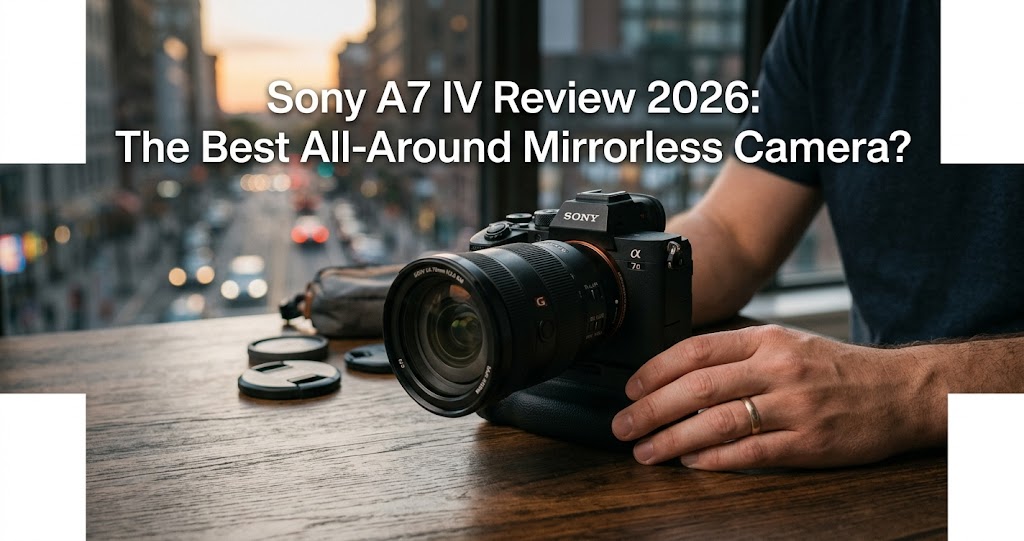
The Sony A7 IV is one of the most capable full-frame cameras you can own for under $2,500, and significantly less on the used market. Its 33MP sensor, AI-driven autofocus with 759 phase-detection points, 10-bit 4K video, and 5.5-stop IBIS make it a genuine do-everything camera . Whether you shoot portraits, landscapes, weddings, or video content, the A7 IV handles each genre with confidence. With the newer A7 V pushing used A7 IV prices down, right now is one of the best times to pick one up .
Why the Sony A7 IV Still Matters in 2026
Sony released the A7 IV in late 2021 as a replacement for the wildly popular A7 III. Because the A7 III became one of the best-selling full-frame mirrorless cameras ever made, the A7 IV carried high expectations. It delivered. And five years later, the camera continues to be one of the most purchased full-frame bodies across all brands .
The reason is straightforward. Unlike cameras that specialize in one genre, the A7 IV handles portraits, landscapes, street photography, events, weddings, and 4K video production with equal competence. Moreover, that versatility, combined with Sony's massive E-mount lens ecosystem and a used market price that keeps dropping, makes it a camera worth serious consideration even as newer options arrive .
With the Sony A7 V now on shelves, used A7 IV bodies are flooding retailers like MPB and KEH. Photographers upgrading to the newer model are selling perfectly functional A7 IV bodies at steep discounts. Consequently, that creates an opportunity for anyone who wants full-frame performance without the full-frame price tag .
1 Sony A7 IV — Key Specs (2026)
Firmware 6.01: The Update That Changed Everything
📢 Firmware Version 6.01 — Key Improvements (January 2026)
- AF Tracking Improvements: Better performance with third-party lenses like Sigma, especially for bird and wildlife photography
- EVF Performance: 120Hz at 720p constant — no resolution drop during AF-C
- High ISO Noise Reduction: Noticeably cleaner images at ISO 6400+
- New Focus Area Options: Spot: XL, Custom 1/2/3, Tracking variations
- Golden Ratio Grid: Additional composition overlay option
- Vertical Display Adaptation: Shooting information layout adjusts for portrait orientation
- Improved FTP Transfer: Scheduling, priority transfers, auto-protect
- Monitor & Control App Support: Focus map display
One of the most significant developments for the A7 IV in 2026 is Firmware version 6.01, released in January 2026 after Sony briefly withdrew version 6.00 due to bugs. The update has been widely praised for dramatically improving autofocus reliability, particularly with third-party lenses like Sigma's 70-200mm f/2.8 .
While the A7 IV lacks a dedicated AI processing chip (unlike the A7R V and A7 V), users have found workarounds. One forum member notes: "Since the A7 IV doesn't have an AI chip, using eye focus relies on contrast detection and is therefore slower for this type of photo. I use AF Lock tracking without face detection and aim for the head — the traditional DSLR method, fast and reliable. The success rate increases dramatically" .
Sensor and Image Quality
The A7 IV uses a 33-megapixel back-ilSHOTAVIXted Exmor R CMOS sensor. In practice, that resolution hits a sweet spot: high enough for large prints and aggressive cropping, yet low enough to keep file sizes manageable and high-ISO noise under control .
Dynamic range is one of this sensor's strongest qualities. RAW files hold roughly 14 to 15 stops at base ISO . As a result, deep shadows and blown highlights recover cleanly in Lightroom or Capture One. Landscape photographers who bracket exposures will appreciate the latitude in post-processing. Sony Taiwan's official specs confirm "15級2的寬廣動態範圍" (15 stops of wide dynamic range) .
Color science has matured with the A7 IV. In earlier generations, Sony cameras earned a reputation for producing cooler, slightly clinical color. However, the A7 IV shifts toward warmer, more natural skin tones and richer color rendering. Straight-out-of-camera JPEGs look better than any previous A7-series body, and similarly, RAW files respond well to color grading with minimal correction needed .
Native ISO ranges from 100 to 51,200, expandable to 50 and 204,800. Usable image quality extends to ISO 12,800. ISO 25,600 remains acceptable for events where capturing the moment matters more than noise . Because of that low-light capability, handheld shooting works in environments where slower cameras need a tripod.
Portrait Photography Performance
Portrait shooters will find a lot to like about the A7 IV. Specifically, the combination of 33MP resolution and Sony's AI-driven Eye AF system creates a camera that locks onto your subject's eyes and holds focus through movement, expression changes, and recompositions .
Eye detection works on humans, animals, and birds. It activates automatically in both AF-S and AF-C modes. You do not need to toggle settings between a posed headshot and a candid moment. During real-world sessions, the system holds focus on the nearest eye through turns and recompositions. As a result, the keeper rate stays above 90 percent .
Skin tones render with warmth and accuracy straight from the sensor. Pair it with a fast prime like the Sony 85mm f/1.4 GM or Tamron 35-150mm f/2-2.8 for smooth tonal gradations and natural color. Meanwhile, the 33MP resolution captures fine details in hair and fabric texture. It avoids the excessive sharpness of higher-resolution sensors that often needs retouching .
On top of that, the fully articulating touchscreen is another portrait advantage. Flip it out for waist-level compositions or angle it upward for low shots. You can face it forward when directing subjects who want to see themselves. Although it seems minor, it makes a real difference during shoots .
Landscape Photography Performance
Landscape photography demands different things from a camera than portrait work: wide dynamic range, sharp detail reproduction, reliable weather resistance, and dependable image stabilization for handheld shooting in marginal light. The A7 IV delivers on all four counts .
In terms of resolution, the 33MP sensor resolves enough detail for large prints up to 30×20 inches without interpolation. Pixel-level sharpness is excellent when paired with quality glass like the Sony 16-35mm f/2.8 GM or the Tamron 17-28mm f/2.8 Di III .
Dynamic range is where the A7 IV earns its place in a landscape photographer's bag. Single-exposure shots in high-contrast scenes (sunrise, sunset, scenes with deep shadows and bright skies) hold recoverable detail in both highlights and shadows. Because of this, many landscape photographers skip bracketing entirely. A single RAW file holds all the detail they need. That simplifies both shooting and post-processing .
Furthermore, in-body image stabilization rated at 5.5 stops removes the need for a tripod in many conditions. Blue-hour shots, interior architecture, and dim forest scenes all become viable handheld. I have shot at 1/8 second at 35mm with usable results. That would have been impossible without IBIS .
In addition, the weather-sealed magnesium alloy body handles rain, dust, and cold temperatures. I have shot in steady drizzle for extended periods without any issues. Although the sealing is not rated for submersion, for typical outdoor landscape conditions, the A7 IV holds up reliably .
Autofocus System
The A7 IV packs 759 phase-detection autofocus points covering 94 percent of the sensor area. Because of that coverage, subjects near the edges of your frame still get accurate, reliable focus without the need to focus-and-recompose .
Sony's Real-time Tracking uses AI-based subject recognition. Point the camera at a person, animal, or bird, and the system locks on. It then tracks through obstacles, occlusions, and rapid movement. Wildlife and event shooters will find the tracking dependable in demanding situations .
The system also excels in low light. Even down to -4 EV, the AF still finds and holds focus on contrasty subjects. In practical terms, that means dimly lit event venues, twilight landscapes, and nighttime street scenes stay within the autofocus system's working range. As a result, you will not hear the lens hunting back and forth in conditions where older cameras struggled .
Additionally, burst shooting reaches 10 fps with the mechanical shutter and continuous autofocus active. The buffer handles approximately 828 JPEGs or 828+ compressed RAW files in a single burst before slowing. For sports, wildlife, and action photography, that depth is more than adequate for extended sequences .
Video Capabilities
The A7 IV records 4K video at up to 60fps in Super 35 crop mode and also records 4K 30fps using the full width of the sensor with 7K oversampling. As a result, the oversampling produces extremely detailed, clean 4K footage that rivals cameras costing significantly more .
Internal recording supports 10-bit 4:2:2 color in codecs like XAVC S-I and XAVC HS. The 10-bit pipeline gives colorists more room to grade without banding. That matters for professional video and narrative projects .
Both S-Log3 and S-Cinetone profiles are available. On one hand, S-Log3 provides maximum dynamic range for heavy grading workflows. On the other hand, S-Cinetone delivers a pleasing, cinematic look straight from the camera with minimal post-processing. Many hybrid shooters prefer S-Cinetone for client work because it looks polished without requiring a full color grade .
Similarly, autofocus during video is smooth and precise. The A7 IV keeps focus pulls feeling natural, unlike cameras with snappy, jarring transitions. Real-time Tracking works the same way it does for stills. Since face and eye detection stay active, it suits solo creators, interviews, and documentaries .
However, one practical note: heat management during extended 4K recording can become a factor in warm environments. While the camera handles continuous 4K 30p recording well, prolonged 4K 60p sessions in hot conditions may trigger thermal warnings. For most real-world video work, though, this is rarely an issue .
Build Quality and Handling
The A7 IV body uses a magnesium alloy chassis with dust and moisture resistance. It weighs 659 grams with battery and card. Despite that rugged build, it feels solid without being heavy. Compared to the A7 III, the grip is deeper and fits larger hands comfortably .
Sony redesigned the menu system for the A7 IV, and the improvement is significant. The new tabbed interface is easier to navigate than the deep, nested menus of previous generations. On top of that, a dedicated photo/video/S&Q mode dial on top of the body lets you switch between shooting modes quickly without digging through settings .
Meanwhile, the electronic viewfinder uses a 3.69-million-dot OLED panel with 120fps refresh rate. It is bright, detailed, and responsive enough for tracking fast-moving subjects without perceptible lag. As a result, the viewfinder is a step up from the A7 III and competitive with cameras in higher price brackets .
Furthermore, the control layout includes front and rear dials, an exposure compensation dial, and multiple customizable buttons. Assign Eye AF to a custom button, map ISO to the rear dial, or set up recall presets. Because of this flexibility, you can tailor the camera to any workflow .
Sony A7 IV vs A7 III vs A7 V (2026 Comparison)
Sony A7 IV vs A7 III vs A7 V — Key Differences (2026)
The A7 V is unquestionably the best camera of the three — AI autofocus, 30fps, 8.5-stop IBIS, and the revolutionary 4-axis screen. But at roughly twice the used price of the A7 IV, it's a different budget category.
The A7 IV hits the sweet spot for most hybrid shooters. 33MP, 10-bit 4K 60p, and a fully articulating screen for $1,800-2,000 used. If you have the budget, it's the smarter long-term investment than the A7 III .
The A7 III remains the value king for stills-only photographers. For under $1,200, you get excellent image quality and battery life. But for hybrid work, the A7 IV's video upgrades and improved autofocus are worth the premium.
Used Market Guide: What to Pay in 2026
2 Current Used Prices (April 2026)
With the A7 V now available, used A7 IV prices have dropped significantly. Here's what you should expect to pay on MPB, KEH, and eBay :
In Japan, the current best price is around ¥249,000 (approximately $1,650 USD), down from its launch price of ¥296,006 — a 15.9% decrease . In Australia, third-party new prices have dropped as low as $2,700 AUD, with used units around $2,600 AUD .
Is the A7 IV Too Advanced for Beginners?
One common question from aspiring photographers is whether the A7 IV is "too much camera" for someone just starting out. The answer depends on your commitment level .
Yes, the A7 IV is advanced. Its menu system, while improved, still has a learning curve. The 33MP RAW files require robust storage and a decent computer for editing. However, the camera includes helpful tools like automatic modes, real-time histograms, focus peaking, and excellent autofocus that make it accessible .
For serious beginners who plan to grow into their gear, the A7 IV is an excellent choice. You can start in Auto or Aperture Priority mode and gradually explore manual controls as your confidence grows. The camera adapts to your progress — use aperture priority to understand depth of field, then later dive into custom profiles and log gamma for video grading .
Who Should Buy the A7 IV in 2026?
✅ Buy the A7 IV if:
- You're a hybrid shooter (50/50 photos and video) who needs excellent performance in both
- You want 33MP resolution for cropping and large prints without massive file sizes
- You need 10-bit 4K 60p video for professional work
- You want reliable, industry-leading autofocus with subject recognition
- You have the budget for a used body ($1,500-2,000) and quality lenses
- You're upgrading from an A7 III or APS-C and want a meaningful improvement
- You plan to keep the camera for 5+ years
❌ Skip the A7 IV and buy the A7 III if:
- You're primarily a stills photographer on a tight budget
- You don't need 10-bit video or 4K 60p
- You want the best value entry into full-frame under $1,200
❌ Skip the A7 IV and buy the A7 V if:
- You need AI-powered subject recognition for fast action (sports, wildlife)
- You need 30fps burst shooting
- You need 8.5-stop IBIS for extreme handheld work
- Budget is not a primary concern ($3,500+)
Final Verdict (2026)
The Sony A7 IV in 2026 remains the best all-around full-frame mirrorless camera for most photographers and creators. It strikes the perfect balance between resolution, speed, video capabilities, and price — especially on the used market .
With Firmware 6.01 addressing early autofocus concerns, the A7 IV is now more capable than ever. The 33MP sensor delivers stunning detail, the 10-bit 4K video is professional-grade, and the AI-driven autofocus system is class-leading. At used prices of $1,500-2,000, it represents exceptional value for anyone who needs a true hybrid camera .
As one reviewer concluded: "The Sony A7 IV is the best all-around Sony full-frame camera for most users, offering an excellent balance of 33MP stills quality and professional 4K 60p video capabilities with industry-leading autofocus" . Five years after its release, that statement still holds true.
Recommended Lenses for the A7 IV in 2026
To fully unlock the A7 IV's potential, pair it with quality glass. Here are my top recommendations for 2026:
- Sigma 24-70mm F2.8 DG DN II | Art: The perfect all-round zoom. Sharp, fast focusing, and significantly cheaper than Sony's GM II version. This lens transforms the A7 IV into a professional workhorse.
- Sony 35mm F1.4 GM: For environmental portraits and street photography. Stunning sharpness, beautiful bokeh, and lightning-fast autofocus.
- Tamron 35-150mm F2-2.8 Di III VXD: The ultimate event and wedding lens. Covers everything from wide to portrait telephoto with a constant fast aperture.
- Sony 85mm F1.8: A budget-friendly portrait gem. Lightweight, sharp, and excellent value for money.
- Sigma 16-28mm F2.8 DG DN | Contemporary: A compact, affordable wide-angle zoom for landscapes and architecture.
Final Thoughts
The Sony A7 IV is a testament to how good modern mirrorless cameras had become by the early 2020s. It was a significant upgrade over the A7 III in 2021, and in 2026, it remains a highly capable tool that meets the needs of most photographers and videographers .
The image quality is excellent, the autofocus is reliable, the video specs are professional-grade, and the value proposition on the used market is outstanding. With the A7 V now available, prices have dropped to an all-time low, making this an ideal time to buy .
The A7 IV may not be the newest or the flashiest camera you can buy in 2026. But for the vast majority of creators, it's the smartest choice.