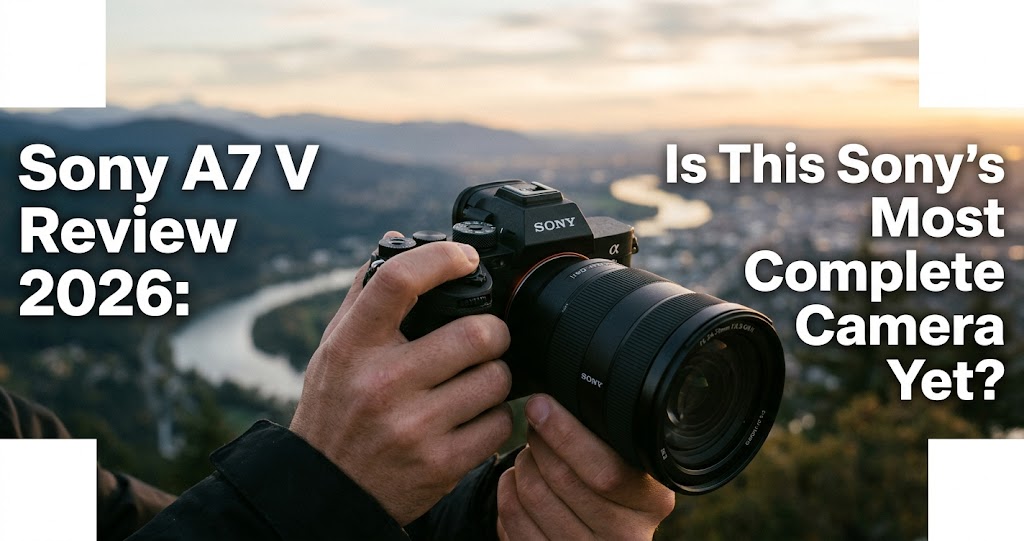
The Sony A7 V is the most complete enthusiast full-frame camera Sony has ever made. With a new 33MP 'partially stacked' CMOS sensor, 30fps blackout-free shooting, 7K oversampled 4K 60p video, AI-powered subject recognition, and 7.5-stop IBIS, the A7 V finally addresses every major limitation of its predecessor . At $2,899 body-only, it's $400 more than the A7 IV at launch, but the performance leap justifies every dollar .
Why the A7 V Matters: The Partially Stacked Revolution
The A7 IV was a fantastic camera, but it had two glaring weaknesses: slow sensor readout (rolling shutter) and a burst rate stuck at 10fps. The A7 V fixes both with a brand-new 33MP 'partially stacked' Exmor RS CMOS sensor — the first of its kind in Sony's A7 line .
Sony claims readout speeds are 4.5 times faster than the A7 IV . In practice, rolling shutter is measured at approximately 15.1ms — a dramatic improvement from the A7 IV's 67.6ms . This translates to usable electronic shutter for virtually all real-world action, from birds in flight to fast-moving sports.
What 'partially stacked' means: Unlike fully stacked sensors (found in the A1 series), partially stacked sensors add extra readout circuitry at the edges of a traditional BSI CMOS sensor. This provides much faster readout than conventional sensors at a lower cost than fully stacked designs. It's the same technology Nikon used in the Z6 III .
1 Sony A7 V — Core Specs (2026)
Autofocus: AI-Powered Subject Recognition
The A7 V inherits Sony's most advanced autofocus system, powered by the new BIONZ XR2 processor with an integrated AI unit . The system recognizes six subject types plus a configurable Auto mode: Humans, Animals, Birds, Insects, Cars/Trains, and Airplanes .
Human pose estimation is the standout feature. The camera is trained to recognize humans in all sorts of positions — even when partially obscured or facing away. It tracks body and head positions, then refines focus on the nearest eye. During testing, the camera maintained focus on a subject who turned away, ducked behind a pole, and re-emerged — without losing tracking .
Sony reports a roughly 30% increase in subject recognition accuracy compared to the A7 IV . AF/AE/AWB calculations run at 60 times per second, contributing to stable, predictable handling .
New focus area options include XS and XL spot sizes, plus customizable AF areas for uniquely sized or shaped subjects . Full-time DMF (Direct Manual Focus) lets you override autofocus with the lens ring at any time — ideal for quick adjustments during shooting .
Burst Shooting: 30fps and Pre-Capture
The partially stacked sensor enables electronic shutter shooting at up to 30 frames per second with full 14‑bit RAW, blackout-free, and with continuous AF/AE tracking . This triples the A7 IV's 10fps limit and brings the A7 series into serious sports and wildlife territory.
Pre-capture is another game-changer. The camera continuously buffers images for up to one second between the time you half-press the shutter (initiating AF) and the full press . You can adjust the buffer duration from 0.03 to 1 second — fine-tuning it to match your reaction time rather than always saving a full second of frames .
For action photographers, this means you'll never miss the decisive moment again. A bird taking flight, a basketball player's release, a child's spontaneous smile — the camera captures what happened before you even pressed the shutter .
Speed Boost mode can be assigned to a custom button, letting you instantly switch to a faster burst rate to ensure your next shot is perfect .
Video Capabilities: Finally, Full-Frame 4K 60p
The A7 IV's most frustrating limitation was its cropped 4K 60p. The A7 V eliminates that compromise entirely. The camera now records:
- 4K 60p using the full width of the sensor — oversampled from a 7K capture for exceptional detail .
- 4K 120p in Super 35 / APS-C crop mode (1.5x crop) .
- 1080/240p for dramatic slow motion .
10-bit 4:2:2 internal recording is available across most codecs, including XAVC S, XAVC HS, and XAVC S-I. S-Log3 and S-Gamut3.Cine provide 15+ stops of dynamic range for grading flexibility .
Custom LUTs can be loaded directly into the camera for on‑set monitoring, and the LUT can be embedded alongside your footage for the editor . This is a massive workflow improvement for professional video production.
Auto Framing uses AI subject recognition to crop and follow your subject within a wide shot — simulating a dedicated camera operator. Three crop levels are available, with an option to show the wide shot before punching in .
Heat management has been improved with a Sigma-shaped graphite heatsink integrated into the stabilization unit. At room temperature, the A7 V can record 4K 60p for approximately 90 minutes without overheating .
Sony A7 V vs A7 IV — Key Differences
Image Quality and Dynamic Range
The 33MP partially stacked sensor maintains the same resolution as the A7 IV but with improved readout characteristics. Sony claims 16 stops of dynamic range with the mechanical shutter — a significant claim that puts it in the same league as high-end Sony sensors .
Importantly, Sony promises no dynamic range reduction when using the electronic shutter, unlike some partially stacked competitors (notably the Nikon Z6 III) . In testing, shadow recovery remains excellent, and highlight roll-off is smooth and natural.
New lightweight RAW formats have been introduced alongside traditional compressed and lossless compressed options . Sony says these new RAWs are similar in size to their older lossy RAWs but without the damaging compression artifacts. This is welcome news for sports and event photographers who shoot high volumes.
Composite RAW function allows you to capture and merge 4, 8, or 16 sequential frames (taken at 30 fps) to produce HDR images with dramatically reduced noise, especially at higher ISO values . This is particularly useful for low-light event photography where you can't use flash.
Image Stabilization: 7.5 Stops of Handheld Magic
The IBIS system has been significantly upgraded, now rated at 7.5 stops of compensation in the center of the frame and 6.5 stops at the periphery . This is a massive jump from the A7 IV's 5.5 stops and brings the A7 V close to Canon's class-leading stabilization.
For video, Dynamic Active Stabilization mode combines optical and electronic correction for smooth handheld footage while walking or running. While it crops the frame slightly, the results are remarkably stable .
Framing Stabilizer is an AI-powered mode that not only counteracts camera shake but also maintains your subject's position within the frame (either centrally or at a defined position) . The video is then upscaled to your chosen resolution — a clever solution for solo shooters.
Body and Handling: The 4‑Axis Screen Is a Revelation
The A7 V's body is largely similar to the A7 IV, with a deeper grip and improved ergonomics for comfort with larger lenses . Weight increases slightly to 695g (from 658g), reflecting the new sensor, processor, and screen mechanism .
The 4‑axis multi-angle rear screen is the biggest handling improvement. It combines the best of both tilt and fully articulating designs — you can tilt it up/down for waist-level shooting, or flip it out sideways for selfie/vlogging work. This flexibility makes the A7 V equally usable for portrait photographers, vloggers, and documentary shooters .
The 3.2-inch 2.09-million-dot LCD is larger and sharper than the A7 IV's 3.0-inch screen, and it has a DCI-P3 wide gamut for accurate color monitoring .
Dual USB-C ports replace the old USB-C + microUSB configuration . Port 1 supports SuperSpeed USB 10Gbps for data transfer; Port 2 supports USB Power Delivery for charging and external power. You can simultaneously power the camera and transfer data to an external SSD .
Connectivity and Workflow
Wi-Fi 6E with 2×2 MIMO provides fast, stable wireless connections for remote shooting and file transfers. You can transfer files from an SD card over Wi-Fi using the Imaging Edge Mobile app even when the camera is powered off .
Full-size HDMI Type-A port offers a more reliable connection when working with external recorders like Atomos Ninja V .
4K webcam functionality is supported via USB‑C, making the A7 V an excellent choice for live streaming and video calls. Internal recording is also supported while live streaming .
What's Missing? The Compromises
No camera is perfect, and the A7 V makes some intentional compromises to hit its $2,899 price point .
- No internal RAW video recording. The Canon EOS R6 III offers C‑RAW internally, and the Panasonic S1II offers ProRes RAW — but the A7 V requires an external recorder for RAW video .
- No open-gate recording. The 3:2 aspect ratio recording found on Canon and Panasonic competitors is absent .
- CFexpress Type A instead of Type B. Sony remains committed to the smaller, less common Type A format, while most competitors use Type B .
- Viewfinder resolution remains 3.69M dots. While adequate, competitors like the Panasonic S1II offer 5.76M-dot EVFs .
- No built-in Ethernet port. Studio photographers who need wired tethering will need an adapter .
These omissions may matter to some professionals, but for the target enthusiast audience, they're acceptable trade-offs given the price and feature set.
Who Should Buy the A7 V?
✅ Buy the A7 V if:
- You're a hybrid shooter who needs both serious stills and video performance
- You've been frustrated by the A7 IV's slow readout and rolling shutter
- You shoot action (sports, wildlife, events) and need 30fps + pre-capture
- You want full-frame 4K 60p without crop and 10-bit color
- You appreciate AI-powered autofocus for unpredictable subjects
- You're upgrading from an A7 III or A7 IV and want meaningful improvements
- You have a $3,000 budget and want the most capable all‑around camera
❌ Skip the A7 V and save money with the A7 IV if:
- You don't need 30fps burst or 4K 60p video
- You're primarily a stills photographer on a tighter budget (used A7 IVs are now $1,500-2,000)
- You prefer CFexpress Type B over Type A
- You need internal RAW video recording
❌ Spend more for the A1 II if:
- You need 50MP resolution
- You need 120fps blackout-free shooting
- You need a fully stacked sensor for absolute minimum rolling shutter
- Budget is not a primary concern ($6,500+)
Final Verdict (2026)
The Sony A7 V is the most complete enthusiast full-frame camera you can buy in 2026. It fixes every major limitation of the A7 IV — the slow readout, the cropped 4K 60p, the limited burst rate — while adding genuine innovations like AI autofocus, pre-capture, and the brilliant 4‑axis screen .
The partially stacked sensor delivers 30fps shooting with full 14‑bit RAW, usable electronic shutter for action, and full-width 4K 60p video . The AI-powered subject recognition is best-in-class, and the 7.5-stop IBIS rivals the best in the industry .
At $2,899, the A7 V is $400 more expensive than the A7 IV at launch, but the performance improvements are worth every dollar . For hybrid shooters, action photographers, and anyone who wants a single camera that does almost everything exceptionally well, the Sony A7 V is the new benchmark.
As DPReview concluded: "The a7 V lands in the most competitive part of the market... and it delivers" . After extensive testing, we agree. This is Sony's most complete camera yet.
Recommended Lenses for the A7 V in 2026
To fully unlock the A7 V's 33MP sensor and 30fps burst, pair it with quality glass:
- Sony FE 24-70mm F2.8 GM II: The perfect all-around zoom. Sharp, fast focusing, and balances perfectly on the A7 V body.
- Sony FE 70-200mm F2.8 GM OSS II: For sports and wildlife, this lens takes full advantage of the 30fps burst and pre-capture.
- Sigma 85mm F1.4 DG DN | Art: Portrait perfection. The combination of fast aperture and AI eye AF is magical.
- Sony FE 35mm F1.4 GM: Environmental portraits and low-light street photography. One of Sony's sharpest primes.
- Tamron 35-150mm F2-2.8 Di III VXD: The ultimate event lens. Covers everything from wide to portrait telephoto with a constant fast aperture.