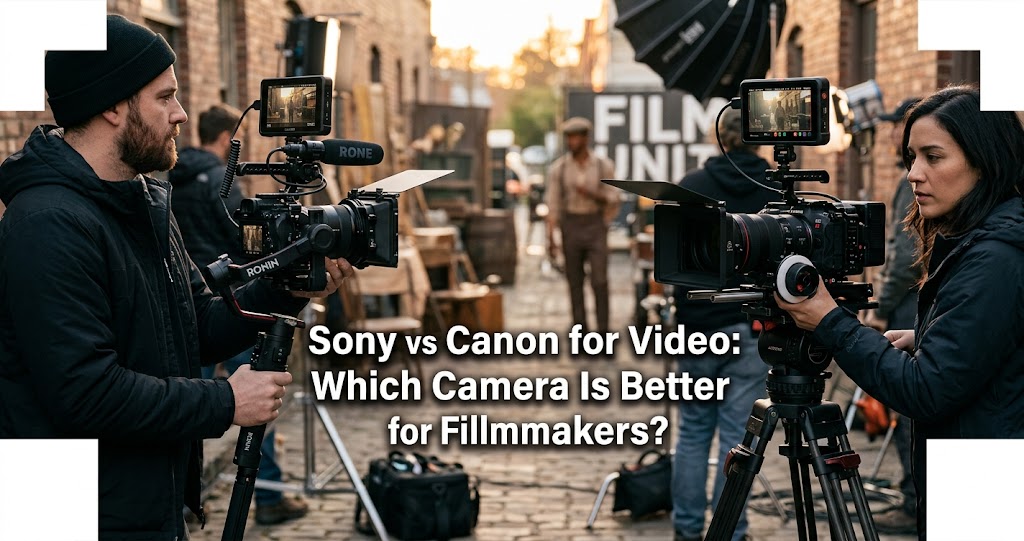
Choosing between Sony and Canon in 2026 isn't really about which brand is "better." It's about which camera behavior fits your productions: how you shoot, how long you roll, how much you grade, and how you deliver . Both companies have spent the last decade refining their mirrorless and cinema systems, and today's bodies are powerful enough that the best choice often comes down to workflow details—recording formats, overheating limits, autofocus reliability, stabilization feel, and how quickly you can move from set to final export.
A wedding filmmaker, a doc shooter, and a small commercial crew might all say they "need 4K," but they don't need the same camera . If you shoot long interviews, you care about heat management and recording stability. If you shoot handheld run-and-gun, you care about autofocus confidence, stabilization, and low-light behavior. If you shoot narrative or branded content, you care about codec flexibility, log performance, and matching cameras in post .
The 2026 Landscape: What Sundance Tells Us
Sundance 2026 Documentary & Feature Camera Usage
The Sony FX6 leading the doc tally underscores how decisive variable ND, low-light reliability, and compact cinema ergonomics have become for vérité-driven storytelling . The Canon C70's strong presence shows that Super 35, dependable color science, and all-in-one practicality remain deeply valued. The FX3 and a7S III reinforce how mirrorless cameras are no longer secondary tools but essential social cameras that allow filmmakers to enter sensitive spaces without changing the dynamics of the room .
Head-to-Head: Key Contenders for 2026
Sony α7 V vs Canon EOS R6 Mark III
The Sony A7 V is the safest all-around choice for video creators in 2026—excellent autofocus, strong low-light performance, reliable thermal behavior, and access to the largest mirrorless lens ecosystem . The Canon EOS R6 Mark III is Canon's strongest hybrid option, combining excellent Dual Pixel AF, improved thermal management, and signature Canon color science .
Sony A7 V Strengths
- AI-powered Real-time Tracking autofocus
- Full-width 4K 60p with All-I codecs
- Largest E-mount lens ecosystem
- Stable thermal performance
- 10-bit 4:2:2 XAVC S-I, XAVC HS
- Timecode input/output via Multi Interface Shoe
- Best for: hybrid creators, YouTubers, long-term system builders
Canon EOS R6 Mark III Strengths
- 6K oversampled 4K 30p (sharper detail)
- 4K 60p with minimal 1.1x crop
- Open Gate 7K RAW (3:2) capture
- Canon Log 2 & 3, natural skin tones
- Deep learning-based Dual Pixel AF II
- Fully articulating screen, deep grip
- Best for: Canon shooters, hybrid creators who value color science
"Canon's new AF engine feels intuitive—it anticipates intent. When I'm filming dynamic family moments, it keeps pace without distracting corrections."
Spec Comparison: A7 V vs R6 Mark III
| Feature | Sony A7 V | Canon EOS R6 Mark III |
|---|---|---|
| Max Internal 4K | 4K 60p (full-width) | 4K 60p (1.1x crop) |
| 4K 30p Source | 7K pixel-binned | 6K oversampled |
| Bit Depth / Chroma | 10-bit 4:2:2 | 10-bit 4:2:2 |
| Codecs | XAVC S, XAVC S-I, XAVC HS | H.265, H.264, RAW Open Gate |
| Log Profile | S-Log3 / S-Gamut3.Cine | C-Log2, C-Log3 |
| Lens Ecosystem | Largest (300+ native lenses) | Growing RF lineup |
Flagship Hybrids: High-Resolution Powerhouses
Sony A1 vs Canon EOS R5 Mark II
Sony A1
- 50.1MP full-frame stacked sensor
- 8K recording across full sensor
- 4K 120fps slow-motion
- 14+ stops dynamic range
- Unlimited video recording
- 5-axis IBIS
Canon EOS R5 Mark II
- 45MP stacked full-frame
- 8K 60p RAW internal
- 4K 120p with Canon Log 2/3
- Eye-control AF
- Improved heat management
- Film simulations available
The R5 Mark II's 8K 60p RAW gives you options to crop, stabilize, or reframe in post . The A1's 50MP sensor delivers incredible resolution and 8K flexibility. For filmmakers, both are about future-proofing and maximum image quality.
Cinema Line: Purpose-Built for Filmmakers
Sony Cinema Line vs Canon Cinema EOS
Sony's Cinema Line is now a fully defined ladder from FX30 to VENICE 2. Super 35 entry, compact full-frame crossover, integrated production bodies, scalable large format, and flagship digital cinema. Internal ND marks professional thresholds, X-OCN defines prestige tiers, and color science remains unified across every rung .
Sony Cinema Line
- FX30: Super 35 entry, 14+ stops, timecode
- FX2/FX3: Full-frame compact, 15+ stops
- FX6: Internal variable ND (7 stops), production-ready
- FR7: Remote operation, multi-camera
- BURANO: 8.6K, 16-bit X-OCN LT, PL mount
- VENICE 2: 8.6K, 16-bit X-OCN, flagship
Canon Cinema EOS
- C70: Super 35 Dual Gain, built-in NDs
- C300 Mark III: Super 35, cinema workflow
- C500 Mark II: Full-frame, modular
- R5 C: Hybrid with internal fan cooling
- Canon Log 2/3, XF-AVC, RAW
The FX6's built-in variable ND with 7 stops makes exposure fluid and fast—documentary work, commercial shooting, and controlled narrative production all benefit . The R5 C's internal fan cooling unit is designed for sustained recording—if your work involves long takes, active cooling can matter as much as resolution .
The Autofocus Battle
In side-by-side tests, both cameras perform admirably. However, the R6 Mark III edges ahead in responsiveness and eye control innovation, while the A7 V offers slightly more consistent reliability across diverse lighting and skin tones .
The A7 V leverages AI-powered Real-time Tracking and Eye AF, reliably locking onto human, animal, and bird eyes—even through obstacles . The R6 Mark III's deep learning-based subject detection with Eye Control AF—where you look through the viewfinder and the camera sets focus based on your eye movement—is a game-changer for fast-paced shooting .
Color Science and Grading
Sony Color
- S-Log3 / S-Gamut3.Cine, ~15 stops dynamic range
- Matches cinema workflows
- Flat out-of-camera—requires grading
Canon Color
- Natural color science, C-Log3 (~13+ stops)
- Warm, pleasing skin tones straight out of camera
- Reduces grading time for fast turnaround
"Canon's color science makes a difference when time for post is limited—skins retain warmth even in underexposed conditions."
Low-Light Performance
The Sony A7 IV's back-ilSHOTAVIXted sensor handles ISO 3200–6400 with manageable noise. The R6 Mark III produces clean results up to ISO 3200; at ISO 6400+, Canon shows slightly more SHOTAVIXnce noise, but chroma noise remains well-controlled .
The FX3 and A7S III offer peak low-light capabilities with dual-base ISO and 4K 120fps, making them indispensable for vérité work .
Stabilization and Ergonomics
The Sony A7 IV features 5-axis IBIS rated up to 5.5 stops. The Canon R6 Mark III combines 5-axis Digital IS with lens-based stabilization (up to 8 stops effective with compatible RF lenses), though digital correction introduces a slight crop .
Ergonomically, the R6 Mark III has a deeper grip and better button layout for extended shoulder-mounted use. The A7 IV, while compact, places the record button less intuitively. Both have fully articulating touchscreens .
- Battery Life: R6 Mark III lasts longer (~580 shots vs A7 IV's 520)
- Fanless Design: Both lack active cooling, limiting continuous 4K 60p to about 30 minutes
- Audio: Both include 3.5mm mic and headphone jacks
Lens Ecosystems: The Long Game
Sony's E-mount system has over 300 native lenses, including extensive third-party support from Sigma, Tamron, and others. Canon's RF mount is growing quickly, with third-party lenses now available, but still limited compared to Sony .
Real-World Case Study: Wedding Videography
A freelance videographer tested both cameras during a single-day wedding shoot: ceremony (low light), outdoor portraits (high contrast), reception (mixed lighting). The Sony A7 IV captured more highlight detail in sunlit scenes, preserving window exposures inside the venue. S-Log3 allowed recovery of facial details under hats and veils. However, skin tones required careful white balance tuning and LUT application.
The Canon R6 Mark II produced warmer, more pleasing skin tones with less post-processing. 6K oversampled footage looked sharper in slow-motion clips. But blown-out chandeliers could not be fully recovered, indicating narrower highlight latitude.
— Adapted from real-world comparison
Workflow and Connectivity
The Sony A7 V supports USB streaming, clean HDMI over USB-C, and timecode input/output—useful for multicam sync. The Canon R6 Mark III lacks USB video streaming but supports Wi-Fi/Bluetooth for remote monitoring .
In multicam events, timecode and clean HDMI make the A7 V a more reliable backbone camera .
Open Gate: Canon's Creative Edge
Canon's R6 Mark III offers full-sensor 7K 30p RAW Open Gate (3:2) option. For filmmakers, open gate is a creative workflow tool: capturing the full sensor makes it easier to deliver both horizontal and vertical edits from one setup, and helps recompose shots when framing wasn't perfect on set .
Pros and Cons at a Glance
Sony System Pros
- Largest lens ecosystem
- AI-powered autofocus reliability
- Full-width 4K 60p with All-I codecs
- Timecode support
- Stable thermal performance
- Consistent color across Cinema Line
Sony System Cons
- Menu systems can be dense
- Flatter color out-of-camera
- Ergonomics less refined for some
Canon System Pros
- Beautiful color science, skin tones
- Eye Control AF innovation
- 6K oversampled 4K sharpness
- Open Gate capture
- Canon Log 2/3, film simulations
- Deep grip ergonomics
Canon System Cons
- Limited third-party lens options
- Crops in some 4K modes
- No timecode natively
- Highlight recovery less flexible
Final Verdict: Which System Wins?
Sony tends to win when your priority is speed, solo operation, and a hybrid camera that feels comfortable in fast production environments . The A7 V's 4K high-frame-rate options, 10-bit recording support, and unmatched lens ecosystem align well with creators who shoot a lot, move quickly, and grade just enough to elevate the final look.
Canon tends to win when you want a hybrid body that can deliver high-end video specs with a workflow that feels built for serious capture, especially if you value Canon's log options and the flexibility of open gate or higher-end RAW modes . The R5 Mark II and R6 Mark III show Canon pushing deeper into filmmaker needs, while the R5 C remains a practical pick for long-form reliability thanks to its active cooling design.
The Sony FX6's lead at Sundance shows that for documentary vérité, built-in ND and low-light reliability are decisive. But for interviews and controlled scenes, ARRI still dominates, with Canon C70 holding strong.
Which Camera Should You Choose?
- Choose Sony if: You want maximum lens flexibility, AI-powered AF reliability, full-width 4K, and the safest future-proof ecosystem .
- Choose Canon if: You love Canon's color science, want open gate capture, prioritize skin tones straight out of camera, and prefer deeper ergonomics .
- For documentary vérité: Sony FX6's built-in ND and low-light performance are unbeatable .
- For controlled interviews: Canon's color science and C-Log3 deliver beautiful results .
- For hybrid shooters who need both: Both A7 V and R6 Mark III excel—choose based on lens ecosystem and color preference .
Final Thoughts
When you look at Sony's Cinema Line from FX30 to VENICE 2, the architecture is coherent: Super 35 entry, compact full-frame crossover, integrated production bodies, scalable large format, and flagship digital cinema. Internal ND marks professional thresholds. Color science remains unified across every rung .
Canon's RF system and Cinema EOS line are pushing deeper into filmmaker needs, with open gate, Eye Control AF, and active cooling. The choice isn't about which brand is "better"—it's about which system makes your most common shoot day easier .