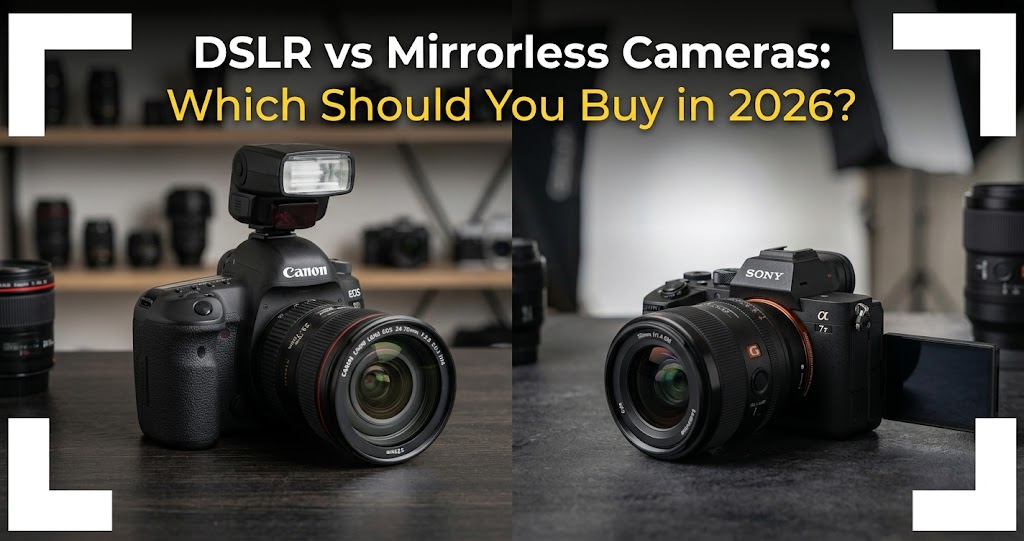
For over two decades, the DSLR reigned supreme in photography—its optical viewfinder, robust build, and massive lens ecosystem made it the default choice for professionals and enthusiasts alike . But in the last ten years, mirrorless cameras have surged forward, offering compact designs, faster autofocus, and cutting-edge video capabilities . Now, in 2026, the landscape has shifted dramatically. Canon has halted DSLR development entirely . Nikon's last DSLR update was years ago . Only Pentax remains as a holdout . This raises a critical question: should you buy a DSLR or a mirrorless camera in 2026? This comprehensive guide breaks down every factor—viewfinders, autofocus, video, lens ecosystems, battery life, and future-proofing—to help you decide.
How DSLRs and Mirrorless Cameras Work
The fundamental difference lies in the viewfinder system. A DSLR (Digital Single-Lens Reflex) uses a mirror mechanism that reflects light from the lens up into an optical viewfinder (OVF) via a prism. When you press the shutter, the mirror flips up, allowing light to hit the sensor . This system provides a real-time, through-the-lens optical view with zero lag—a feature many photographers still love .
Mirrorless cameras, as the name suggests, eliminate the mirror. Light passes directly from the lens to the image sensor, which then sends a live preview to an electronic viewfinder (EVF) or the rear LCD screen . This simplifies the internal structure, making mirrorless bodies smaller and lighter, but it also means the viewfinder is a digital screen rather than an optical window .
Head-to-Head Comparison: DSLR vs Mirrorless in 2026
DSLR vs Mirrorless: Key Differences
The Viewfinder Debate: OVF vs EVF
One of the most personal decisions is viewfinder preference. Optical viewfinders (OVF) in DSLRs show real light with no electronic interference, no lag, and natural color rendering—qualities many photographers still cherish . In bright sunlight, OVFs excel, and they consume no battery power .
Electronic viewfinders (EVF) in mirrorless cameras have improved dramatically. Modern EVFs offer high resolution (up to 5.76M dots), 120Hz refresh rates, and features that OVFs simply can't match: exposure preview (you see exactly how the final image will look before shooting), focus peaking, zebra patterns for exposure, and histograms . As one photographer put it, "An EVF doesn't just show you the scene—it shows you the photograph" . For beginners, this real-time feedback accelerates learning dramatically .
However, some users report eye strain during extended EVF use, and older EVFs can struggle in very low light . In 2026, the gap has narrowed significantly, but the choice remains personal.
Autofocus: Where Mirrorless Pulls Ahead
In autofocus performance, mirrorless cameras now lead decisively. Most high-end mirrorless models use phase-detection pixels across the entire sensor, enabling fast, accurate subject tracking—even for moving eyes, animals, birds, insects, and vehicles . Canon's R3, Sony's A7 series, and Nikon's Z lineup all offer AI-powered subject recognition that outperforms flagship DSLRs .
DSLRs rely on a separate autofocus module beneath the mirror, limiting coverage to around 60% of the frame and reducing responsiveness in live view or video . While excellent for static portraits or landscapes, they struggle with erratic motion or low-light tracking compared to mirrorless counterparts . For action, sports, or wildlife, mirrorless is the clear winner.
Video Capabilities: No Contest
If you shoot video—or plan to—the case for mirrorless is overwhelming . Modern mirrorless cameras support 4K, 6K, and even 8K recording with 10-bit color, log profiles (S-Log3, N-Log, V-Log), and advanced codecs like ProRes and N-RAW . Continuous autofocus during recording is standard, with smooth focus transitions and eye tracking .
DSLRs were never designed for video. Their phase-detect AF systems falter during live view, forcing reliance on slower contrast-detect focusing . Many DSLRs either lack 4K entirely or offer cropped, low-bitrate footage with poor AF . For hybrid shooters—those who switch between photos and videos—mirrorless is essential .
Lens Ecosystems: Past vs Future
DSLRs benefit from decades of lens development. Canon EF and Nikon F mounts boast hundreds of lenses—from budget primes to exotic telephotos—available used at bargain prices . If you're on a tight budget, this is a genuine advantage.
However, major manufacturers have stopped developing new DSLR lenses . All innovation is now focused on mirrorless mounts: Canon RF, Nikon Z, and Sony E-mount receive new lenses regularly, including ultra-fast primes and stabilized zooms designed specifically for mirrorless advantages like shorter flange distance . For beginners building a long-term kit, investing in a growing ecosystem makes more sense than supporting a declining one . As one analyst noted, "Lens roadmaps tell the real story. Companies aren't launching new DSLR glass—they're pouring resources into mirrorless. That's where the future is" .
Good news: You can adapt DSLR lenses to mirrorless bodies using official adapters (Canon EF-EOS R, Nikon FTZ) that maintain autofocus and aperture control . This gives you the best of both worlds: access to cheap used glass now, with a path to native lenses later.
Battery Life: The DSLR's Last Stand
Battery life remains the one area where DSLRs still lead. A single DSLR battery can last 800–1200+ shots (CIPA rating) because the optical viewfinder uses no power . For all-day shoots, weddings, or extended travel without charging access, this is a genuine advantage.
Mirrorless cameras typically manage 300–500 shots per charge due to constant sensor and EVF usage . However, newer models have improved significantly, and USB-C charging (often with power delivery) means you can recharge from power banks on the go . Most mirrorless users carry one or two spare batteries or a portable charger—a small compromise for the size and feature benefits .
Size, Weight, and Portability
Mirrorless cameras are inherently smaller and lighter due to the absence of a mirror box and pentaprism . This difference matters for travel, street photography, or anyone who carries a camera all day. A typical pro DSLR setup (e.g., Canon 1D X Mark III with 70-200mm) weighs nearly 1.6 kg, while a mirrorless equivalent (Sony A1 with 70-200mm) comes in around 1.2 kg—a significant saving over long shoots .
Smaller bodies can mean smaller grips, which may not suit users with larger hands . But for most photographers, the portability advantage is compelling.
Real-World Case Study: A Beginner's Journey
Sarah, a college student starting photography, considered buying a used Nikon D5600. It was cheap, had good reviews, and used existing lenses her uncle owned. But after testing a Nikon Z30 at a local store, she noticed immediate differences. The flip screen helped her frame selfies for Instagram. The eye autofocus locked onto her dog effortlessly. And seeing her exposure change as she adjusted settings demystified manual mode .
She bought the Z30, spent six months mastering basics, then upgraded to a Z50 with a prime lens. Within a year, she was shooting events for friends. "If I'd started with the DSLR," she said, "I think I would've given up. The mirrorless just made everything click faster" .
The Market Reality: Are DSLRs Dead?
Canon announced in 2023 it would stop developing new DSLRs, focusing entirely on its EOS R mirrorless lineup . Nikon's last DSLR update was the D7500 in 2017—now over six years old . Only Pentax continues active DSLR production, catering to a niche audience . CIPA data shows over 80% of new interchangeable-lens cameras sold are now mirrorless .
That doesn't mean DSLRs are unusable—millions still function perfectly, and used models remain excellent bargains for learners who prioritize battery life and tactile controls . But for anyone buying new in 2026, the momentum is undeniable: mirrorless is the standard .
Pros and Cons Summary
DSLR Strengths
- Optical viewfinder with zero lag, natural colors
- Superior battery life (800–1200+ shots)
- Vast selection of affordable used lenses
- Excellent bargains on used market
- Tactile controls and robust build
DSLR Weaknesses
- Autofocus coverage limited (~60%)
- Poor video AF and limited 4K
- No new lens development
- Larger, heavier bodies
- No firmware updates or future support
Mirrorless Strengths
- 100% sensor coverage autofocus with AI subject recognition
- 4K/6K/8K video with 10-bit, log, continuous AF
- Compact, lightweight design
- Growing native lens ecosystem
- Exposure preview, focus peaking, histograms in EVF
- Active development and firmware updates
Mirrorless Weaknesses
- Shorter battery life (300–500 shots)
- EVF can cause eye strain for some
- Smaller grips may not suit large hands
- New lenses are expensive
- Can overheat during extended video (varies by model)
Which Should You Buy in 2026?
Choose Mirrorless If:
- You're a beginner who wants real-time feedback to learn faster
- You shoot video or plan to
- You want the latest autofocus technology (eye AF, animal tracking)
- You travel and prioritize compact size
- You want a future-proof system with new lenses coming
- You're a hybrid shooter (photos + video)
Choose DSLR If:
- You're on a tight budget and want maximum value from used gear
- You need all-day battery life without charging access
- You prefer optical viewfinders and have no interest in video
- You already own a collection of DSLR lenses
- You're a traditionalist who loves the tactile feel of a DSLR
What About Adapting Lenses?
If you already own DSLR lenses, you can use them on mirrorless cameras with adapters. Canon, Nikon, and others sell official adapters (like the EF-EOS R or FTZ) that maintain autofocus, image stabilization, and EXIF data . Third-party adapters also exist, though they may lack full functionality . This gives you a bridge: buy a mirrorless body now, use your existing glass, and gradually invest in native lenses later.
The Bottom Line
The heavy gear of the DSLR era isn't obsolete overnight—but its dominance is over . Mirrorless cameras now offer better integration of stills and video, smarter autofocus, and greater portability without sacrificing image quality . The industry's investment is clear: future innovation lies in mirrorless systems .
That doesn't mean every photographer must abandon their DSLR. Legacy tools still serve important roles, especially for budget-conscious buyers or those with specific needs . But for anyone considering an upgrade or entering serious photography in 2026, mirrorless is the present and future .
Final Recommendation
For 95% of photographers in 2026, mirrorless is the right choice. The combination of superior autofocus, professional video capabilities, compact size, and active development makes it the logical investment. DSLRs remain viable for specific use cases—extreme budget, all-day battery needs, or optical viewfinder preference—but they are a declining platform. As one expert put it, "Mirrorless isn't just the future—it's already the present" . Choose based on your needs, but understand that mirrorless is where photography is headed.
Checklist: Choosing Your Camera in 2026
- ✅ Prioritize mirrorless unless you have specific needs (battery life, budget constraints)
- ✅ Look for models with eye autofocus and real-time tracking
- ✅ Ensure the brand has a growing lens lineup (Canon RF, Sony E, Nikon Z)
- ✅ Choose a camera with a flip-out screen if you vlog or shoot video
- ✅ Test ergonomics—does it feel comfortable in your hands?
- ✅ Verify video specs if you plan to post online or create content
- ✅ Consider used DSLR only if budget is extremely tight and video isn't needed