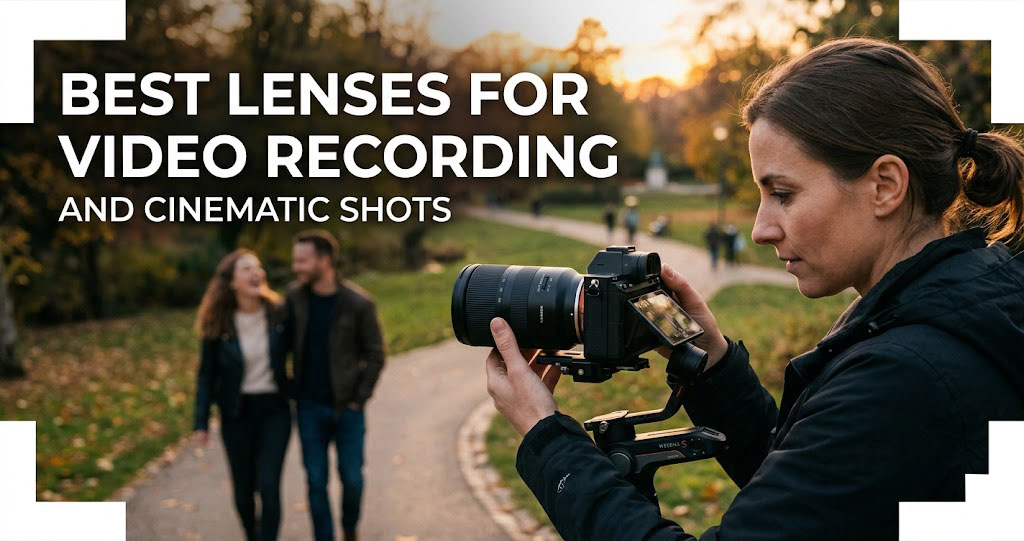
The camera body gets all the attention, but it's the lens that truly shapes your image. A great lens can make an average camera look cinematic; a poor lens can ruin footage from even the most expensive body. In 2026, the lens market is more exciting than ever, with groundbreaking releases from Sigma, Nikon, Canon, Zeiss, and Tamron pushing optical performance to new heights .
Whether you're shooting narrative films, documentaries, YouTube content, or commercial work, this guide will help you find the perfect lens for your needs and budget. We'll cover everything from affordable primes to professional cinema zooms, explaining what makes each lens special for video work.
- Fast, consistent aperture: For low-light performance and shallow depth of field
- Smooth, quiet autofocus: Linear motors (VXD, SSVCM, HLA) eliminate focus noise
- Minimal focus breathing: Framing stays stable during focus pulls
- Manual aperture ring: Often with de-click option for smooth exposure changes
- Internal zoom/focus: Length doesn't change, crucial for gimbal balance
Quick Picks: Best Video Lenses 2026
Understanding Focal Lengths for Video
Standard Zooms: The Workhorse Lenses
Nikon Z 24-70mm f/2.8 S II
The Nikon Z 24-70mm f/2.8 VR S II is a professional telephoto powerhouse that has been heavily refined for modern hybrid creators. By stripping away unnecessary bulk, Nikon has managed to make this second generation S Line zoom 26 percent lighter than the original, weighing just 998g, and 12mm shorter. This dramatic reduction in weight makes handheld shooting significantly more comfortable over long event days .
What truly sets this lens apart for video is its internal zoom mechanism—the physical length never changes, which is a massive benefit for videographers trying to maintain balance on a gimbal . The autofocus system utilizes the new Silky Swift Voice Coil Motor, delivering focusing speeds up to 3.5 times faster and 50 percent quieter than the previous model . Focus breathing is all but eliminated, ensuring framing stays stable during focus transitions .
Pros
- Internal zoom—perfect for gimbal work
- 26% lighter than predecessor
- Silky Swift VCM AF—fast and silent
- 6-stop image stabilization
- No focus breathing
Cons
- Premium price point
- Heavier than some competitors
- Nikon Z mount only
Ideal for: Professional hybrid shooters, event videographers, and anyone needing a versatile, gimbal-friendly zoom with exceptional optical quality .
Tamron 35-100mm F/2.8 Di III VXD
Designed with portrait, event, and travel photographers in mind, the Tamron 35-100mm F/2.8 Di III VXD covers the most essential focal lengths while maintaining a fast, constant f/2.8 aperture. What truly sets this lens apart is its astonishing portability. It weighs just 565g for the Sony version and measures less than 122mm in length, making it a much lighter alternative to traditional 70-200mm f/2.8 zooms .
The Voice-coil eXtreme torque Drive (VXD) linear motor ensures autofocus is blisteringly fast and whisper quiet, tracking moving subjects with absolute confidence for both high resolution stills and video recording . The moisture resistant build and fluorine coating make it a dependable workhorse for daily use .
Pros
- Remarkably lightweight (565g)
- Fast, silent VXD autofocus
- Constant f/2.8 aperture
- Excellent close-up capability (0.22m)
Cons
- No internal zoom
- Not available for Canon RF
Ideal for: Travel videographers, run-and-gun shooters, and anyone prioritizing portability without sacrificing f/2.8 performance .
Nikon Z 28-135mm f/4 PZ
If you need a nimble video system that can tackle almost any situation—especially for solo videographers or small crews—the NIKKOR Z 28-135mm f/4 PZ attached to a Nikon ZR is a strong contender for the best value combo you can get. The wide focal range, constant f/4 aperture and short minimum focus distance give you a huge variety of creative options .
Three customisable control rings (all with different knurling patterns so you don't have to look to check which one you're turning) let you control the lens exactly how you want to… and fast. It also supports external video-specific accessories such as matte boxes and follow focus units. And then there's the power zoom. With 11 different speeds, ease-in, ease-out and even the ability to control it remotely with either a PC or mobile device, your zooms will be consistent, finely controlled and give that all-important, high-level professional feel to your footage .
Pros
- Power zoom with 11 speeds, ease-in/out
- Remote control via PC/mobile
- Three tactile control rings
- Matte box compatible
Cons
- f/4 aperture (not f/2.8)
- Nikon Z mount only
Ideal for: Solo videographers, documentary filmmakers, and anyone needing precise, repeatable zoom moves .
Fast Primes for Cinematic Storytelling
Zeiss Aatma Series T1.5
ZEISS has unveiled Aatma – a new series of full-frame cinema prime lenses, designed to combine modern optical precision with a nostalgic visual character. The Aatma lineup draws inspiration from some of ZEISS's most iconic 20th-century lenses while meeting the technical demands of contemporary productions .
The Aatma series comprises T/1.5 prime lenses in nine focal lengths: 18mm, 25mm, 35mm, 40mm, 50mm, 65mm, 85mm, 100mm, and 135mm. The name "Aatma," derived from the Sanskrit word for "soul," reflects the lenses' focus on emotional rendering. ZEISS says the lenses deliver softly rendered skin tones, reduced contrast, smooth focus fall-off, and rich bokeh with a subtle soap-bubble character, offering a refined yet expressive aesthetic suited to narrative filmmaking .
Despite their vintage-inspired look, the lenses are built to ZEISS's modern cinema standards, maintaining consistent size, weight, and ergonomics for streamlined on-set operation. They feature ZEISS eXtended Data (XD) technology and integrate with the ZEISS CinCraft ecosystem, supporting visual effects, camera tracking, and virtual production workflows .
Pros
- Beautiful, nostalgic rendering with modern precision
- Consistent ergonomics across entire set
- XD metadata for VFX workflows
- Cinematic T1.5 aperture
- Soft skin tones, smooth focus fall-off
Cons
- Very expensive (professional cinema pricing)
- No autofocus
- Requires cinema camera ecosystem
Ideal for: Professional cinematographers, narrative filmmakers, and high-end commercial productions seeking a distinctive, soulful look .
Sigma 35mm F1.4 DG II | Art
The Sigma 35mm F1.4 DG II | Art represents a massive leap forward for one of the most beloved focal lengths in photography. Available for Sony E mount and L mount full-frame cameras, this completely redesigned optic is 20 percent lighter and 14 percent shorter than its predecessor, coming in at a highly manageable 530g .
Despite the compact size, optical performance is breathtaking. The 15 element, 12 group construction includes specialised aspherical and low dispersion glass to virtually eliminate axial chromatic aberration, resulting in razor sharp images across the entire frame. The new Advanced Amorphous Coating effectively combats ghosting and flare in challenging lighting .
Focus is driven by Sigma's dual High-response Linear Actuator motors, providing lightning fast and totally silent autofocus that keeps up with demanding video workflows and fast-paced street photography. Video shooters will also appreciate the heavily suppressed focus breathing and the physical aperture ring, which can be de-clicked for smooth, seamless exposure adjustments .
Pros
- Exceptional value for cinematic quality
- De-clickable aperture ring
- Minimal focus breathing
- 20% lighter than predecessor
- Silent dual HLA autofocus
Cons
- Limited to E-mount and L-mount
- No weather sealing on all versions
Ideal for: Independent filmmakers, content creators, and anyone wanting high-end cinematic rendering on a budget .
Nikon Z 35mm f/1.2 S
For pros and those who want the best possible results, the NIKKOR Z 35mm f/1.2 S is practically indispensable. With incredible resolving power, fabulous light gathering capabilities and beautiful, balanced bokeh, the images it creates can fill the biggest of screens. Autofocus is fast and true and focus breathing is severely minimised, while advanced coatings and weather sealing make it a top performer in all filming situations .
The 35mm focal length lends itself perfectly to reportage and human stories with its natural field of view, while a fast f/1.2 aperture allows both creative use of depth of field to focus on what's important in the frame and low-light filming .
Ideal for: Professional videographers, narrative filmmakers, and those who demand the absolute best optical performance .
Telephoto Zooms for Documentary and Compression
Nikon Z 70-200mm f/2.8 VR S II
The Nikon Z 70-200mm f/2.8 VR S II is a professional telephoto powerhouse that has been heavily refined for modern hybrid creators. By stripping away unnecessary bulk, Nikon has managed to make this second generation S Line zoom 26 percent lighter than the original, weighing just 998g, and 12mm shorter .
The optical design comprises 18 elements in 16 groups, delivering flawless edge to edge resolution and gorgeous bokeh, courtesy of the 11 blade rounded aperture. The autofocus system is a revelation, utilising the new Silky Swift Voice Coil Motor to deliver focusing speeds up to 3.5 times faster and 50 percent quieter than the previous model. The internal zoom mechanism ensures the physical length of the lens never changes, which is a massive benefit for videographers trying to maintain balance on a gimbal .
Ideal for: Documentary filmmakers, event videographers, and anyone needing professional telephoto reach with gimbal-friendly internal zoom .
Specialty Cinema Lenses
Sigma AF Cine Line
The Sigma Corporation has announced the development of the Sigma 28-45mm T2 FF and the Sigma 28-105mm T3 FF from new lineup the AF Cine Line, as part of Sigma's Cine Lens series. As the first AF-compatible Cine Lens series from Sigma, the Sigma AF Cine Line "brings innovation to the film production scene" .
Building on the optical system of Sigma's Art lenses, the AF Cine Line offers exceptional rendering performance, along with high-precision autofocus with excellent tracking capability, combined with the ergonomics required for professional cinema production. This allows it to handle multiple shooting styles and on-set environments that were previously challenging with traditional still lenses or cine lenses .
Equipped with a linear motor HLA (High-response Linear Actuator), the Sigma AF Cine Line captures intense movements in action scenes, rapid focus shifts in gimbal or handheld shooting, and unpredictable moments in documentaries without missing a split second, providing reliable support for filmmakers in various shooting situations .
Pros
- First cinema lenses with autofocus
- Art-series optical quality
- Cine-standard mechanics (0.8M gears)
- Linear motor for fast, quiet AF
Cons
- Limited focal range currently
- Professional pricing
Ideal for: Documentaries, run-and-gun cinema work, and productions needing both cine ergonomics and autoflexibility .
Sigma 15mm F1.4 DC | Contemporary
Expanding the creative horizons for APS-C mirrorless users, the Sigma 15mm F1.4 DC | Contemporary is a remarkable ultra wide angle prime lens. Offering a full-frame equivalent focal length of roughly 22.5mm, it is perfectly suited for dynamic street photography, vast landscapes, and vlogging. The standout feature is its featherweight design, weighing a mere 220g and measuring just under 65mm in length. This represents a 50 percent weight reduction compared to older models in the series, making it incredibly easy to balance on a small gimbal .
The fast f/1.4 maximum aperture excels in low light and creates a pleasingly shallow depth of field. Autofocus is handled by a smooth and quiet stepping motor, and the lens boasts a minimum focusing distance of 17.7cm for dramatic close-ups. Notably, the Canon RF version features a customisable control ring in place of the standard aperture ring, adding tactile flexibility .
Ideal for: Vloggers, gimbal users, and APS-C shooters needing an ultra-wide, fast aperture lens .
How to Choose Your Video Lens
1. Match Your Focal Length to Your Story
The 35mm and 50mm focal lengths lend themselves perfectly to reportage and human stories with their natural fields of view . For wide establishing shots or vlogging, consider 16-24mm. For compression and subject isolation, 70-200mm is ideal.
2. Prioritize Video-Specific Features
Look for internal zoom mechanisms that maintain balance on gimbals , clickless aperture rings for smooth exposure changes , and linear AF motors (VXD, SSVCM, HLA) for silent, fast focus . Minimal focus breathing ensures your framing stays consistent during focus pulls .
3. Consider Your Mount Ecosystem
Sony is expected to have more than 300 native lenses by 2026, comprising both prime and zoom lenses. Canon also has a similar number of native lenses and offers adapters for EF lenses, making it a more versatile option . Third-party lenses are also available, so be sure to consider this when making your decision .
4. Budget for What Matters
A good choice enhances your camera body . The SIRUI AURORA Series 35mm F1.4 is an example of a budget-friendly lens under $1,000 that offers extreme value for most videographers and content creators . But for professional cinema work, investing in high-end glass like Zeiss Aatma or Nikon S Line pays dividends in image quality and workflow efficiency.
5. Specs Go Along with Skillset
When shopping for the top videography camera this year, consider that specs only amplify talent, not replace it. A professional with ample experience can easily outclass a videographer who hasn't tried stuff with their shiny new gear . With time, your skills will complement the camera specs and its lens. For example, the dynamic range of your camera will improve through exposure practice, your steady hands will enhance the IBIS effect, and more .
2026 Lens Trends to Watch
- Internal zoom becoming standard: The Nikon Z 24-70mm f/2.8 S II and Z 70-200mm f/2.8 VR S II both feature internal zoom for better gimbal balance
- AF in cinema lenses: Sigma's AF Cine Line brings autofocus to professional cine glass
- Power zoom advancements: Nikon's 28-135mm f/4 PZ offers 11 zoom speeds and remote control
- Vintage character in modern lenses: Zeiss Aatma combines classic rendering with modern data integration
- Dramatic weight reduction: Sigma's 35mm F1.4 II is 20% lighter, Tamron's 35-100mm is 565g—portability is priority
Which Lens Should You Buy?
For most filmmakers and hybrid shooters: The Nikon Z 24-70mm f/2.8 S II is the ultimate all-rounder—internal zoom, silent AF, and professional optics .
For budget-conscious creators: The Sigma 35mm F1.4 DG II | Art delivers stunning cinematic quality at an accessible price .
For professional cinema work: The Zeiss Aatma series offers soulful rendering with modern precision .
For run-and-gun documentary: The Tamron 35-100mm F/2.8 is lightweight and versatile .
For power zoom needs: The Nikon Z 28-135mm f/4 PZ gives you consistent, remote-controlled zooms .
For APS-C gimbal users: The Sigma 15mm F1.4 DC is featherweight and fast .
Final Thoughts
The lens you choose shapes every frame of your video. It determines how your story feels—intimate or expansive, clinical or soulful. In 2026, the options are better than ever, from budget-friendly primes to professional cinema zooms that rival Hollywood's best .
Remember that specs only amplify talent, not replace it. A professional with ample experience can easily outclass a videographer who hasn't tried stuff with their shiny new gear . Invest in glass that inspires you, learn it inside out, and let your skills grow alongside your gear.