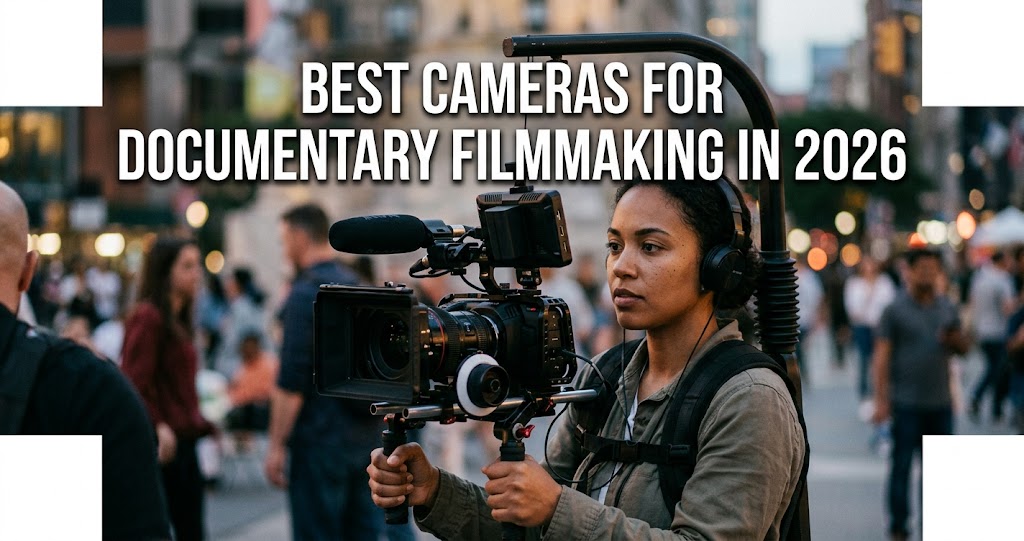
Documentary filmmaking demands cameras that disappear—both physically and socially—while remaining robust enough to carry emotionally demanding stories . Unlike studio productions, documentaries unfold in unpredictable environments: conflict zones, intimate interviews, crowded streets, or remote wilderness. The right camera becomes invisible, allowing subjects to forget they're being filmed and letting the story breathe.
Based on extensive testing and insights from Sundance 2026 documentary cinematographers , this guide covers the best documentary cameras for every budget and shooting style. From the run-and-gun workhorse Sony FX6 to the emotional rendering of ARRI Alexa, here's what you need to know to choose your documentary tool.
- Discretion: Small footprint that doesn't change the dynamics of the room
- Reliability: Weather-sealing, dual card slots, and consistent performance under pressure
- Low Light: Real-world usable ISO 6400+ for vérité shooting
- Ergonomics: Internal NDs, comfortable handheld operation
- Audio: Professional audio inputs with manual controls
- Silent shutter: To capture raw, candid moments without interrupting
Quick Picks: Best Documentary Cameras 2026
What Sundance 2026 Tells Us About Documentary Cameras
Sundance 2026 Documentary Camera Usage
The Sony FX6 leading the tally underscores how decisive variable ND, low-light reliability, and compact cinema ergonomics have become for vérité-driven storytelling . The Canon C70's strong presence shows that Super 35, dependable color science, and all-in-one practicality remain deeply valued. The ARRI Alexa Mini holding equal ground with Canon confirms that when filmmakers have time and controlled environments, ARRI is still the emotional and visual anchor of choice, particularly for interviews and structurally important scenes .
Top Documentary Cameras of 2026
Sony FX6
The Sony FX6 emerged as the most-used documentary camera at Sundance 2026 for good reason . It strikes the perfect balance between cinema quality and run-and-gun practicality. The built-in variable ND filter is a game-changer for documentary work—you can dial through multiple filtration stops without adding external glass, letting you maintain exposure and depth of field on the fly while staying submerged in the scene .
With dual-native ISO 800/3200, the FX6 delivers exceptional low-light performance, crucial for vérité shooting where you can't control lighting . The Super 35 sensor provides a familiar doc look, while the compact form factor allows you to work fast, with a light crew and minimal presence . It's designed for the documentary reality where a moment happens once and then disappears.
Pros
- Built-in variable ND for fast exposure control
- Excellent low-light performance
- Compact cinema ergonomics
- Dual card slots
- XLR audio inputs
Cons
- Requires rigging for shoulder use
- Menu system complex initially
- CFexpress cards expensive
Ideal for: Documentary filmmakers who need a reliable, versatile camera that performs under pressure, in sensitive environments, and across unpredictable conditions .
Canon C70
The Canon C70's strong presence at Sundance 2026 confirms that Super 35, dependable color science, and all-in-one practicality remain deeply valued by working DPs . It packs Canon's cinema DNA into a compact, ergonomic body perfect for documentary work.
The built-in ND filters and dual gain output deliver Canon's renowned color science and skin tones. The RF mount gives access to Canon's extensive lens lineup, while the compact form factor makes it easy to handle for long shooting days. Films like "Birds of War" (Canon C70) and "Give Me the Ball!" (Canon C80, C70) showcase its versatility across documentary genres .
Pros
- Beautiful Canon color science
- Built-in ND filters
- Compact, ergonomic design
- Dual gain output for dynamic range
Cons
- Body design unconventional at first
- No full-frame option
Ideal for: Documentarians who prioritize color science, need built-in NDs, and want a compact cinema camera that delivers professional results .
ARRI Alexa Mini LF
The ARRI Alexa Mini LF remains the emotional and visual anchor of choice when filmmakers have time, access, and controlled environments . Its exceptional dynamic range, natural color reproduction, and skin tone rendering make it the benchmark for high-end documentary interviews and vérité where conditions allow .
Films like "Antiheroine" (Alexa Mini with Canon K35 lenses) and "Time and Water" (Alexa Mini) demonstrate its ability to create intimate, grounded portraits . The compact form factor (Mini) makes it viable for documentary work when the production budget and schedule permit.
Pros
- World-class skin tones and color science
- Exceptional dynamic range
- Industry-standard reliability
- Beautiful highlight roll-off
Cons
- Very expensive (primarily rental)
- Requires more setup time
- Less discreet than smaller cameras
Ideal for: High-end documentaries with controlled access, interview-heavy projects, and productions where emotional rendering is paramount .
Sony FX3 / a7S III
The Sony FX3 and a7S III reinforce how mirrorless cameras are no longer secondary tools but essential social cameras that allow filmmakers to enter sensitive spaces without changing the dynamics of the room . Their tiny footprint, exceptional low-light performance, and 4K 120p capabilities make them indispensable for vérité work.
In "American Doctor," the a7S III was used in Gaza because it gave the filmmakers "a small, low-profile body with high-end, cinematic output" where mobility was a safety issue . "Aanikoobijigan" used the FX3 on a gimbal, paired with a Sony 16–35mm f/2.8 GM II, for wide, floating shots that registered the vastness of institutional spaces .
Pros
- Extremely compact and discreet
- Incredible low-light performance
- 4K 120p for slow motion
- Active stabilization for handheld
Cons
- Overheating in extended 4K recording
- Smaller body can be less ergonomic
- No XLR inputs without adapter
"The a7S III's size allowed us to work fast, with a light crew and minimal presence, which is crucial in real locations where a moment happens once and then disappears."
Ideal for: Sensitive environments, vérité shooting, travel documentaries, and situations where discretion is paramount .
Canon R5 C Mark II
For documentary projects that require both high-resolution stills and professional video, the Canon R5 C Mark II is unmatched. With 8K60 internal recording, 10-bit 4:2:2 color, and a fan-cooled design that sustains 32-minute 8K recording , it's a hybrid powerhouse.
The RF lens ecosystem depth gives documentary shooters tremendous flexibility, while the ability to seamlessly switch between stills and video modes makes it ideal for multimedia journalists and documentary teams who need both formats from the same shoot .
Pros
- 8K60 internal recording
- 45MP stills resolution
- Active cooling for extended recording
- Seamless stills/video hybrid
Cons
- Heavy 8K files require robust workflow
- Shorter battery life
Ideal for: Documentary projects needing both high-res stills and video, multimedia journalists, and hybrid shooters .
Panasonic Lumix GH6
For photojournalists and documentary shooters who want both stills and video on a budget, the Panasonic Lumix GH6 is one of the best choices you can make . It's a Micro Four Thirds mirrorless camera with staggering video specs: 5.7K 60fps, 4K 120fps, Full HD up to 300fps, and Apple ProRes internal recording .
There are no recording time limits—crucial for interviews and events. Photographers get 75fps bursts with fixed focus. While the autofocus is still contrast-based (Depth From Defocus), it performs reliably .
Pros
- Superb pro-level video features
- No recording time limits
- Excellent resolution for MFT
- Fast burst modes
Cons
- Aging contrast-detect AF system
- Smaller sensor than APS-C/full-frame
Ideal for: Budget-conscious documentarians who need professional video features, unlimited recording, and don't require phase-detect AF .
Blackmagic Pocket 6K Pro
For documentary filmmakers who prioritize color grading flexibility and RAW capture, the Blackmagic Pocket 6K Pro delivers cinema-quality images at an indie price. Used in films like "Jaripeo" at Sundance 2026 , it features a Super 35 sensor, 6K resolution, 13 stops of dynamic range, and built-in ND filters .
The tilting HDR touchscreen and dual native ISO make it viable for run-and-gun work, though it benefits from rigging for handheld comfort. Blackmagic RAW provides incredible grading latitude for documentaries where color is critical to storytelling.
Ideal for: Independent documentary filmmakers who want RAW capture, grading flexibility, and cinema-quality images on a budget.
Sony Alpha A7 III
Released as part of Sony's entry-level full-frame mirrorless A7 series, the Sony Alpha A7 III is a well-rounded alternative to the more expensive Sony A9 series . Its twin card slots, extremely accurate eye-tracking autofocus, 10 fps continuous shooting, good low-light performance, and impressive battery life—all in a compact mirrorless package—make it ideal for emerging documentarians.
While Sony has released the A7 IV, it's a significant price hike—probably more than documentary beginners need. The A7 III remains our pick for best entry-level documentary camera .
Ideal for: Beginner documentary filmmakers, students, and those starting their documentary journey .
What Documentary Cinematographers Say
"We thought a lot about filmmakers like Barry Barclay and Alanis Obomsawin, and their writing and work on filming in Indigenous communities as Native people, not as access, but as responsibility. That thinking shaped very practical decisions."
"We shot the film predominantly on the Canon C300 Mark II and Sony a7S III with a zoom-lens package because the story demanded a truly observational approach, with as few interruptions as possible."
"The K35s' imperfections—gentle contrast, organic flares, and natural fall-off—helped create a sense of closeness and presence with the character, rather than the feeling of observing her from a distance, 'through the glass.'"
How to Choose Your Documentary Camera
1. Match the Camera to Your Access
In sensitive environments, a small footprint isn't a preference—it's a necessity . Cameras like the Sony FX3 and a7S III allow you to work fast, with a light crew and minimal presence, which is crucial in real locations where a moment happens once and then disappears .
2. Consider Your Shooting Conditions
For vérité documentary work, the Sony FX6's built-in ND and low-light performance are decisive . For controlled interviews where emotional rendering matters most, the ARRI Alexa Mini remains the benchmark .
3. Lens Ecosystem Matters
Documentary lenses need to be versatile and reliable. Sony is expected to have more than 300 native lenses by 2026 . Canon also has a similar number of native lenses and offers adapters for EF lenses, making it a more versatile option . Third-party lenses are also available, so consider this when making your decision .
4. Don't Overlook Audio
Documentary work demands professional audio inputs. Cameras with built-in XLRs (like the Sony FX6) or included XLR adapters (Canon C70) save rigging time and ensure reliable sound capture.
5. Future-Proof Your Investment
If you are planning for the long term, avoid dead-end DSLRs and entry-level APS-C cameras. Instead, opt for bodies with a mirrorless system, a bigger sensor, CFexpress slots, and 6K video shooting for 2026 .
Specs Go Along with Skillset
When shopping for the best documentary camera this year, consider that specs only amplify talent, not replace it. A professional with ample experience can easily outclass a videographer who hasn't tried stuff with their shiny new gear .
With specs, you are advised to also invest a significant amount of time in learning histograms, manual settings, and storytelling. With time, your skills will complement the camera specs and its lens .
Which Documentary Camera Should You Buy?
For most documentary filmmakers (2026's sweet spot): The Sony FX6 is the workhorse—built-in ND, dual-native ISO, and proven reliability at Sundance .
For color science lovers and all-in-one practicality: The Canon C70 delivers beautiful skin tones and compact cinema ergonomics .
For high-end productions with emotional rendering needs: The ARRI Alexa Mini LF is the benchmark .
For sensitive environments and vérité work: The Sony FX3 / a7S III disappear into the room .
For budget-conscious documentarians: The Panasonic GH6 offers pro features without the pro price .
For hybrid stills/video shoots: The Canon R5 C Mark II gives you both formats in one body .
For beginners starting their documentary journey: The Sony A7 III is an entry-level bargain .
Final Thoughts
Sundance 2026 confirms that modern documentary cinematography is no longer driven by resolution races or brand loyalty, but by a quiet consensus around tools that disappear physically and socially while remaining robust enough to carry emotionally demanding stories .
The best documentary camera is the one that earns trust through reliability, ergonomics, and social invisibility—not the one with the highest specs on paper . Whether you're shooting in Gaza with an a7S III or interviewing icons with an Alexa Mini, the camera is just a tool. What matters is the collective responsibility to carry those stories forward .