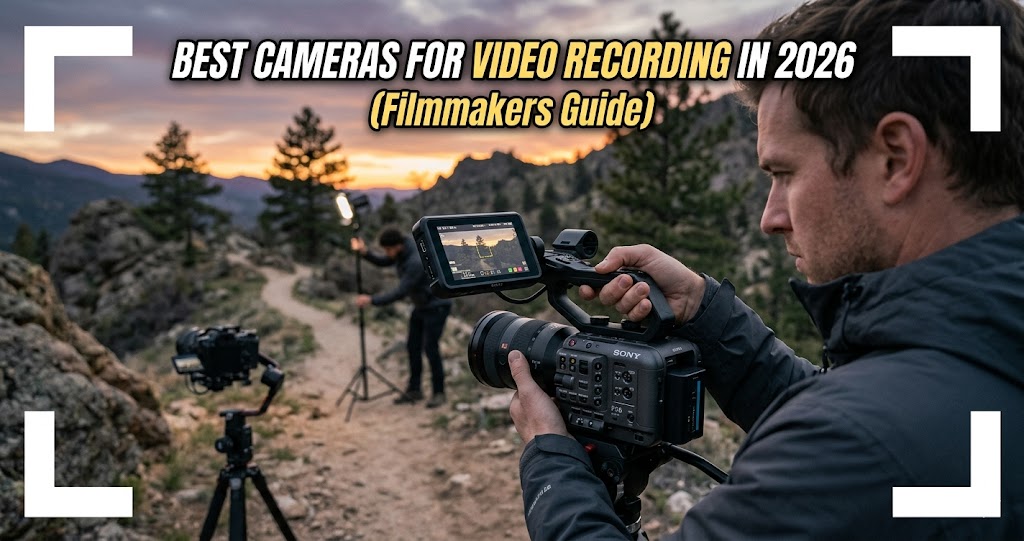
If 2026 is the year you plan to finally get your filmmaking or content creation career off the ground, one of the best video cameras will help you make it happen. Providing a demonstrable upgrade in video quality and shooting versatility compared to a smartphone, a good video camera will kit you out with everything you need to create content that looks and sounds professional .
With video content on platforms like YouTube, Netflix, and TikTok more popular than ever, the video camera market is a busy place. Pretty much every camera release from a major manufacturer will come bearing claims of how brilliantly suited it is for video, and some of those claims are truer than others. I've pulled together this list to include only video cameras that are genuinely worth your consideration—everything here has been thoroughly tested and reviewed, and scored highly enough to merit inclusion. I've also made sure not to just fill this list with expensive professional options. Many creators are working to tight budgets, so this guide includes plenty of affordable and beginner-friendly options, as well as the high-end cinema cameras for those with more cash to splash .
Quick Picks: Best Video Cameras 2026
Panasonic Lumix S5IIX
The Panasonic LUMIX S5IIX is a great mirrorless camera in all aspects, sporting a 24.2 MP full-frame CMOS sensor. It's the first in the LUMIX line to boast Phase Hybrid AF, which delivers fast, accurate autofocusing performance across 779 phase-detection points .
Its new sensor design, coupled with an enhanced processor, allows the camera to record up to 6K video for 30 minutes and unlimited 4K video recording. The S5IIX also offers an innovative Active I.S. system optimized for video, supporting walking shots for advanced image stabilization .
The S5IIX camera is no less exceptional when it comes to video features, loaded with HDMI RAW video data output, USB-SSD recording, ALL-Intra recording and ProRes recording. For livestreaming, it offers Wireless IP streaming, USB tethering to smartphones and Wired IP streaming .
Pros
- Cinematic video features and performance
- Dual native ISO
- Internal ProRes capture
- SSD recording via USB
Cons
- No tally light
- Articulated screen twists into HDMI cable path
Ideal for: Videographers needing a full-frame hybrid with professional codecs and reliable autofocus. This is the best all-around video camera for most creators .
Panasonic Lumix GH7
The Panasonic LUMIX GH7 mirrorless camera features a 25.2-MP Live MOS Micro Four Thirds sensor. This is a small sensor, so buying quality lenses is more affordable. However, its small sensor doesn't compromise the resolution. This camera can internally capture 4K at 60 frames per second in 4:2:2 10-bit. Or, if you want to shoot wide, you can shoot up to 5.7K and crop later .
Because H.265 is hard to decode, for a smoother edit, the GH7 enables a ProRes workflow with the ability to capture in ProRes 422 HQ internally. Also, you can get even more dynamic range using either V-Log or Dynamic Range Boost . The built-in fan enables long takes without overheating—essential for interviews and events .
Pros
- ProRes RAW internal
- 32-bit float audio avoids clipped dialogue peaks
- Built-in fan—no overheating
- Low-light performance
Cons
- Menu design
- 32-bit float requires additional hardware
Ideal for: Filmmakers who need a reliable "work camera" for demanding production, supporting pro-level codecs and long recording sessions without shutdowns .
Canon EOS R5 Mark II
The Canon EOS R5 Mark II is the much-anticipated successor to the Canon EOS R5. The R5 II's most significant upgrade is its new 45-megapixel Stacked CMOS sensor. This technology enables the camera to process images dramatically faster than traditional sensors. As a result, the camera can now record 8K 30p video and shoot 30 frames per second .
The viewfinder on the previous R5 was already known for being one of the best. But with the Mark II, we now have a new viewfinder with a 5.76 million-dot 120fps screen. But that is not all, the viewfinder has the same eye-tracking autofocus control as the flagship Canon EOS R1, which allows you to control focus with your eye .
Ideal for: Hybrid shooters who need both high-resolution stills and professional 8K video capabilities .
Nikon Z6 III
The Nikon Z6 III is an excellent 'all-rounder' camera but is also especially great at speed and fast action. The Z6 III features a 24-megapixel 'partially stacked' CMOS sensor and boasts an impressive 14fps with the mechanical shutter and 20fps with the electronic shutter at an outrageous buffer of 1000 RAW files. It also has the same class-leading autofocus performance as the Nikon Z9, that is to say, it's damn near instantaneous .
This iteration of the Z6 series of cameras dramatically improves the video specs, making it a more appealing camera for hybrid shooting. It is now capable of 6K/60p N-Raw video and 6K/30p ProRes RAW video, along with support for H.265 video at 5.4k/60p. Couple these improved specs with a beneficial eight stops of image stabilisation, and the Nikon Z6 III is an extremely capable 'do it all' camera going forward .
Ideal for: Filmmakers who need speed, action capabilities, and professional video codecs .
Sony ZV-E10 II
The Sony ZV-E10 II is designed for creators who want flexible storytelling and simple operation in one compact body. Built for everyday vlogging and serious YouTube production, this best video camera for creators combines intuitive controls, strong autofocus reliability, and fast sharing tools .
With a 26 megapixel APS-C Exmor CMOS sensor, the Sony ZV-E10 II can record up to UHD 4K at 30 frames per second and in Full HD at 120 frames per second. With 759-point Fast Hybrid autofocus, it offers Real-Time Eye autofocus and tracking, so you're sure your subject's in focus .
Pros
- Compact and lightweight design
- Headphone and microphone ports
- Excellent autofocus
Cons
- No in-body image stabilization
- Significant cropping with active stabilization
- Overheating in extended 4K
Ideal for: Budget-conscious creators, YouTubers, and vloggers who need excellent autofocus and a compact body .
DJI Osmo Action 6
The DJI Osmo Action 6 is the best action camera of 2026, with a new 1/1.1-inch square CMOS sensor bringing dynamic range up to 13.5 stops and low-light performance that beats GoPro . It's the first action camera with variable aperture f/2.0–f/4.0, giving you creative control over depth of field .
With 4K/120fps and up to 8K/30fps recording, cold-resistant battery lasting up to 4 hours, 50GB built-in storage, and RockSteady 3.0+ stabilization, it's built for adventure creators who need reliability in extreme conditions .
Ideal for: Adventure filmmakers, travel creators, and anyone shooting in extreme conditions .
Canon EOS R6 Mark II
The Canon EOS R6 Mark II is a great camera for videographers who also shoot photos. It features a 24.2-megapixel full-frame CMOS sensor and a DIGIC X Image Processor. Its low-light performance is impressive, introducing no noise until ISO 12,800 .
It can oversample 6K to 4K at up to 60 fps. Plus, it features in-body image stabilization with up to eight stops of shake correction with Coordinated Control IS. Its RAW burst mode and pre-shooting capture up to 30 frames per second .
Ideal for: Hybrid creators who need one camera for both professional video and photography .
Nikon Z30
The Nikon Z 30 features a 24.2 megapixel APS-C CMOS sensor that can record up to UHD 4K at 30 frames per second. It also features a fast and accurate autofocus system. For those wishing to shoot in full auto mode, it offers Advanced A+ Assist, where the camera analyzes the scene and automatically sets the optimum settings .
Additionally, you can use the camera as a webcam via USB. If you want a great camera but want to save some money, the Nikon Z 30 is a great option .
Ideal for: Beginners, livestreamers, and budget-conscious creators .
How to Choose the Right Video Camera
1. Sensor Size and Type
Full-frame sensors (like in the S5IIX, R5 II) offer better low-light performance and shallower depth of field for cinematic looks. APS-C sensors (ZV-E10 II, Z30) are more compact and affordable while still delivering excellent quality. Micro Four Thirds (GH7) offers lens affordability and portability .
2. Video Resolution and Frame Rates
4K is the minimum for professional work. 6K and 8K give you flexibility to crop and reframe in post. High frame rates (120p, 240p) allow smooth slow-motion. For most creators, 4K 60p is a sweet spot .
3. Autofocus Performance
Reliable autofocus with eye-tracking is essential for solo creators. Look for systems with 700+ phase-detection points and AI-based subject recognition. The Panasonic S5IIX finally brought phase-detect AF to L-mount, making it a top contender .
4. Codecs and Color
10-bit 4:2:2 internal recording gives you much more flexibility for color grading. ProRes, RAW, and Log profiles (V-Log, C-Log, S-Log) are essential for professional workflows .
5. Stabilization
In-body image stabilization (IBIS) makes handheld shooting much smoother. The GH7 offers 7.5 stops, the Nikon Z6 III offers 8 stops. For run-and-gun work, good stabilization is invaluable .
6. Audio and Connectivity
Headphone and microphone jacks are essential. The GH7's 32-bit float audio workflow is revolutionary for avoiding clipped audio. USB-C power delivery allows long streaming sessions .
7. Lens Ecosystem
Sony E-mount has over 300 native lenses, Canon RF and Nikon Z are growing rapidly with third-party support. Consider long-term investment in glass when choosing a system .
DSLR vs Mirrorless for Video in 2026
The mirrorless vs DSLR debate is essentially over—mirrorless has won for video. Mirrorless cameras offer on-sensor phase detection (better video AF), silent shooting, and more compact designs. DSLRs, with their mirror mechanisms, struggle with video autofocus and are larger. All major manufacturers have shifted development to mirrorless .
Filmmaker's Checklist: What to Consider Before Buying
- Where do you shoot most often? (studio, travel, events, action)
- Do you work solo or with a crew? (eye AF matters for solo creators)
- What's your post-production workflow? (ProRes vs H.265 affects editing speed)
- Do you need external recording? (some cameras output RAW via HDMI)
- How important is low-light performance? (full-frame sensors excel here)
- What lenses do you already own? (system compatibility)
Future-Proofing Your Investment
For 2026, avoid dead-end DSLRs and entry-level APS-C cameras. Instead, opt for bodies with a mirrorless system, a bigger sensor, CFexpress slots, and 6K video shooting for future-proofing .
The Bottom Line
Which Camera Should You Buy?
For most filmmakers and serious creators: The Panasonic Lumix S5IIX is the best all-around choice, offering full-frame quality, ProRes internal recording, and reliable phase-detect AF .
For cinema-quality work: The Panasonic GH7 delivers with ProRes RAW, 32-bit audio, and a built-in fan for unlimited recording .
For high-resolution hybrid shooters: The Canon R5 Mark II offers 8K and 45MP stills .
For budget creators: The Sony ZV-E10 II gives you excellent autofocus and interchangeable lenses at an affordable price .
For action and adventure: The DJI Osmo Action 6 is the action camera to beat .
Remember: specs only amplify talent, not replace it. A professional with ample experience can easily outclass a videographer who hasn't tried stuff with their shiny new gear . With specs, you are advised to also invest a significant amount of time in learning manual settings, exposure, and storytelling .