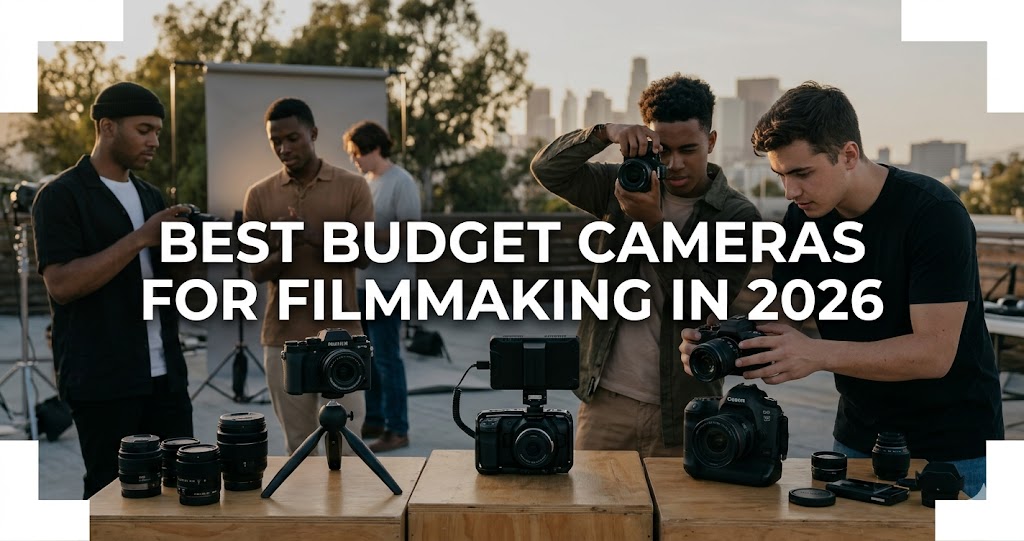
You don't need a Hollywood budget to make films that look cinematic. In 2026, the gap between affordable gear and professional results has never been narrower. With tariffs and global supply chains affecting prices, many budget-friendly models now offer features that were once exclusive to high-end cinema cameras . Whether you're shooting your first short film, building a YouTube channel, or starting a freelance videography business, this guide will help you find the perfect camera without breaking the bank.
- Video Resolution: 4K is the standard in 2026, with many budget cameras offering oversampled 4K from 6K sensors .
- Picture Profiles: Flat or Log profiles (like Canon Log 3, S-Log, or V-Log) give you room to color grade .
- Autofocus: 700+ phase-detection points with eye-tracking make solo filmmaking easier .
- Audio Inputs: A microphone jack is essential; headphone monitoring is a bonus .
- Lens Ecosystem: Consider future growth—Sony E-mount has 300+ native lenses, Canon RF is growing fast .
Quick Picks: Best Budget Filmmaking Cameras 2026
Cameras Under $1000
Sony ZV-E10 II
The Sony Alpha ZV-E10 II is designed for creators who want flexible storytelling and simple operation in one compact body . With a 26 megapixel APS-C Exmor CMOS sensor, the Sony ZV-E10 II can record up to UHD 4K at 30 frames per second and in Full HD at 120 frames per second. With 759-point Fast Hybrid autofocus, it offers Real-Time Eye autofocus and tracking, so you're sure your subject's in focus .
The ZV-E10 II has a headphone and a microphone port. Having both is not typical for cameras under $1,000. With them, you can use an external microphone and listen to what you are capturing. This will greatly improve your ability to get clean and clear audio .
Pros
- Excellent autofocus with Real-Time Tracking
- Compact and lightweight design
- Both mic and headphone ports
- Free-angle tilting touchscreen
Cons
- No in-body image stabilization (IBIS)
- Significant cropping with active stabilization
- Can overheat in extended 4K recording
Ideal for: Beginner filmmakers, vloggers, and content creators who need excellent autofocus and a compact body with room to grow into E-mount lenses .
Canon EOS R50
The Canon EOS R50 features a 24.2 megapixel APS-C CMOS sensor that can record up to UHD 4K at 30 frames per second. It also features a fast and accurate autofocus system . This model is a fantastic choice for filmmakers thanks to Canon's impressive Dual Pixel autofocus that keeps footage sharp. It has a fully articulating display, and unlike other cameras in this price range, an electronic viewfinder .
For those wishing to shoot in full auto mode, the R50 offers Advanced A+ Assist. With it, the camera analyzes the scene and automatically sets the optimum settings. Additionally, you can use the camera as a webcam. All you need is a USB cable . It also supports 4K 10-bit video at up to 30p with supersampling and no crop .
Pros
- Dual Pixel CMOS AF II system
- 4K 10-bit video with no crop
- Fully articulating display
- Electronic viewfinder included
- USB webcam functionality
Cons
- No headphone jack
- Single media card slot
- No in-body stabilization
Ideal for: Filmmakers on a tight budget, livestreamers, and those wanting Canon's excellent color science and Dual Pixel AF .
DJI Osmo Pocket 3
The DJI Osmo Pocket 3 is arguably the most popular camera among YouTubers and run-and-gun filmmakers right now . It has a big 1-inch sensor, the same size found on Sony's ZV-1 II compact camera. That boosts image quality considerably, particularly in low light. It also has a new, large swiveling touchscreen that makes it easier to switch between horizontal and vertical video .
What really makes it great for filmmaking are the follow modes combined with face tracking. If you're working solo, you can simply set it up and it'll rotate and tilt to follow you around. That also applies for walk-and-talk vlogging, so you don't have to worry about focus or even pointing the camera at yourself . The 3-axis mechanical gimbal delivers smooth, cinematic footage without any post-stabilization.
Pros
- Built-in gimbal for smooth footage
- Excellent low-light performance for its size
- Face tracking and follow modes
- Easy vertical video switching
Cons
- Fixed lens (no interchangeable options)
- Not ideal for photos
- Price higher than previous model
Ideal for: Run-and-gun filmmakers, travel creators, and solo shooters who want gimbal-smooth footage without complex rigs .
Nikon Z30
The Nikon Z 30 features a 24.2 megapixel APS-C CMOS sensor that can record up to UHD 4K at 30 frames per second. It also features a fast and accurate autofocus system. For those wishing to shoot in full auto mode, it offers Advanced A+ Assist, where the camera analyzes the scene and automatically sets the optimum settings .
Additionally, you can use the camera as a webcam via USB. It has the same lens mount as the full-frame Nikon Z cameras, giving you a clear upgrade path as your skills grow . It's a great option if you want a great camera but want to save some money .
Pros
- Same lens mount as full-frame Nikons
- Can shoot up to 120 fps in HD
- Livestreaming via USB
- Affordable entry to Z system
Cons
- No headphone jack
- 28-minute record limit in some modes
- Single media slot
Ideal for: Budget-conscious filmmakers who want to invest in the Nikon Z system and upgrade to full-frame later .
Cameras Under $2000
Blackmagic Pocket Cinema Camera 6K Pro
The Blackmagic Design Pocket Cinema Camera 6k Pro EF stands out as the best budget cinema camera due to its impressive blend of professional-grade features and affordability . Boasting a Super 35 sensor with 13 stops of dynamic range and dual native ISO, it delivers stunning image quality even in challenging low-light conditions. The camera supports 6K resolution, ensuring crisp footage that meets the demands of modern filmmaking .
Additionally, the 6K Pro includes built-in ND filters, a tiltable HDR touchscreen and an improved battery life, enhancing its usability on set. Its compatibility with EF lenses also offers flexibility for various shooting styles. With robust features typically found in higher-end models, the Pocket Cinema Camera 6K Pro provides exceptional value for filmmakers seeking a versatile and high-performance camera without breaking the bank .
Pros
- Professional-grade image quality
- 13 stops of dynamic range
- Built-in ND filters
- Tiltable HDR touchscreen
- Dual native ISO (400 & 3200)
Cons
- Limited stabilization features
- Requires rigging for handheld use
- Battery life requires planning
Ideal for: Indie filmmakers, narrative projects, and anyone wanting true cinema image quality on a budget .
Sigma fp
The Sigma fp remains a unique option for filmmakers in 2026. A minimalist metal body weighing under 1 pound, built around a 24.6MP full frame BSI sensor capable of recording CinemaDNG RAW internally . Its disruption came from purity. Internal CinemaDNG RAW in a body this small was extremely rare at this price point. The fp could record RAW internally to a UHS II card, with bit depth depending on resolution .
Add to that the Leica L mount ecosystem, Director's Viewfinder simulations including ARRI ALEXA LF and RED MONSTRO, and a heat sink-based design that allowed sustained recording without artificial time limits, and it became clear this was not a consumer experiment but a compact cinema brain aimed at intentional filmmakers . In controlled environments, the image still holds up beautifully with 12-bit CinemaDNG offering significant grading flexibility .
Pros
- Full-frame CinemaDNG RAW internally
- Incredibly compact and modular
- No recording time limits
- Director's Viewfinder simulations
- Excellent grading flexibility
Cons
- Contrast-detect autofocus only
- No in-body stabilization
- Noticeable rolling shutter
- Large CinemaDNG files need serious storage
- Modest battery life
Ideal for: Intentional filmmakers who light their scenes, pull focus manually, and value RAW flexibility above automation .
Special Considerations for Budget Filmmaking
DSLR or Mirrorless?
One of the major differences between mirrorless and DSLR cameras is size. A DSLR has a mirror in front of the image sensor, allowing the user to look into an optical viewfinder. When shooting video, the mirror remains down, and the video can be seen on the LCD screen. Because of the mirror mechanism, DSLRs tend to be larger and heavier than mirrorless cameras . For filmmaking, mirrorless cameras are almost always the better choice due to their compact size, silent operation, and advanced video features.
Don't Forget the Support Kit
A complete budget filmmaking kit includes more than just the camera. Invest in:
- A sturdy tripod or gimbal for stabilization
- External microphone (crucial for audio quality)
- ND filters for controlling exposure in bright light
- Extra batteries and high-speed memory cards
- Basic lighting setup (softbox or LED panel)
What to Look for When Buying
Which camera to buy obviously depends on what you shoot. If it's mostly extreme sports or adventurous activities, the best choice is an action camera from GoPro or DJI . If you're making narrative films, prioritize dynamic range and Log profiles. For run-and-gun documentary work, prioritize autofocus and stabilization .
Compact cameras tend to have smaller sensors and slightly lower quality lenses, but they're obviously easier to carry — most will fit in a large pocket. So, if budget, convenience and portability is the most important to you, then go for a model in this category .
When you're trying to make the highest quality videos, though, you'll want to choose a mirrorless camera with a decent lens. With the larger sensor, you'll be able to create nice blurred bokeh backgrounds to separate your subject from the foreground. Lenses are usually sharper as well, and you'll be able to expand your collection over time for even more versatility .
Future-Proofing Your Investment
If you are planning for the long term, then avoid dead-end DSLRs and entry-level APS-C cameras. Instead, opt for bodies with a mirrorless system, a bigger sensor, CFexpress slots, and 6K video shooting for 2026 .
Which Budget Camera Should You Buy?
For most filmmakers under $1000: The Sony ZV-E10 II offers the best balance of autofocus, audio features, and lens ecosystem .
For the tightest budget under $800: The Canon EOS R50 delivers Canon's excellent Dual Pixel AF and 4K quality .
For run-and-gun creators: The DJI Osmo Pocket 3 is unbeatable for smooth, stabilized footage .
For cinema-quality image under $2000: The Blackmagic Pocket 6K Pro offers professional-grade dynamic range and color .
For full-frame RAW filmmakers: The Sigma fp is a unique, modular cinema brain .
Final Thoughts
When shopping for a budget filmmaking camera this year, consider that specs only amplify talent, not replace it. A professional with ample experience can easily outclass a videographer who hasn't tried stuff with their shiny new gear . With specs, you are advised to also invest a significant amount of time in learning histograms, manual settings, and storytelling. With time, your skills will complement the camera specs .
The best camera is the one you'll actually use. Start creating today, learn your gear inside out, and upgrade when your skills demand it. Your best film is your next film.