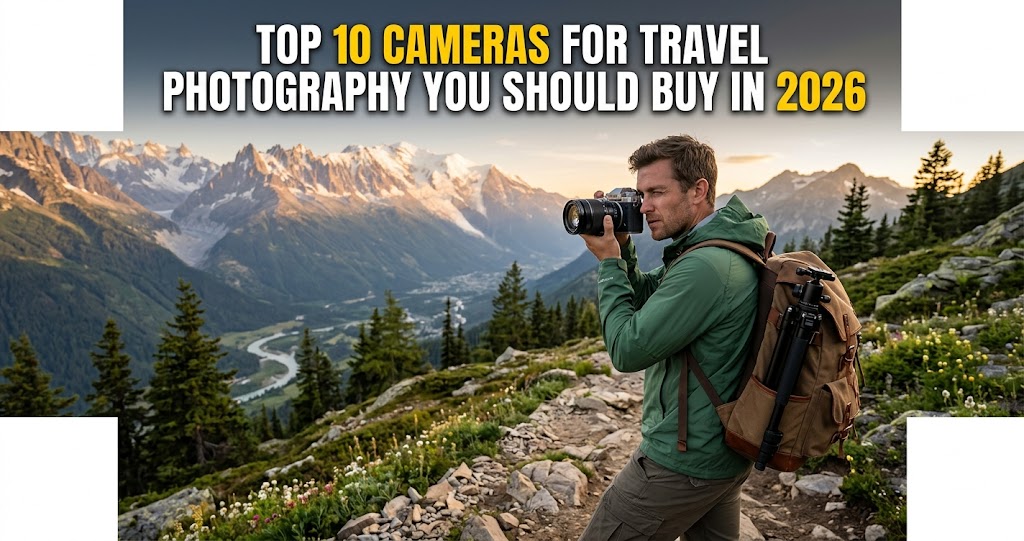
As photographer Chase Jarvis famously said: "The best camera is the one you have with you." For travel photography, this rings especially true. The perfect travel camera isn't necessarily the one with the highest resolution or fastest burst rate—it's the one you're willing to carry through airport terminals, up mountain trails, and down narrow cobblestone streets all day without complaint .
In 2026, travelers are spoiled for choice. Whether you want a pocketable compact that slips into a jeans pocket, a rugged weather-sealed companion for outdoor adventures, or a lightweight interchangeable lens system for ultimate flexibility, there's never been a better time to invest in a travel camera. I've spent months testing and researching dozens of models to bring you this definitive guide to the top 10 travel cameras you should buy in 2026 .
🏆 Top 10 Travel Cameras of 2026
Fujifilm X-E5
The Fujifilm X-E5 is, in the words of Amateur Photographer's Technical Editor, "a sublime, well-balanced mirrorless model that takes brilliant images, and delivers on everything the travel photographer is likely to need, without taking up too much space in a bag" . It combines the compact, rangefinder-style body of the beloved X100 series with the flexibility of interchangeable lenses—a winning formula for travel.
The 40.2MP APS-C X-Trans sensor delivers exceptional resolution, while Fujifilm's legendary Film Simulations produce gorgeous JPEGs straight out of camera, saving you hours of editing on the road . The addition of a dedicated Film Simulation dial (borrowed from the X-T50) lets you cycle through looks like Provia, Velvia, and Acros in seconds, keeping you in the creative flow. 7-stop in-body stabilization means handheld shots in low light are crisp, and the 6.2K video capability covers all bases .
Ideal for: Travelers who want the flexibility of interchangeable lenses without sacrificing the compact, inspiring shooting experience of a premium compact. The X-E5 is a joy to own, hold, and use .
Ricoh GR IV
The Ricoh GR IV is the camera that professional photographers slip into their pocket when they need to travel light but refuse to compromise on image quality. It features a redesigned 28mm f/2.8 lens with improved corner sharpness and a new 25.7MP APS-C CMOS sensor that delivers image quality rivaling much larger cameras . The GR series has been a cult favorite for street and travel photography for years, and the fourth generation refines the formula.
Key upgrades include a dust-proofing mechanism that finally addresses the dust issues of earlier models, improved autofocus with subject tracking, and a reconfigured rear dial for better ergonomics . At just 257g, it's genuinely pocketable—you'll forget you're carrying it until a moment worth capturing appears . The hybrid AF system is fast and responsive, and the 3-axis IBIS (new for the GR IV) makes handheld shooting in low light viable .
Ideal for: Street photographers and minimalists who want DSLR-level image quality in a package that truly disappears into a pocket. As one reviewer put it, "How did they fit so much into a camera that is only 257 grams?"
Leica Q3
The Leica Q3 is the travel camera you buy when only the best will do. It pairs a full-frame 60MP sensor with a fixed 28mm f/1.7 Summilux lens—a combination that delivers "that classic 'Leica look'" with dreamy rendering and exceptional sharpness even wide open . No other camera on this list can match the Q3's image quality, with outstanding tonality, 15 stops of dynamic range, and minimal noise .
The 28mm focal length is ideal for street, landscape, and environmental portraits—the core of travel photography. The hybrid AF system combines phase and contrast detection, and while it's not the fastest for action, the bright 5.76M-dot EVF makes manual focusing a joy . The build quality is, predictably, superb—this is a camera built to last decades, not years .
Ideal for: Discerning photographers who value uncompromising image quality, beautiful design, and the Leica experience. If your travel style allows for a single, perfect 28mm lens, the Q3 is unparalleled .
OM System Tough TG-7
The OM System Tough TG-7 is the camera you take places you'd never risk a more expensive setup. It's waterproof to 15m, shockproof from 2.1m, freezeproof to -10°C, and crushproof—literally built to survive the elements . For snorkeling, beach days, jungle treks, or mountain hikes in unpredictable weather, it's the ultimate companion.
Despite its rugged build, it's a capable shooter. The 12MP 1/2.33-inch sensor is small, but the f/2.0 4x optical zoom lens (24-100mm equivalent) is versatile, and the macro performance is genuinely impressive . Built-in GPS, a compass, thermometer, and accelerometer appeal to outdoor enthusiasts who want to track their adventures .
Ideal for: Adventurers, snorkelers, families with kids, and anyone who needs a camera that can take a beating and keep shooting .
Sony A7C R
The Sony A7C R packs a stunning 61MP full-frame sensor into one of the smallest full-frame bodies on the market—it's essentially an A7R V in a travel-sized package . For travelers who demand maximum resolution for large prints or heavy cropping, there's nothing else like it. The dynamic range measures an impressive 14.7 EV, giving you tremendous latitude in post-processing .
The autofocus is class-leading, with a dedicated AI processor that nails subject recognition and tracking in both stills and video . 4K/60p video (with a 1.2x crop) and 10-bit 4:2:2 color make it a capable hybrid for travel content creators. The Auto Framing mode uses AI to keep subjects centered—perfect for solo travel vloggers .
Ideal for: Resolution-obsessed travelers who need maximum detail and are willing to pay for it. As DPReview notes, "If you're looking for maximum resolution in a travel-sized body, the A7C R is tough to beat" .
GoPro Hero 13 Black
The GoPro Hero 13 Black remains the king of action cameras for a reason. Its new interchangeable lens system allows you to attach ultra-wide, anamorphic, or macro lenses, expanding creative possibilities beyond any previous GoPro . For travelers documenting activities like surfing, skiing, mountain biking, or diving, it's the ultimate tool.
HyperSmooth stabilization is as good as ever—footage looks like it was shot on a gimbal, even in rough conditions. The rugged build is waterproof without a housing, and the camera is designed to survive impacts that would destroy any other camera. 5.3K video and 27MP stills cover all bases .
Ideal for: Adventure travelers who need a camera that can keep up with extreme activities. The Hero 13 Black is the action camera to beat .
GoPro Max 2
The GoPro Max 2 is "the best 360 camera for travel" according to GQ . With dual 14mm (equivalent) lenses and 1/2.3-inch sensors, it captures 8K 360° video at 10-bit, allowing you to "shoot first, frame later"—a revolutionary concept for travel where you can't predict where the action will happen .
The improved sensors deliver sharper, more detailed footage than any previous 360 camera, and the ability to swap lens covers if scratched is a game-changer for travel durability . HyperSmooth stabilization works in 360 mode too, and the Max 2 can double as a traditional 4K Hero-style camera in single-lens mode .
Ideal for: Travelers who want to capture everything without worrying about framing—perfect for group shots, dynamic scenes, and "I was there" moments .
Fujifilm X-T50 w/ 16-50mm f/2.8-4.8
The Fujifilm X-T50 is an excellent travel camera, especially when paired with the new 16-50mm f/2.8-4.8 kit lens. The 40MP APS-C sensor delivers outstanding detail, and the 7-stop IBIS means you can leave the tripod at home . The lens covers a versatile range equivalent to 24-76mm—wide enough for landscapes, long enough for portraits.
The Film Simulation dial encourages creative exploration, and the full-featured auto mode makes it approachable for beginners while offering depth for enthusiasts . It's compact and light, though the viewfinder is on the small side . Fujifilm's X-mount lens lineup is superb, with excellent primes and zooms to expand your kit over time.
Ideal for: Travelers who want a versatile, high-quality kit that produces beautiful images straight out of camera. The X-T50 is a camera that grows with you .
DJI Mini 4 Pro
The DJI Mini 4 Pro is the ultimate travel drone. Its key advantage? It weighs under 250 grams, meaning in most countries you can fly without registration . Despite the sub-250g weight, it packs a 1/1.3-inch 48MP sensor capable of 4K/60fps and 4K/100fps slow-motion video, with 10-bit D-Log M color for grading .
Omnidirectional obstacle sensing makes it remarkably safe to fly in unfamiliar locations—it will avoid trees, walls, and poles automatically . Real-world flight time is around 34 minutes, and the Fly More combo with extra batteries is essential for serious travel shooting .
Ideal for: Travelers who want stunning aerial perspectives without the bureaucratic hassle. The Mini 4 Pro is the drone you'll actually bring along .
Sony RX100 VII
The Sony RX100 VII remains the ultimate pocket superzoom. In a body barely larger than a deck of cards, it packs a 24-200mm equivalent f/2.8-4.5 lens and a 20MP 1-inch stacked sensor . The zoom range covers everything from wide landscapes to distant details—you'll never miss a shot for lack of reach.
The autofocus is magically fast, borrowed from Sony's A9 series, with 20fps blackout-free shooting . 4K video is excellent with minimal rolling shutter, and the pop-up EVF is a marvel of engineering . For a camera that slips into a jeans pocket, it's astonishingly capable .
Ideal for: Travelers who want maximum zoom range in minimum size. As MPB puts it, "If you're heading somewhere sunny, the Sony RX100 VII is the one for you" .
How to Choose Your Travel Camera
1. Size and Weight: The Decisive Factor
The best travel camera is the one you'll actually carry. Professional photographer Chase Jarvis's famous quote—"The best camera is the one you have with you"—has never been more relevant . If you're hiking, city-hopping, or backpacking, every gram matters. The Ricoh GR IV (257g) and Sony RX100 VII (302g) disappear into a pocket, while the Leica Q3 (743g) is more substantial but still manageable .
2. Sensor Size vs. Portability
Full-frame sensors (Sony A7C R, Leica Q3) offer the best image quality but require larger lenses. APS-C cameras (Fujifilm X-E5, X-T50, Ricoh GR IV) strike an excellent balance between quality and portability. 1-inch sensors (Sony RX100 VII) are smaller but still out-perform phones, especially in good light .
3. Lens Versatility
Do you need zoom flexibility (Sony RX100 VII's 24-200mm) or is a single high-quality prime enough (Ricoh GR IV's 28mm, Leica Q3's 28mm)? Interchangeable lens systems (Fujifilm X-E5, X-T50, Sony A7C R) offer maximum versatility but require carrying additional glass .
4. Weather Resistance
If you're heading to beaches, rainforests, or mountains, consider the OM System Tough TG-7 (waterproof to 15m) or weather-sealed options like the OM System OM-5 II .
5. Special Needs
- Underwater/beach: OM System Tough TG-7
- Action sports: GoPro Hero 13 Black
- Immersive/360: GoPro Max 2
- Aerial: DJI Mini 4 Pro
- Maximum zoom: Sony RX100 VII
- Maximum resolution: Sony A7C R
Final Thoughts
Your choice of travel camera ultimately depends on your shooting style and what you're willing to carry. The Fujifilm X-E5 is our top pick for its perfect balance of compact size, image quality, and sheer enjoyment of use . If you prioritize pocketability above all, the Ricoh GR IV is unbeatable . For those who want the absolute best image quality regardless of cost, the Leica Q3 delivers .
Adventure travelers should consider the OM System Tough TG-7 for its ruggedness, while resolution-obsessed shooters will love the Sony A7C R . Whichever you choose, the best camera for your 2026 travels is the one that makes you want to pick it up and shoot every day. Happy travels!