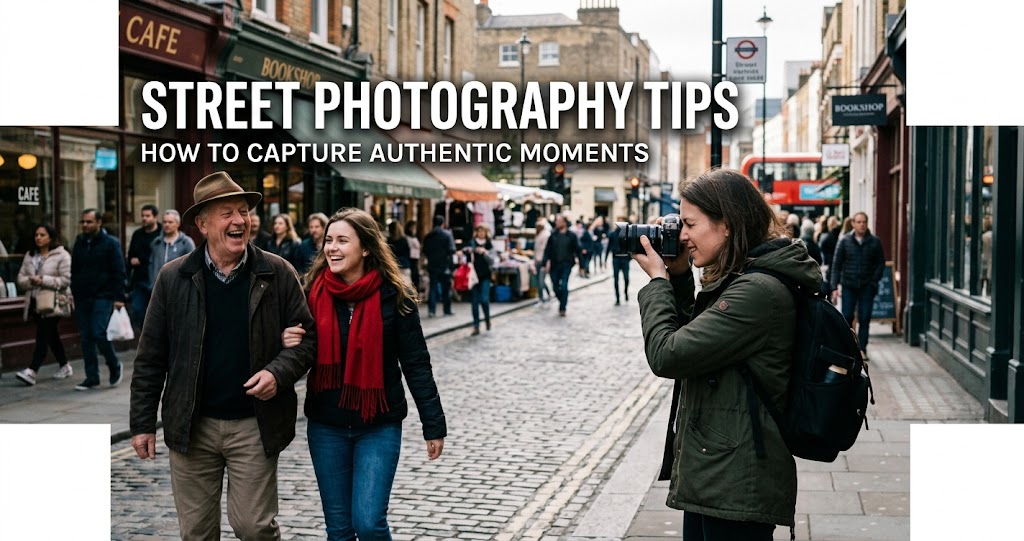
Life and its constant flotsam and jetsam of activity in the cities and towns making up our world are the essence of street photography. But capturing these truly candid moments can be challenging, especially when you're conspicuously walking around with all your gear .
Authentic street photography requires intuition, patience, and a great deal of respect for your environment and the people you capture within it . Striking that balance between disruptive voyeurism and respectful observation is a difficult skill to master, but it is one you can master nonetheless . This comprehensive guide shares the top techniques for roaming the streets unnoticed and creating more honest, impactful scenes.
Essential Gear for Discreet Shooting
1 Choose a Small, Quiet Camera
Want to attract less attention while snapping street photos? Swap out your bigger cameras for smaller options like the Fujifilm X100V, Ricoh GR III, or Leica Q series. These cameras are unobtrusive in size, quick to operate, and often equipped with silent shutters .
Subtle features like these can help you avoid detection and go about your work unnoticed. For your subjects, this also removes the pressure of being "watched," so they remain in their natural, seemingly unobserved state .
Lens choice: A 35mm or 50mm prime lens is ideal for street photography—versatile, fast, and forces you to move physically to frame your shot .
Mastering Camera Settings
2 Master Zone Focusing
Zone or scale focusing is a technique in which you set your aperture to a high f-stop (such as f/8 or f/11), pre-focus your shot manually, and then use depth of field to keep your subject in sharp focus . It works well for spontaneous yet subtle shots because it allows for quicker focusing without needing to lift the camera to your eye, enabling you to capture moments without drawing too much attention to yourself .
How to zone focus: Set your aperture to f/8–f/11, focus manually at a set distance (e.g., 2–3 meters), and shoot when subjects enter that zone. Everything within that range will be sharp .
Zone Focusing
Focus on one particular zone. Ideal for shooting from the hip. Aperture f/5.6–f/11 .
Double-Distance Focusing
Focus from one point to infinity. Uniform sharpness throughout frame. Start with closest element, then refocus to twice that distance .
3 Dial in Your Exposure Settings
I aim for an aperture that creates a definite visual effect. I like f/1.4 the most for its dramatic pull of the eye and its isolating effect on the subject. f/16 or f/22 will render the whole scene in spectacular and graphic detail .
For general outside pictures in which people are travelling around the frame, I'll have a shutter speed between 1/500 sec and 1/16,000 sec .
Quick Reference: Street Photography Settings
I generally keep ISO quite high to give myself a good margin for changing conditions. I'd rather have a bit of noise from an ISO 1600 image than subject blur from a shutter speed that was just a bit too long .
4 Avoid Auto White Balance
To convey the true atmosphere of a scene in your pictures, avoid auto white balance. Auto WB can remove some of the colors that made us react to that scene in the first place .
The colors we meet with our eyes affect how we feel in their presence, as these are what we react to and compel us to stop and shoot, so we want them to be integral to the pictures we take . We see with a Daylight white balance for the most part, so that's what I always set when shooting the street .
5 Shoot Silently with Electronic Shutter
I really value the ability to shoot silently when I'm in the street, as this allows me to shoot unnoticed and to take multiple shots of the same thing without the shutter sound clearing the area . To shoot silently we need to engage the electronic shutter .
Watch out for banding when shooting in areas lit by fluorescent lights, and distortion when the subject is moving quickly across the frame. In these situations, switch back to mechanical shutter .
Blending In and Staying Discreet
6 Move with Purpose and Blend In
The way that you move through the street can tell people a lot about who you are or what you perceive your role to be in their environment . If you are agitated, overly eager, or seem to be in a rush, you're not only more likely to draw attention, but you'll also push people away .
Stay cool and casual, take a few purposeful shots where you see opportunity, and don't linger too long in one area or on one subject. Move intentionally and without being overly showy .
Wear neutral, everyday clothes with minimum frills or accessories to blend into the background and assume an anonymous identity .
7 Master Shooting from the Hip
When done right, shooting from the hip can be a powerful way to improve your composition skills while allowing you to remain respectfully discreet on the streetside . The technique involves lowering your camera to either chest or waist level, thus avoiding eye contact with your subject and lessening the chances of them realizing they're being photographed, creating a more candid moment .
But shooting from the hip takes practice. Initially, you can expect some unpredictable results, but over time, your compositions will improve, and the spontaneous element will keep things interesting .
8 Go Fishing: Find a Spot and Wait
Sometimes the best way to capture candid moments discreetly is to simply find a great location and wait. This is an age-old photography technique sometimes referred to as "fishing" .
Set up your frame and patiently wait. Eventually, someone will walk into your shot naturally, and the scene will create itself. This approach may require a lot of patience, but it can be very rewarding when the chemistry is right, and it gives you a lot more control over composition .
Use the "corner technique": position yourself at a busy street corner with your back to a wall. Pre-focus your lens and wait. People will move toward you from multiple directions, creating spontaneous compositions .
Composition Techniques for Authentic Moments
9 Think in Terms of Form and Content
Traditional compositional rules come out of pre-photographic art forms. But when it comes to street photography—spontaneous, reactive, and chaotic—the rules of composition can limit the photographer .
Replace "composition" with "form and content." Form is the structure of the photo—the elements within the frame that hold it together. Content is what's going on in the photo .
The subject of the photograph is the photograph itself. Uncle Joe is not the subject; he's an element within the photograph, just like the trees and the back of the toolshed .
10 Capture Reflections for Added Depth
Reflections, when used carefully, can add lots of extra depth and dimension . A reflection can duplicate a subject, or it can introduce other elements that may not be otherwise visible in your compositions .
Look for puddles, glass storefronts, or shiny cars. Flipping the camera upside down at water level can turn a reflection into the main subject .
11 Use Foreground Elements and Leading Lines
If you can include something relevant to the story in the foreground, it'll help draw the viewer's eye into the shot . Aim to frame this element so it's not the main subject but instead helps draw attention to the most important part of the shot .
Leading lines are strong lines in your composition that help draw the viewer's eye through the photo toward the main subject . Positioning yourself to make use of strong lines that run diagonally through your frame is particularly effective .
12 Create Layers for Visual Interest
Place multiple subjects at different distances to create complex, story-rich frames . This technique, known as layering, adds depth and invites the viewer to explore the image .
Look for scenes with foreground, midground, and background elements that interact with each other. A person in the foreground, activity in the midground, and architectural context in the background can tell a complete story in one frame .
13 Look for Patterns and Juxtaposition
Patterns and repetition often provide wonderful backgrounds to interesting action . When you find a nice pattern, move around and look at it. Watch how your perception of the pattern changes from different angles .
Juxtaposition—contrasting subjects like old vs. new, calm vs. chaotic, or serious vs. humorous—creates visual tension that immediately draws attention . These contrasts invite viewers to interpret deeper meaning within the frame .
Anticipation and Timing
14 Anticipate Moments, Don't Chase Them
Resist the urge to orchestrate interesting scenarios (even when you think you know best), and trust that they will happen organically. Don't pursue moments, anticipate and recognize them when you're lucky enough to encounter them .
Timing is a key part of any good street photography composition (assuming the scene includes movement). For instance, when people or vehicles are passing by, it's essential that you choose your moment .
15 Change Your Perspective
It's easy to get in a habit of shooting from a standing height, but if you want to capture unique images, try to change it up . Look for opportunities to get up high above the action or down low so you're looking up at your subject .
A busy crowd looks different at hip level than eye level. Experiment with taking images above your head height, too .
You can use a footbridge overlooking a street or market area to capture life as it carries on below you. Take your time to watch the activity below, and wait for the decisive moments to occur .
Ethics and Human Connection
16 Put Respect and Ethics First
Discretion should never turn into deception. While it can be tempting to shoot as special moments or unique subjects arise, remember to always operate from a perspective of respectful boundaries .
Street photography treads a fine line between documenting public life and intruding on others' privacy .
- If you capture someone who seems uncomfortable, move away from them or delete the footage if they request it
- If they're curious about your work, give them a business card or your social handles so they can see how you portray your subjects with care and respect
- Some countries have strict laws regarding photographing the public without consent. If you're traveling, do your research and respect cultural sensitivities
17 Don't Be Afraid to Talk to People
Candid portraits will level up your street photography, but remember to ask permission, smile and be polite . Sometimes the best images come from a brief human connection.
If someone notices your camera and offers to pose, keep them in their element—leaning on a wall, holding their work tools. Suggest small movements, like shifting weight or adjusting clothing .
Common Mistakes to Avoid
Do
- Use a small, quiet camera with silent shutter
- Practice zone focusing for quick, discreet shooting
- Move with purpose and blend into your environment
- Spend time observing before shooting ("go fishing")
- Use reflections, layers, and leading lines
- Respect personal boundaries and cultural sensitivities
- Shoot from different angles and perspectives
Don't
- Don't use large, conspicuous gear
- Don't rely on auto white balance—it kills the atmosphere
- Don't chase moments—anticipate and wait
- Don't linger too long on one subject
- Don't ignore the background—check for distractions
- Don't over-edit—keep the authenticity
- Don't photograph people who are uncomfortable—move away
Your 7-Day Street Photography Challenge
- Day 1: Start local. "Go where you know" is good advice for beginners . Photograph your familiar neighborhood with fresh eyes.
- Day 2: Practice zone focusing. Set aperture to f/8, pre-focus at 2 meters, and shoot from the hip for 30 minutes .
- Day 3: The fishing technique. Find an interesting spot with good light and wait for 20 minutes without moving .
- Day 4: Experiment with reflections. Look for puddles, windows, and shiny surfaces .
- Day 5: Shoot from different angles—get low to the ground, find a high vantage point .
- Day 6: Focus on a theme (e.g., "people waiting" or "red objects") to train your eye .
- Day 7: Review and edit your 10 best shots from the week. Look for patterns in what works.
Final Thoughts
Capturing authentic moments in street photography while staying under the radar requires empathy, intuition, and respect . By developing a humble reverence for your subjects, committing to blending in rather than standing out, and learning to anticipate human behavior, you can begin to unlock the magic of candid streetside storytelling .
Understanding the basics of street photography takes time, effort, and—most of all—practice. The more you practice, the more you'll understand what works and what doesn't . As you spend time in the street with your camera in your hands, you'll become more confident and capable .